ÄRNA AIR BASE, Sweden — In a significant move that underscores the rapid military integration of NATO’s newest member, the Swedish government has officially confirmed the procurement of the M142 High Mobility Artillery Rocket System (HIMARS). The deal, valued at SEK 7 billion ($732 million), represents a transformative shift in Sweden’s long-range strike capabilities, moving the nation toward a more aggressive and integrated posture within the Alliance’s defensive framework.
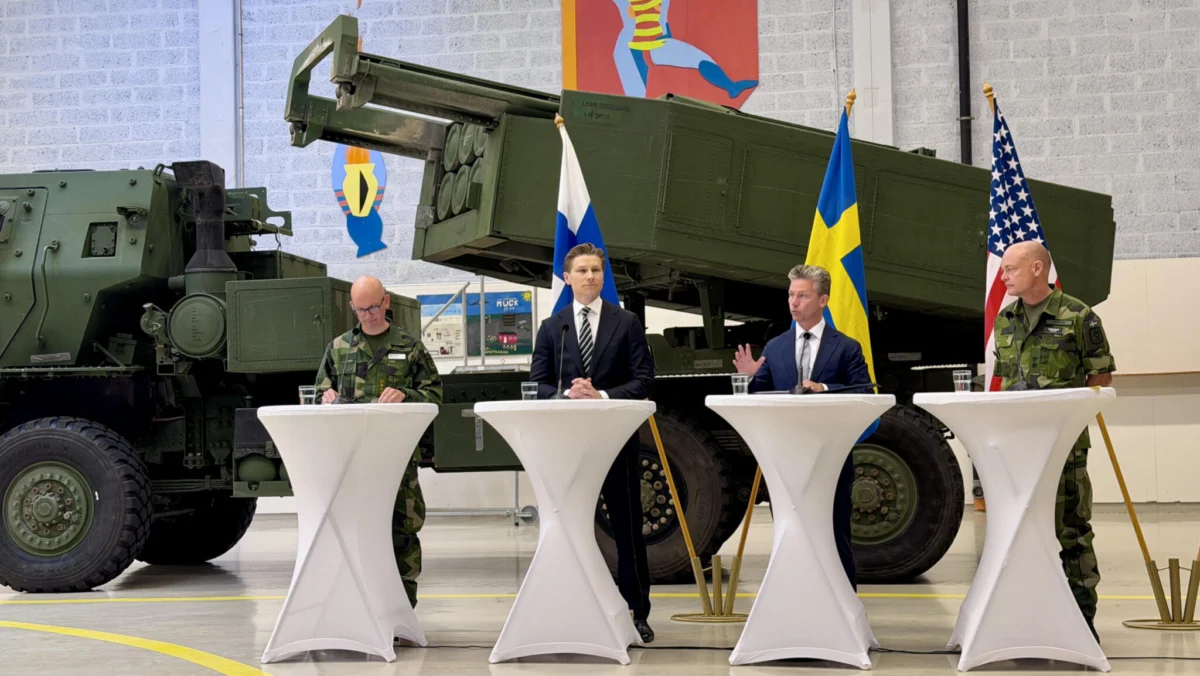
The announcement was made at the Ärna Air Base near Uppsala, where a U.S. Army HIMARS launcher—shipped from a classified location in Europe—served as the backdrop for a joint press briefing involving Swedish Defense Minister Pål Jonson and his Finnish counterpart, Antti Häkkänen. This acquisition, which was formally greenlit by the U.S. government in March 2026, marks the beginning of a new chapter in Scandinavian defense cooperation.
The Strategic Shift: Filling the Deep-Strike Void
For decades, the Swedish Armed Forces have relied heavily on air-delivered munitions and ground-based tactical artillery. However, the changing security landscape in the Baltic Sea region has necessitated a rethink of land-based power projection.
Maj. Gen. Johan Pekkari, head of the Swedish Army, was candid regarding the motivation behind the procurement. "The long-range precision capability that you get with HIMARS is something we don’t have in our toolbox at the moment," Pekkari stated during the event. "While we possess significant deep-strike capabilities within the Air Force—most notably through the integration of Taurus missiles on our Gripen fighters—we have lacked that equivalent reach from the ground. This acquisition addresses a critical gap in our deep-fire capabilities, allowing the Army to strike high-value targets deep behind enemy lines."
The HIMARS system is renowned for its mobility and versatility. By adding this platform to their arsenal, Sweden gains the ability to engage command centers, logistics hubs, and air defense systems at ranges that significantly complicate any potential adversary’s operational planning.
Chronology of the Procurement and Future Deliveries
The path to today’s announcement has been one of focused diplomacy and logistical planning. The timeline of this strategic acquisition is as follows:
- March 2026: The U.S. State Department officially approves the potential sale of the M142 HIMARS system to Sweden, signaling a green light from Washington.
- September 2026: Following months of contractual negotiations, the Swedish government signs the final procurement agreement, valued at SEK 7 billion.
- Late 2026/Early 2027: Initial training and logistical setup commence, supported by Finnish expertise in the operation of the similar M270 Multiple Launch Rocket System (MLRS).
- 2027: The first deliveries of the launchers and an unspecified "substantial quantity" of munitions are scheduled to arrive in Sweden.
- Beyond 2027: The system is slated to achieve full operational capability, with future upgrades expected to include the integration of the Precision Strike Missile (PrSM), extending range to 500 kilometers.
Industrial Synergies: The Saab-Lockheed Martin Partnership
Beyond the immediate acquisition of hardware, the deal carries significant implications for the European defense industrial base. A key element of the agreement is a Letter of Intent (LOI) between Sweden’s defense powerhouse, Saab, and the American aerospace giant, Lockheed Martin.
The partnership aims to explore the joint production of munitions, specifically looking at integrating Saab’s Ground-Launched Small Diameter Bomb (GLSDB) with the HIMARS architecture. This collaboration is designed to bolster "security of supply," a concept that has gained renewed importance in the wake of the protracted conflict in Ukraine and global supply chain volatility.
"We need to produce a lot more munitions in Europe and in Sweden," Minister Jonson noted. "I am particularly glad that Saab and Lockheed Martin are teaming up on this. It covers everything from the GLSDB to the potential for producing PrSM and other long-range strike capabilities domestically."
While current production will initiate at Saab’s facility in Grayling, Michigan, there is a clear strategic intent to bring manufacturing closer to home. Görgen Johansson, head of Saab Dynamics, confirmed that while the agreement is in its infancy, it acts as a foundational step toward European production. "We are setting up a production area in Grayling right now," Johansson said. "Over time, we are absolutely open to seeing whether we could localize production within Europe."
Finland as the Regional Sustainment Hub
A defining feature of this procurement is the unprecedented level of coordination between Sweden and Finland. Recognizing that Sweden is starting its HIMARS journey from a blank slate, the two nations have entered into a comprehensive sustainment pact.
Finland, which already operates the tracked M270 MLRS—a system that shares a significant degree of ammunition interoperability with HIMARS—is positioning itself as the regional hub for maintenance and training. This is anchored by Lockheed Martin’s decision to establish Europe’s first dedicated HIMARS maintenance center in Tampere, Finland.
"We made a deal with Lockheed Martin that the center will come to Finland to support the whole of Europe," Minister Häkkänen explained. "We hope allies procuring new HIMARS units will utilize our center for sustainment. Sweden is the first, and this collaboration is the blueprint for future regional security."
This integration goes beyond simple maintenance. The defense ministers highlighted that the interoperability between the Swedish HIMARS and the Finnish MLRS creates a unified "strike umbrella" over the Nordic region, significantly increasing the combined deterrence factor against regional threats.
Addressing Global Constraints and Supply Chain Resilience
In the current geopolitical climate, the procurement of high-demand American weapon systems is rarely without logistical friction. The ongoing conflict in the Middle East has placed immense strain on U.S. production lines, leading to reported delays for other European nations, including Estonia.
When asked if Sweden fears similar delivery bottlenecks, Minister Jonson expressed confidence in the robustness of the deal. He emphasized that the industrial partnership with Lockheed Martin and the focus on domestic production capacity provides a buffer against the delays seen elsewhere.
"It’s not just about buying a launcher," Jonson remarked. "It is about building a security of supply on the industrial side. By deepening the collaboration between Saab and Lockheed, we are creating a more resilient supply chain. This is a benefit not just for Sweden, but for all European nations operating the HIMARS system."
Implications for NATO’s Northern Flank
The integration of HIMARS into the Swedish arsenal serves as a clear signal of the changing nature of the Nordic security architecture. By moving toward a standardized, high-precision, long-range strike capability, Sweden and Finland are effectively aligning their land forces with the broader NATO doctrine of "deep-strike" deterrence.
The ability to strike high-value targets at range, combined with the logistical support center in Tampere and the prospect of localized munitions production, represents a major leap in regional military autonomy. As NATO continues to refine its posture in the High North and the Baltic, the Swedish-Finnish HIMARS alliance will likely serve as a cornerstone of the Alliance’s ability to project power and deter aggression along its most exposed frontier.
For a nation that for centuries maintained a policy of non-alignment, this investment represents a definitive commitment to the collective defense of Europe. The "toolbox" of the Swedish Army is no longer limited to the tactical horizon; with the arrival of HIMARS, Sweden has extended its reach, ensuring that its contribution to NATO remains both technologically advanced and strategically decisive.