In the heart of China’s Shaanxi province lies Xi’an, an ancient capital that served as the seat of power for 13 dynasties over a millennium. Famed globally as the home of the legendary Terracotta Army, Xi’an is a cornerstone of global heritage. Today, it stands as a titan of the domestic tourism industry, welcoming approximately 330 million visitors annually. Yet, as the digital age matures, the expectations of these millions are shifting. Modern travelers no longer seek static plaques and generic audio guides; they demand immersive, conversational, and highly personalized narratives.
To meet this demand, Huawei and the Shaanxi Culture Industry Investment Group (SCG) have unveiled "BoGuan," the world’s first commercial multimodal Large Language Model (LLM) purpose-built for the cultural tourism sector. This initiative represents a paradigm shift in how historical data is curated, processed, and experienced by the public, effectively transforming raw archaeological and museological archives into dynamic digital assets.
The Genesis of BoGuan: A Data-Driven Approach to History
The primary challenge facing standard generative AI models is their reliance on broad, internet-scale datasets. While these models are proficient in general knowledge, they frequently struggle with the nuance, precision, and specialized vocabulary required for accurate historical and archaeological interpretation.
To bridge this "contextual gap," the partners behind BoGuan spent two years constructing a massive, specialized dataset. This repository encompasses 1.2 Petabytes of data, featuring 31 million images, 4.4 million minutes of high-definition video, and 960 million pieces of structured text. By aggregating 10 diverse open- and closed-source models—including Huawei’s own PanGu model—BoGuan serves as a unified gateway, capable of delivering historically verified information that general models simply cannot provide.
Edric Chu, General Manager of Huawei’s Shaanxi Representative Office, explains the rationale: "General large models lack specialized knowledge in museology, archaeology, and history, making it difficult to meet the nuanced demands of niche scenarios. We completed 12 high-quality cultural tourism datasets using Huawei Cloud Data Engineering to process and label text, images, audio, and video. Supported by three major standards of data collection, management, and circulation, the platform transforms raw data resources into data assets with verifiable ownership."
Chronology of Development and Deployment
The development of BoGuan was not a singular event but a methodical, multi-stage evolution:
- 2022–2023: The Foundation Phase: Huawei and SCG began the intensive labor of data ingestion, normalization, and labeling. This period focused on building the 1.2 Petabyte dataset and establishing the secure, high-throughput computing environment required to train a multimodal model of this scale.
- September 2023: The Pilot Launch: BoGuan made its public debut, powering the "GO-SHAANXI" app and introducing the AI travel companion "Xiaoqi."
- Late 2023 – Early 2024: Integration and Scaling: The model was integrated into B2B workflows, including the AI "Video Factory," which automates the creation of short-form promotional dramas and advertisements.
- Mid-2024 to Present: The platform has been successfully stress-tested in high-traffic zones like the Grand Tang Mall, supported by a 5G-Advanced network infrastructure. Expansion discussions are now underway with tourism authorities in Xinjiang and Guizhou to replicate the model on a national scale.
Supporting Data: Economic Impact and Performance Metrics
The economic impact of BoGuan has been immediate and measurable. Since its pilot launch, the model has serviced more than four million users, significantly enhancing the visitor experience while creating new revenue streams for stakeholders.
Jin Yan, Chairman of the Digital and Intelligent Culture Technology Group at SCG, highlighted the dramatic efficiency gains: "With the same team size, thanks to these technologies, our revenue has increased by roughly 30–40% between last year and this June. Furthermore, the sales of related digital collectibles and creative products have exceeded 2 million Chinese yuan ($300,000)."
The technical backbone supporting these results is equally impressive. The system runs on an on-premise 48P computing platform utilizing Huawei’s SuperPoD architecture. By employing UnifiedBus technology, the system enables individual physical servers to function as a single, cohesive logical entity, facilitating complex AI reasoning in real-time.
Infrastructure: The Silent Partner in Digital Heritage
Deploying an LLM of this magnitude requires more than just powerful computing; it necessitates a robust, low-latency network. In Xi’an’s high-traffic tourist hubs, such as the Grand Tang Mall, the volume of data generated by AI interactions—such as real-time photo generation and augmented reality (AR) tours—is immense.
China Telecom Shaanxi and Huawei have deployed a 5G-Advanced network in these areas, delivering downlink speeds of 3.5 Gbps and uplink speeds of 600 Mbps. Wang Hao, Director of Mobile Communications Network Business at China Telecom Shaanxi, notes that the density of this deployment is unprecedented. "The Grand Tang Mall is a textbook example of a high-traffic, high-concurrency, and high-interaction scenario. We have deployed 46 base stations within this compact area, a density that far exceeds standard regions."
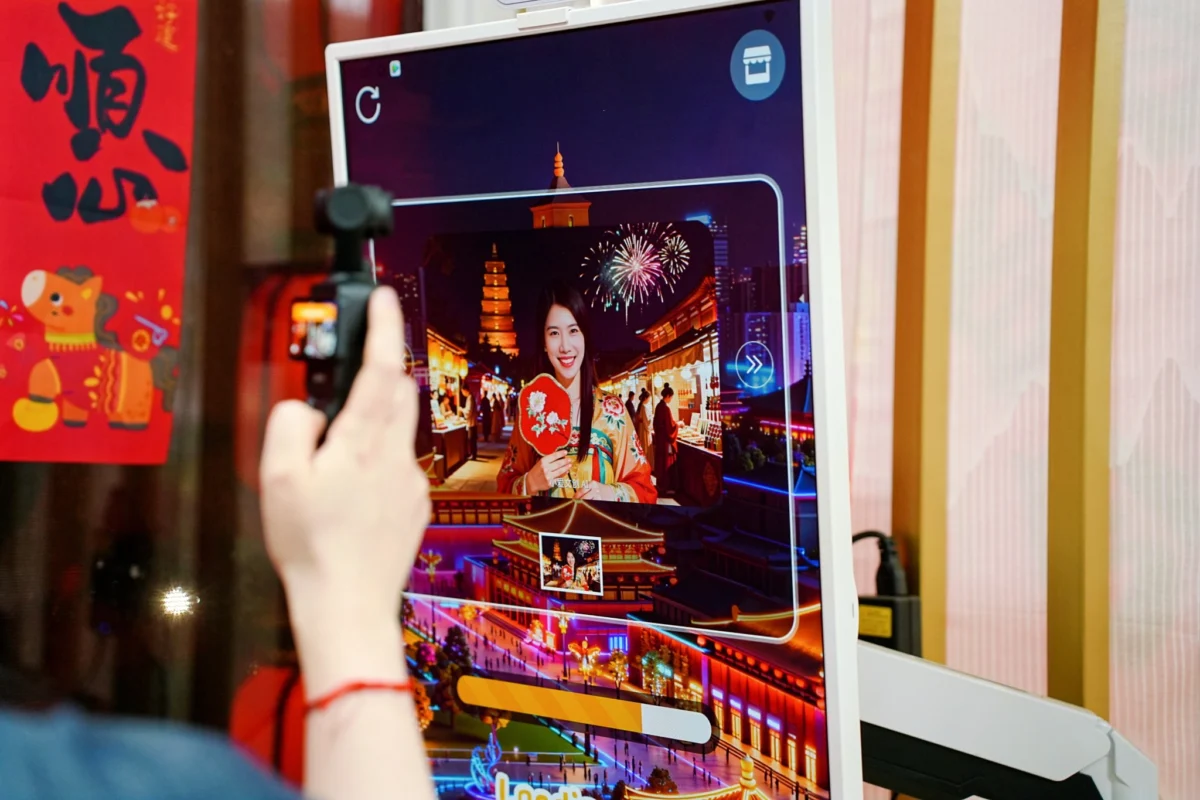
These base stations are equipped with AI-powered intelligent control boards that dynamically allocate network resources. When a tourist uses the "Zhiying Camera" mini-program to merge their photograph with a historical backdrop, the network detects the demand for high-compute, low-latency processing and triggers service acceleration protocols, ensuring a seamless experience even when supporting 23,000 concurrent users.
The Human Element: Bridging the Talent Gap
As AI integrates deeper into the cultural sector, a new challenge has emerged: the talent gap. Edric Chu highlights that the industry is currently suffering from a shortage of professionals capable of navigating both the nuances of cultural heritage and the technical requirements of AI deployment.
"The industry faces a deficit of millions of interdisciplinary professionals who bridge the gap between cultural tourism and AI," Chu explains. "Shaanxi alone faces a talent gap of 30,000 to 50,000 in this niche, and the national gap is expected to exceed 1 million by 2030."
To address this, SCG, Huawei, and over 10 academic and vocational institutions have established a dedicated training base. The program aligns vocational certifications with Huawei’s AI curricula and university micro-majors. The initiative aims to train over 1,000 specialists this year, scaling to 3,000 annually in the near future. This effort is vital, as the success of vertical AI depends not only on the sophistication of the algorithms but on the human expertise required to curate and interpret the data.
Implications: A Blueprint for Global Tourism
The success of the BoGuan LLM offers a compelling blueprint for the global telecommunications and tourism industries. It demonstrates that the future of telecom growth lies in moving beyond simple connectivity to provide managed, AI-driven vertical services. By combining cloud, high-performance compute, and industry-specific data, operators and technology partners can create ecosystems that drive sustainable growth.
The implications for heritage preservation are equally profound. By digitizing cultural assets, BoGuan does more than entertain; it preserves, analyzes, and contextualizes history for future generations. As the model expands into provinces like Guizhou and Xinjiang, the prospect of a nationwide "Digital Cultural Grid" becomes a tangible possibility.
"Artificial intelligence is not simply a stack of technologies," Chu concludes. "In Shaanxi, it has become a key enabler that can activate thousands of years of cultural heritage, reshape travel experiences, and inject new momentum into the industry."
As the world continues to grapple with the role of AI in creative and historical sectors, the BoGuan project stands as a testament to the potential of human-centric, purpose-built technology. By respecting the depth of history while embracing the speed of modern innovation, the partners have created a platform that ensures ancient civilizations remain relevant, vibrant, and accessible in the digital age.