By Cesar Jimenez, CTO, Trans Americas Fiber
Latin America is currently experiencing an unprecedented surge in digital demand, with international bandwidth consumption growing at a pace that eclipses most other global regions. Yet, as the digital economy accelerates, a fundamental disconnect remains: a significant portion of this traffic is traversing subsea infrastructure designed for a bygone era of internet usage.
While upgrading legacy systems is a vital stopgap measure, it is no longer a sustainable long-term strategy for a region increasingly defined by cloud computing, AI, and distributed data centers. To remain globally competitive, Latin America must pivot toward a dual strategy that balances the maintenance of existing assets with the deployment of next-generation, high-capacity, and resilient subsea architectures.
Main Facts: The LatAm Bandwidth Paradox
The current state of Latin American connectivity presents a classic paradox of "capacity on paper" versus "capacity in practice." While the aggregate portfolio of subsea cables may appear sufficient to stakeholders looking at broad regional averages, the reality is far more fragmented.
TeleGeography reports that used international bandwidth in Latin America surged by approximately 25% in 2025, surpassing 400 Tbps. However, this growth is not uniform. Nations like Brazil are seeing a compound annual growth rate (CAGR) of 29%, while Mexico and Colombia are witnessing even more aggressive expansion at 32% and 40%, respectively.
The primary issue is geographic and commercial accessibility. Spare capacity sitting idle on a cable in one region provides zero utility to a carrier or enterprise requiring bandwidth in another. Furthermore, the commercial terms associated with legacy cables often favor incumbent owners, creating a barrier to entry for smaller ISPs and emerging enterprises. True connectivity requires that capacity be available where it is needed, when it is needed, and under flexible commercial terms.

Chronology of Infrastructure Evolution
To understand where we are going, we must look at where the industry has been.
- The Legacy Era (Pre-2010s): Subsea cables deployed during this period were optimized for voice traffic and basic, predictable internet usage. These systems were characterized by limited fiber pairs, higher signal attenuation, and repeaters that are now approaching the end of their operational lifecycles.
- The Content Shift (2017–2022): The industry saw a marked transition as hyperscalers and content providers began to influence cable design. Demand for low-latency, high-bandwidth pathways between the U.S. and Latin America began to explode, driven by the rise of streaming, social media, and early-stage cloud adoption.
- The Modern Expansion (2023–2026): We are currently in a period of catch-up. Total investment in cables entering service between 2023 and 2025 totaled approximately USD 0.7 billion. While this is a positive start, it remains significantly lower than the capital allocation seen in Trans-Pacific or Trans-Atlantic routes.
- The Future Horizon (2026–2029): Projections indicate a jump to USD 1.3 billion in investment for the upcoming four-year cycle. This shift is being driven by the arrival of major cloud availability zones, necessitating massive, direct, high-capacity links to the global internet backbone.
Supporting Data: The Cloud and AI Imperative
The growth of the cloud footprint is perhaps the most significant indicator of future bandwidth requirements. Latin America currently trails Asia, Europe, and the U.S. in terms of cloud availability zones, but this gap is narrowing. With five new zones planned for the near term, the demand for "middle-mile" connectivity is reaching a boiling point.
The Content Provider Influence
Content providers, who were largely absent from the Latin American subsea landscape before 2017, now play a dominant role. Currently, more than 90 Tbps of content-provider-driven traffic moves between the U.S. and Latin America, growing at a blistering 50% year-over-year.
The Limits of Upgradability
There is a common misconception that legacy cables can be upgraded indefinitely with advanced terminal equipment. While coherent optical technology has certainly extended the life of these systems, they are bound by the physical constraints of the fiber in the water. Older systems utilize fiber generations with smaller effective areas and higher attenuation. Even with the best terminal gear, an upgraded 20-year-old cable cannot match the spectral efficiency or the sheer fiber count of modern designs.
Official Perspective: Designing for Today’s Traffic
At Trans Americas Fiber (TAFS), we recognize that the design philosophy for subsea cables has undergone a paradigm shift. Modern traffic is not just "more" of the same; it is fundamentally different. It is dynamic, distributed, and driven by the processing needs of Artificial Intelligence and real-time data synchronization.
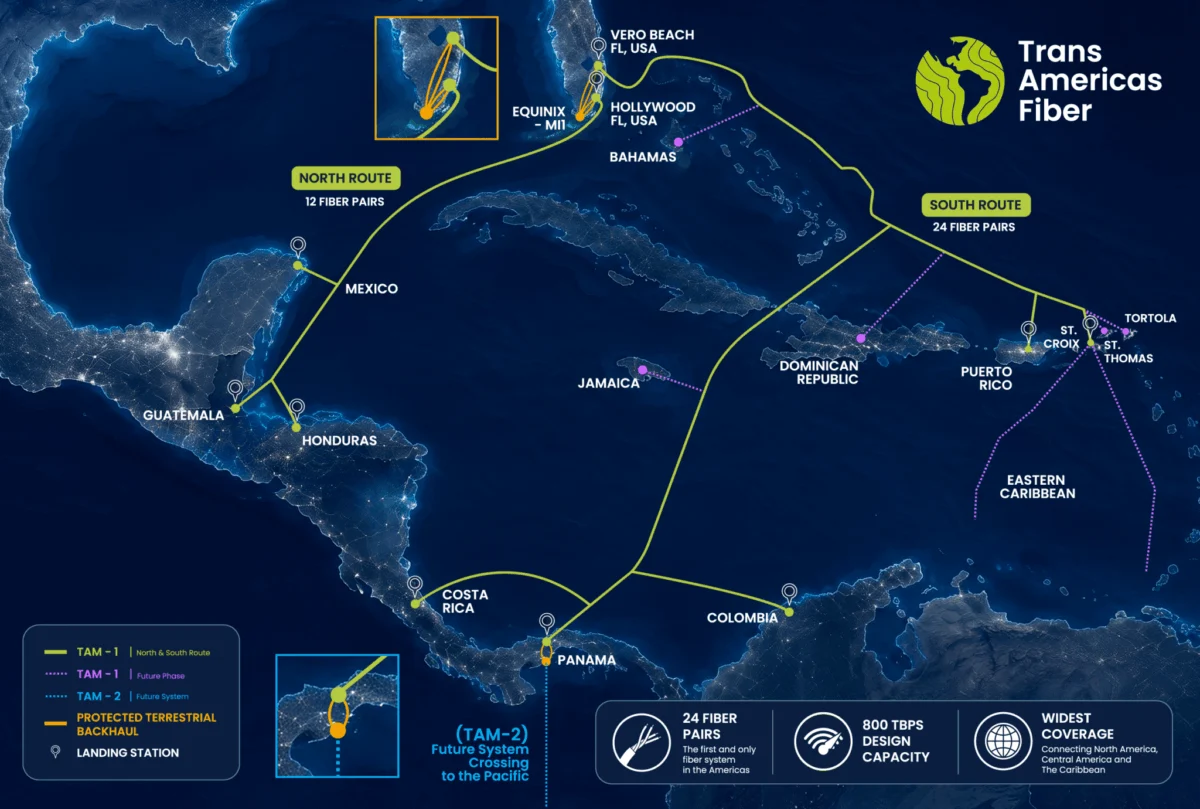
The TAM-1 cable is a direct response to these requirements. As one of fewer than five 24-fiber-pair subsea systems globally—and the first of its kind in the Americas—it represents a leap in capacity. By offering 24 fiber pairs on the South System and 12 on the North, it provides a design capacity of approximately 800 Tbps. This is not merely an incremental improvement; it offers more than 200 times the capacity of legacy Caribbean systems.

A Focus on Neutrality
Beyond capacity, the industry must embrace open access. For too long, the best connectivity in the region was gated behind proprietary ownership models. TAFS has adopted a neutral, open-access architecture. This model empowers carriers, hyperscalers, and ISPs to purchase capacity directly without restrictive minimums or opaque pricing structures. The success of this model is evidenced by the commitment of ten anchor tenants—including industry leaders like AT&T, Millicom, AXTEL, and Grupo ICE—even before the construction was finalized.
Implications: Resilience as a Competitive Advantage
In a region frequently exposed to environmental challenges—such as hurricanes, earthquakes, and the daily risks of commercial fishing activity—resilience is not a "nice-to-have" feature; it is a critical business requirement.
The Diversity Mandate
Resilience is synonymous with route diversity. Relying on a single, aging cable system is a strategic liability. Past storm events have clearly demonstrated the economic cost of a single point of failure. The TAM-1 system addresses this through a dual-system approach: a North System and a South System, interconnected via switchable branching units.
These units allow for the intelligent re-routing of traffic during outages, ensuring continuity of service. Furthermore, we have integrated "stubbed" branching units into the design. This allows for future-proof scalability—such as the planned TAM-2 Pacific extension—without requiring intrusive and costly marine operations on an active, live system.
The Human Element
The evolution of subsea infrastructure is not just about fiber optics; it is about the expertise behind the network. Success in this sector requires a fusion of high-performance engineering, secure data center operations, and a commitment to customer-centric provisioning. As we move into 2026 and beyond, the focus will shift toward integrated platforms that manage DWDM, IP, and security as a singular, cohesive service layer.
Conclusion: The Path Forward
Latin America stands at a digital crossroads. The region’s trajectory—marked by 25% to 30% annual growth in traffic—demands a departure from the "good enough" mentality of the past. We should not ask the region’s businesses and consumers to settle for infrastructure designed for the voice-centric internet of the 1990s and 2000s.

The solution is not a zero-sum game between upgrading old systems and building new ones. Both are necessary. However, the market must prioritize the deployment of modern, open-access, and resilient platforms that can handle the massive, AI-driven workloads of the future.
Capacity on paper is irrelevant if it is not accessible, reliable, and affordable. By prioritizing diversity, open-access business models, and high-fiber-count architectures, Latin America can transform from a region playing catch-up into a global hub of digital innovation and connectivity.
Cesar Jimenez serves as the Chief Technology Officer at Trans Americas Fiber (TAFS). With over 25 years of global engineering and operations leadership, he has been at the forefront of deploying cutting-edge subsea and terrestrial networks. For more insights into the future of subsea connectivity, join the industry discussion at the upcoming Submarine Networks EMEA conference.