The era of unchecked reliance on massive, cloud-based AI data centers may be approaching a quiet, calculated end. As organizations grapple with the volatile economics of generative AI—specifically the spiraling costs of API-based inference tokens and the persistent, nagging anxieties surrounding data privacy and governance—a significant trend is emerging in the enterprise sector. Businesses are increasingly looking away from the cloud and toward the high-performance local compute capabilities of Apple’s M-series and A-series hardware.
While Apple’s latest Q4 financial results highlighted a staggering $33 billion expenditure linked to memory price inflation—a figure that serves as a sobering proxy for the current "AI data center bubble"—the company’s earnings report contained a more subtle, yet far more disruptive narrative: the migration of mission-critical AI workloads to local hardware.
The Economic Imperative: Why Local Inference Wins
For the past two years, the enterprise playbook for AI has been dominated by the cloud. Companies have flocked to massive GPU clusters, often owned by hyperscalers, to run Large Language Models (LLMs). While this approach provided immediate access to advanced AI, it introduced a new, permanent operational expense: the "token tax." Every query, every prompt, and every automated process incurs a cost, which, when scaled across thousands of employees, can reach millions of dollars annually.
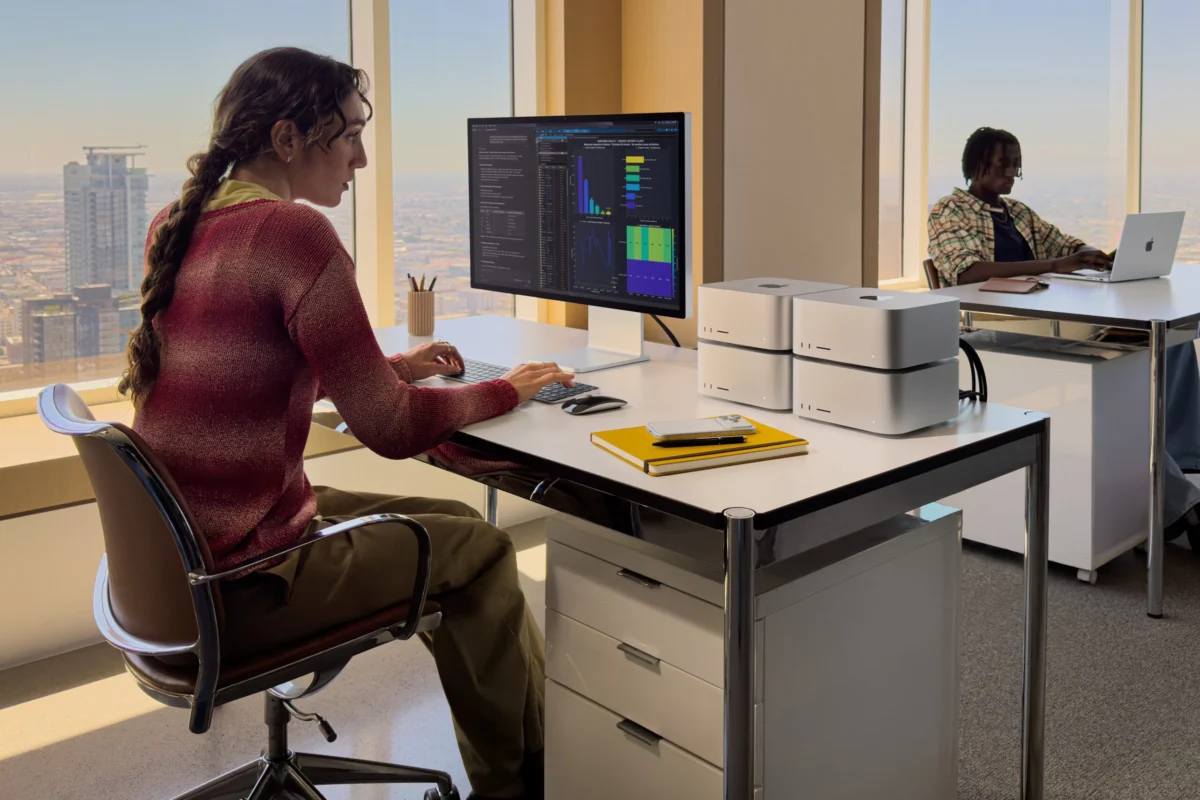
Apple is positioning its hardware as the antidote to this economic model. By leveraging the unified memory architecture and Neural Engine capabilities of the Mac Studio, Mac mini, and even the iPad Pro, companies are finding that they can run sophisticated models entirely on-premises.
Consider the math: if a high-end Mac workstation costs a few thousand dollars but replaces tens of thousands of dollars in annual cloud inferencing fees, the capital expenditure pays for itself in record time. This is not merely a theoretical advantage; it is a practical, boardroom-ready strategy.
Industry Case Studies: Moving from Cloud to Client
The shift is already well underway among major global entities. During its recent earnings call, Apple highlighted two marquee examples that illustrate the versatility of its "edge-first" AI strategy:
- Gap Inc.: The retail giant has moved its loss-prevention models away from cloud servers, opting to run them entirely on Mac mini hardware. By localizing these calculations, Gap has successfully eliminated recurring cloud token costs while maintaining the high-speed, low-latency performance required for real-time loss prevention.
- Christie’s: The world-renowned auction house is utilizing the Mac Studio to power its local pricing estimate models. For a business where precision and privacy are paramount, running models on dedicated local hardware ensures that proprietary valuation data never leaves the firm’s secure environment.
These deployments are not isolated incidents. They represent a broader corporate acknowledgment that the "cloud-only" model is becoming a liability, both in terms of cost predictability and intellectual property security.
A Chronology of the Apple Enterprise Pivot
To understand how Apple reached this point, one must look at the systematic development of its silicon and ecosystem:
- 2020: The Silicon Transition: The introduction of the M1 chip marked the beginning of Apple’s journey toward high-performance, low-power, unified memory architecture. This hardware foundation was the prerequisite for running large models locally.
- 2023: Neural Engine Maturity: As Apple refined its Neural Engine, it began optimizing macOS and iPadOS for on-device machine learning, laying the groundwork for Private Cloud Compute (PCC) and local LLM execution.
- 2024: The Enterprise Push: Apple expanded its reach, securing massive hardware deployments—such as 25,000 iPads for American Airlines and 37,000 iPhone 17 devices for flight attendants—which normalized the use of Apple hardware for specialized business tasks.
- Late 2026: The Strategic Synthesis: Apple’s recent Q4 results confirm that its hardware ecosystem is no longer just for productivity; it is the primary engine for local AI deployment. With the introduction of free server-side LLM access for smaller developers and the clear monetization of iCloud+ for power users, Apple has effectively created a full-stack AI ecosystem.
Supporting Data: The Scale of Deployment
The depth of Apple’s enterprise penetration is extensive, providing a massive, existing user base that can be easily converted to local AI users.
Beyond the specific AI-focused deployments, Apple continues to capture large-scale government and corporate contracts that solidify its presence in the enterprise. The recent deal with the Department of Education in the Philippines—involving the deployment of 170,000 MacBook Neos—demonstrates that Apple is not just competing in the high-end workstation market, but is also successfully scaling its reach into institutional education and government infrastructure. These deployments act as a "Trojan Horse" for AI; once the hardware is in place, the leap to running local AI agents becomes a software update rather than a hardware overhaul.
Official Responses and Strategic Vision
Apple leadership has been vocal about the role of its hardware in the AI revolution. CEO John Ternus underscored the company’s unique position during the Q4 financial call, stating:
"From Mac to iPhone to iPad, we are proud that our products are the best platforms in the industry for AI for both first-party and third-party applications, and we’re excited about the opportunities that creates."
Ternus also addressed the evolution of the company’s most visible AI product, Siri. While Siri has historically been limited by its request-based architecture, Ternus confirmed that the "modern orchestrator-driven architecture" unveiled at WWDC provides the necessary headroom for "agentic" capabilities. This suggests a future where Siri doesn’t just answer questions, but autonomously executes tasks across applications—provided, as Ternus noted, that the user maintains strict control over privacy and permissions.
The Dual-Monetization Model
Apple is employing a two-pronged strategy to ensure long-term dominance in the AI space.
On one end, it is courting the developer ecosystem by lowering the barrier to entry. By offering free access to server-side LLMs for applications with under two million downloads, Apple is essentially subsidizing innovation, ensuring that the best new AI tools are built on the Apple framework.
On the other end, Apple is monetizing the end user. By integrating heavy-duty server-side queries into the iCloud+ subscription tiers, the company is transforming a storage service into an AI-as-a-service utility. This model allows Apple to generate recurring revenue while providing users with a "premium" layer of AI intelligence that works in tandem with the "free" local intelligence provided by the hardware.
Implications for the Tech Landscape
The broader implications for the tech industry are profound. If the enterprise shift toward local, hardware-based AI continues, the reliance on hyperscalers for AI inference may decline. This creates a challenging environment for cloud providers who have spent hundreds of billions of dollars on data center infrastructure based on the assumption that AI would remain a cloud-native service.
Furthermore, Apple’s focus on "Private Cloud Compute" (PCC) suggests a hybrid future. For tasks that are too heavy for a local device, Apple offers a secure, audited cloud environment that promises privacy—a key differentiator in an era where data leaks and model training on private data have become major concerns for enterprise IT departments.
As businesses continue to scrutinize their AI budgets, the pitch for local, on-device intelligence becomes increasingly difficult to ignore. Apple, with its unique combination of proprietary silicon, unified software ecosystems, and a reputation for privacy, is perfectly positioned to capture the enterprise market that is tired of the cloud’s hidden costs and risks.
The "AI bubble" may be inflated by massive data center investments, but the long-term, sustainable value of AI may reside in the silicon sitting on a professional’s desk or in their pocket. As Apple continues to bridge the gap between high-end local performance and accessible cloud intelligence, it is clear that the future of enterprise AI will be less about the cloud and more about the device.