By: Monolithic Power Systems | November 2, 2026
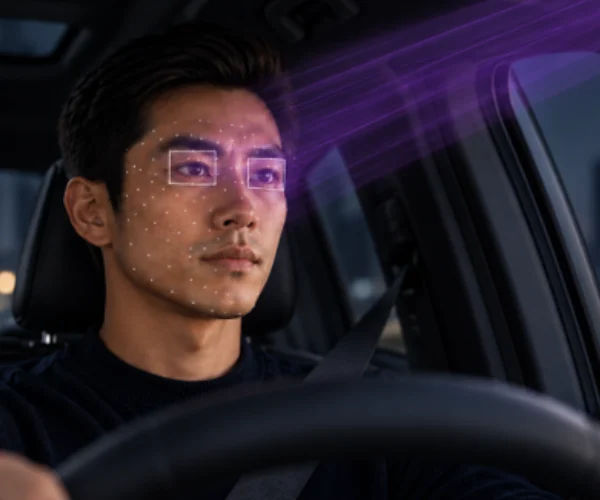
As the automotive industry pivots toward increasing levels of autonomy and heightened regulatory scrutiny regarding road safety, the modern vehicle cockpit is undergoing a profound transformation. No longer just a space for steering and navigation, the cabin has become a sophisticated sensory environment. At the heart of this evolution are Driver Monitoring Systems (DMS) and Occupant Monitoring Systems (OMS)—technologies designed to act as the "eyes and ears" of the interior, ensuring passenger safety through real-time vigilance.
However, the rapid integration of these systems into production vehicles brings a new suite of engineering hurdles. From the complexities of infrared (IR) illumination to the stringent demands of power density and thermal management, engineers are being pushed to innovate at the intersection of optics, power electronics, and artificial intelligence.
The Core Mandate: Why DMS and OMS Matter
The push for DMS and OMS is driven by both safety imperatives and legal mandates. Global safety organizations, including the European New Car Assessment Programme (Euro NCAP), have begun integrating driver monitoring as a prerequisite for five-star safety ratings. These systems serve a critical function: detecting driver fatigue, distraction, and impairment—factors that contribute to a significant percentage of annual traffic accidents.
OMS extends this protective umbrella to all passengers. By identifying the presence of children, pets, or vulnerable occupants, these systems provide a vital safety net, mitigating the risks of heatstroke or accidental abandonment. As these systems move from "luxury add-on" to "standard equipment," the automotive supply chain must address the scalability and reliability of the hardware that makes this intelligence possible.
Technical Challenges in Cockpit Sensing
Developing a robust DMS/OMS architecture is not as simple as installing a camera. The cockpit environment is notoriously hostile to sensitive electronics.
1. The Challenge of Infrared Illumination
To ensure consistent performance across all lighting conditions—including total darkness—DMS and OMS rely on active infrared (IR) illumination. High-performance IR LEDs are essential for illuminating the driver’s face or the cabin interior without causing distraction to the driver. Yet, these LEDs require high-peak currents to capture high-speed images, creating significant power delivery challenges. The rapid switching and current regulation required for these LEDs must be achieved with minimal electromagnetic interference (EMI) to prevent disruption of other sensitive vehicle systems.
2. Thermal Management and Form Factor
Space is at a premium in the modern cockpit. Whether integrated into the steering column, the instrument cluster, or the rearview mirror, DMS/OMS hardware must be compact. This physical limitation makes thermal management particularly difficult. High-performance imaging sensors and the associated processing units generate considerable heat, which can degrade image quality and reduce the lifespan of critical components if not managed with sophisticated power-conversion techniques.
3. System Architecture and Reliability
The automotive environment demands components that can withstand extreme temperature fluctuations, vibration, and long-term exposure to sunlight. A failure in a DMS system isn’t just a nuisance; it’s a failure of a primary safety feature. Therefore, the power delivery architecture must be redundant, efficient, and resilient, ensuring that the system remains functional under the most demanding conditions.
Upcoming Technical Seminars: Deep Dive into Design
To address these challenges, Monolithic Power Systems (MPS) is hosting a series of technical deep-dive webinars. These sessions are designed for automotive design engineers, systems architects, and technical managers looking to optimize their cockpit sensing platforms.
Seminar Schedule
- European Session: Wednesday, November 18, 2026, at 10:00 AM CET
- North American Session: Thursday, December 3, 2026, at 9:00 AM PST / 12:00 PM EST
Attendees will receive a comprehensive overview of the design lifecycle, ranging from high-level system architecture to granular board-level design tips.
Supporting Data: The Efficiency Imperative
The shift toward electric vehicles (EVs) adds another layer of complexity: energy efficiency. Every watt drawn by a cabin monitoring system is a watt taken away from the vehicle’s range. Engineering teams are now tasked with optimizing the "power-per-pixel" ratio of their monitoring suites.

Advanced IR LED driver solutions now allow for more precise control, utilizing pulse-width modulation (PWM) strategies that synchronize with the camera’s shutter. By only firing the IR LEDs exactly when the sensor is active, engineers can significantly reduce the average power consumption of the system without compromising image quality. This synergy between the power management integrated circuit (PMIC) and the optical stack is the new benchmark for efficient cabin design.
Official Perspectives: The Road to Standardization
Industry leaders argue that the lack of standardization in DMS/OMS hardware is the biggest barrier to rapid deployment. Currently, manufacturers use a fragmented array of proprietary solutions, which inflates development costs and complicates the supply chain.
"The goal for the next 24 months is to create modular, scalable power architectures that can be adapted to different vehicle classes," notes a senior systems architect at MPS. "By standardizing the power delivery interface for DMS/OMS, we allow Tier 1 suppliers to focus on the software and AI algorithms that provide the real value to the end user, rather than reinventing the wheel on power electronics for every new model year."
This modular approach is expected to lower the barrier to entry for mid-range vehicle segments, effectively democratizing advanced safety features across the entire automotive market.
Implications for the Automotive Industry
The widespread adoption of DMS and OMS will trigger a massive shift in how automotive silicon is designed and sourced.
Shift in Tiered Supply Chains
The demand for high-performance, compact LED drivers and specialized PMICs will favor semiconductor vendors who can provide a "system-level" solution rather than just discrete components. Integration is the name of the game. Components that consolidate power, sensing, and communication interfaces will become the standard.
The Role of Artificial Intelligence
While the hardware captures the data, the AI processes it. The implications for processing power within the cabin are immense. As DMS/OMS evolve to detect not just drowsiness, but complex emotions and health emergencies, the onboard compute requirements will grow. This necessitates a tighter partnership between hardware designers—who provide the clean, stable power—and software developers, who push the limits of neural network inference at the edge.
Regulatory Evolution
Governments are closely watching the efficacy of these systems. As data on road safety improvements from DMS-equipped vehicles becomes available, we can expect stricter mandates. For automotive companies, the message is clear: DMS/OMS is not a feature for the future—it is a requirement for the present.
Conclusion: Bridging the Gap Between Design and Reality
The evolution of DMS and OMS is a testament to the ingenuity of modern automotive engineering. By balancing the competing demands of high-performance illumination, stringent power efficiency, and compact design, engineers are building the infrastructure that will define the safety standards of the next decade.
As we look toward the upcoming technical sessions, the focus remains on practical, actionable intelligence. By mastering the nuances of power delivery, thermal control, and system architecture, the industry can ensure that the next generation of vehicles is not only "smarter" but significantly safer for everyone on the road.
Join the Conversation
To gain a competitive edge in your next automotive design project, we invite you to participate in our upcoming technical webinars. Register via the official MPS Event Portal to secure your spot and join the dialogue on the future of cockpit sensing.
Keywords: #AUTOMOTIVE #DMS #LED_DRIVER #LEDS #OMS #MONOLITHIC_POWER_SYSTEMS