In the rapidly evolving landscape of artificial intelligence, the divide between traditional machine learning workflows and the burgeoning world of Large Language Models (LLMs) has long been a source of friction for data scientists. For years, the standard approach to AI engineering involved two disparate paths: the disciplined, modular, and repeatable pipelines of scikit-learn, or the chaotic, bespoke scripting of API loops, fragile string parsing, and extensive error-handling blocks.
Today, a bridge has been built across this divide. Scikit-LLM has emerged as a transformative library, effectively wrapping the raw power of LLMs within the familiar, standardized scikit-learn estimator API. By enabling developers to leverage fit, predict, and transform methods on language models, the project invites LLMs into the robust ecosystem of pipelines, cross-validation, and performance metrics that define professional-grade machine learning.
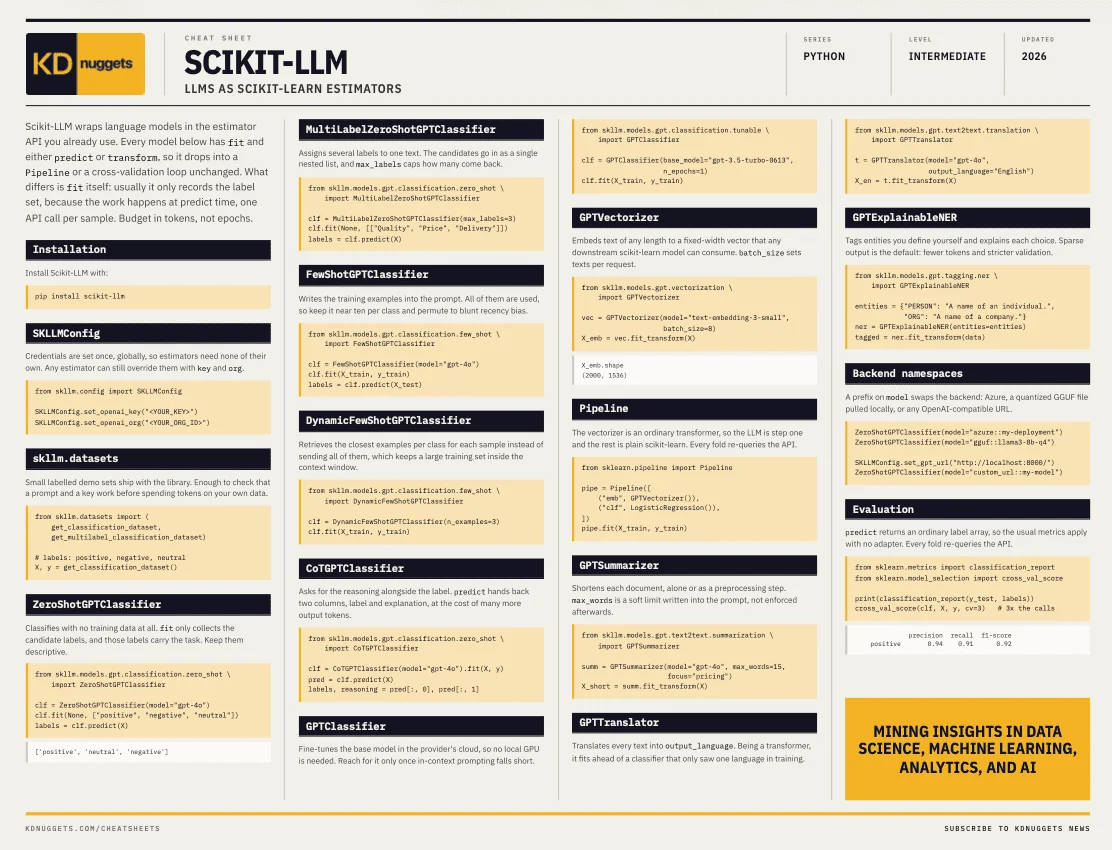
To help practitioners navigate this integration, KDnuggets has released a comprehensive Cheat Sheet on Scikit-LLM Estimators, a vital resource for those looking to harmonize traditional statistical methods with modern generative AI.
The Evolution of the AI Workflow: From Scripts to Systems
The "Wild West" Era of LLM Integration
Before the arrival of libraries like Scikit-LLM, integrating an LLM into a production environment was often an exercise in architectural frustration. A typical developer might spend hours writing custom Python scripts—looping over datasets, triggering API calls to services like OpenAI’s GPT models, and attempting to parse the resulting text into structured classifications.
These scripts were often fragile. A minor change in a model’s output format could break a downstream data pipeline, and the lack of standardization meant that integrating a new model or a new preprocessing step required a complete rewrite of the underlying logic. It was, by all accounts, a "non-reusable" approach that lacked the rigor required for enterprise-level data science.
The Scikit-Learn Paradigm
Conversely, the scikit-learn ecosystem provides a gold standard for predictability. By utilizing pipelines, developers can chain preprocessing, feature engineering, and model training into a single, serializable object. The ability to perform cross-validation out-of-the-box allows for reliable model evaluation, minimizing the risk of overfitting and ensuring that performance metrics are statistically sound. Scikit-LLM effectively takes these benefits and extends them to the domain of large language models.
Decoding the Scikit-LLM Architecture
The core philosophy of Scikit-LLM is simplicity through abstraction. By implementing the scikit-learn estimator interface, the library ensures that the transition from a traditional model (like a Random Forest) to an LLM-based model is seamless.
How the fit Method Works
One of the most common points of confusion for developers new to Scikit-LLM is the fit method. In a traditional machine learning model, fit is where the heavy lifting of training—the adjustment of weights and biases—occurs.
In the context of Scikit-LLM, the fit process is fundamentally different. Because the underlying models (such as GPT-4) are already pre-trained, the fit method primarily acts as a registrar for labels or as a mechanism to store metadata. The actual "reasoning" or classification occurs during the predict phase, where the input sample is sent to the LLM via an API call. This distinction is crucial for developers to internalize: the "intelligence" is externalized, but the interface remains local and consistent.
Essential Estimators: A Deep Dive
The Zero-Shot GPT Classifier
The ZeroShotGPTClassifier is the workhorse of the library. It is designed for scenarios where labeled training data is sparse or non-existent.
Pro-Tip for Practitioners: The secret to successful zero-shot classification is the framing of your labels. Because the model relies on the inherent semantic understanding of the LLM, the labels should not be treated as arbitrary codes (e.g., "0", "1", "2"). Instead, they should be treated as descriptive, natural language identifiers. If you are classifying customer feedback, labels like "Urgent Issue" or "Positive Sentiment" will yield significantly higher accuracy than abstract numerical tags.
The Power of Dynamic Few-Shot Learning
While zero-shot is excellent for general tasks, it often hits a ceiling when the problem domain is highly specialized. This is where DynamicFewShotGPTClassifier shines.
Unlike standard few-shot prompting, which forces the developer to feed the entire training dataset into the prompt window—risking high costs and hitting token limits—the Dynamic Few-Shot classifier intelligently retrieves the most relevant examples for each specific input. By matching the input against a vector database or a localized pool of examples, the model receives only the most pertinent context, improving both accuracy and computational efficiency.
Feature Extraction with GPTVectorizer
For those who prefer to keep their downstream classification logic in traditional scikit-learn territory, GPTVectorizer is a game-changer. It converts text input of arbitrary length into high-dimensional, semantically rich vectors. These embeddings can then be fed into a simple Logistic Regression or a Support Vector Machine (SVM). This hybrid approach allows the LLM to handle the "heavy lifting" of language understanding while allowing a lightweight, explainable, and cost-effective algorithm to make the final prediction.
Breaking Language Barriers with GPTTranslator
The GPTTranslator is designed to be a "transformer" in the literal sense of the pipeline. By positioning it ahead of a classifier that was trained exclusively on English text, developers can create a multilingual system without ever needing to retrain their core model on a multilingual corpus. It acts as a normalization layer, ensuring consistent input for the rest of the pipeline.
Implications: The Cost of Intelligence
While Scikit-LLM simplifies the development process, it does not magically waive the operational costs associated with LLMs. As the KDnuggets cheat sheet notes, there is a significant caveat regarding token consumption.
The Hidden Costs of Cross-Validation
In traditional machine learning, running a 10-fold cross-validation is computationally inexpensive, often taking only seconds or minutes on a standard CPU. However, when using an LLM-based estimator, that same cross-validation loop triggers the API thousands of times.
A grid search across a set of hyperparameters can result in a massive spike in API usage, leading to significant costs and latency issues. Data scientists must adopt a "cost-aware" mindset:
- Sample Data Aggressively: Use smaller subsets of data during the tuning phase.
- Cache Responses: Ensure that you are caching API calls so that identical inputs are not re-processed.
- Budgeting: Calculate the cost of a full training run before launching a grid search to avoid unexpected billing surprises.
Official Perspective and Best Practices
The integration of LLMs into standard workflows represents a shift toward "AI Engineering," where the focus moves from optimizing model architectures to optimizing the orchestration of models.
Why the Cheat Sheet Matters
The KDnuggets cheat sheet serves as a tactical guide to this orchestration. By condensing the complex API documentation into a single reference point, it allows developers to quickly decide which estimator fits the problem at hand. Whether you are dealing with sentiment analysis, text summarization, or categorical routing, the cheat sheet helps in avoiding the "trial and error" loop that frequently plagues early-stage AI projects.
Strategic Implications for Businesses
For organizations, the adoption of Scikit-LLM means that their existing data science teams can begin deploying LLM-based solutions without a steep learning curve. It leverages the existing skill set of Python-literate analysts, allowing for faster prototyping and a more streamlined path to production. The ability to use scikit-learn pipelines means that models can be easily versioned, tracked, and deployed using standard MLOps tooling (like MLflow or DVC), which is essential for maintaining governance in enterprise environments.
Conclusion: The Path Forward
The convergence of traditional machine learning and LLMs is not just a trend; it is the natural maturation of the AI field. Tools like Scikit-LLM provide the structure necessary to move beyond the experimental phase and into the era of robust, maintainable, and scalable AI systems.
By mastering these estimators, data professionals can maintain their comfort in the scikit-learn ecosystem while harnessing the unparalleled power of modern language models. As we move forward, the successful practitioners will be those who can balance the raw intelligence of LLMs with the disciplined, modular, and cost-conscious practices that have defined data science for the last decade.
Recommended Action: Download the KDnuggets Scikit-LLM Cheat Sheet today. Whether you are a seasoned expert or just beginning your journey with LLMs, this document will serve as an essential reference for building efficient, effective, and professional AI pipelines.