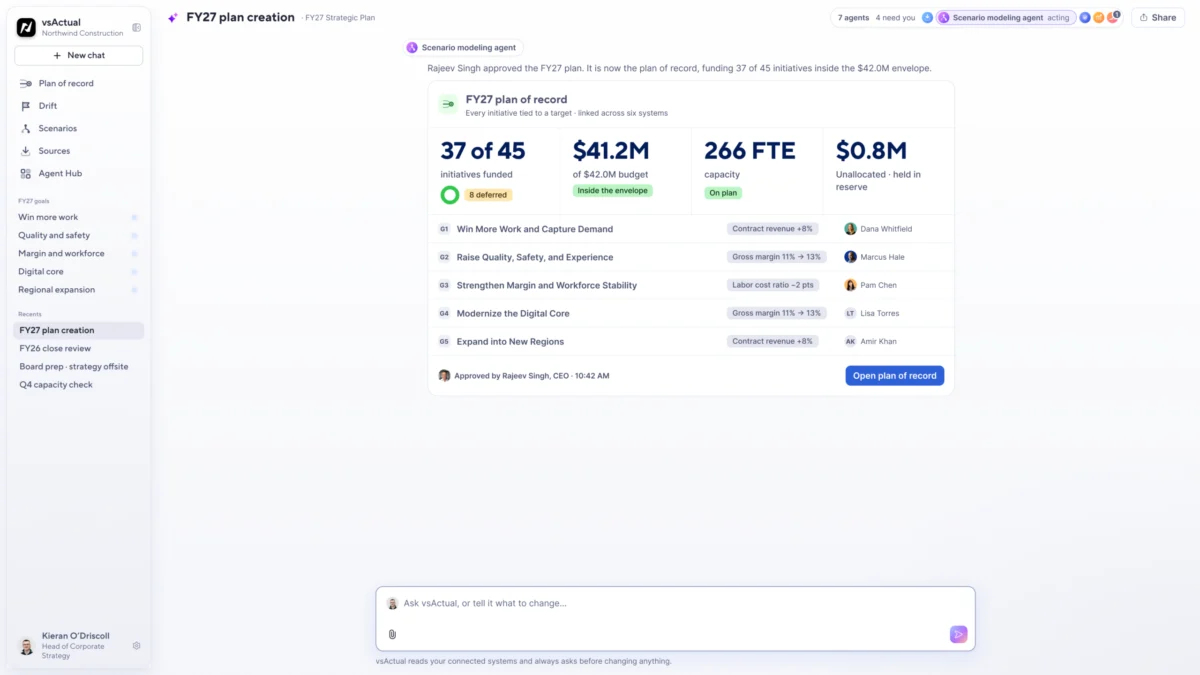
In a significant pivot from task management to strategic governance, Smartsheet has unveiled vsActual, an AI-native application designed specifically for the C-Suite. Announced during the company’s annual Engage event, the standalone platform aims to solve the persistent "execution gap"—the disconnect between high-level corporate strategy and the day-to-day reality of operational performance.
By integrating data across fragmented enterprise ecosystems, vsActual leverages autonomous AI agents to monitor, identify, and mitigate "execution drift," providing executives with a real-time, proactive lens into their organization’s health.
The Core Problem: The Myth of the "Plan of Record"
For decades, the C-Suite has relied on a reactive cadence to manage company strategy. Budget reviews, capacity planning, and progress reports have traditionally been relegated to static PowerPoint decks or disparate Excel spreadsheets, often updated on a quarterly or monthly basis. By the time an executive sees a deviation in a slide deck, the "drift"—budget overruns, schedule delays, or resource conflicts—has often calcified into a structural problem.
Smartsheet’s introduction of vsActual is a direct response to this systemic failure. The application is designed to act as a centralized intelligence layer that sits above the noise of daily operations, aggregating data from heavy-hitting enterprise platforms including Oracle, SAP, Workday, and Salesforce, as well as Slack and Smartsheet’s own core management suite.
A New Architecture: How vsActual Works
Unlike traditional reporting dashboards that merely visualize historical data, vsActual is "AI-native," meaning its core functionality is driven by agents capable of both analysis and action.
The Agentic Workflow
vsActual operates through a specialized suite of AI agents, each assigned a specific role in the execution lifecycle:
- The Intake Agent: This agent processes unstructured data from existing documentation—such as project decks and spreadsheets—to codify a "Plan of Record." This establishes the definitive baseline for goals, budgets, and timelines.
- The Planning Agent: Focused on capacity and scenario modeling, this agent allows leaders to stress-test their strategies. If a project hits a roadblock, the agent can simulate the impact of resource reallocation or timeline shifts.
- The Drift Agent: The heartbeat of the application, this agent continuously scans connected systems for anomalies. It detects if actual progress deviates from the "Plan of Record" and flags potential budget or resource conflicts in real-time.
- The Data Quality and Reporting Agents: These agents maintain the integrity of the information ecosystem and provide ongoing, automated updates to stakeholders, ensuring that the "source of truth" remains consistent across the organization.
The Power of the Execution Graph
Underpinning these agents is Smartsheet’s Execution Graph. This proprietary knowledge graph maps the complex, often invisible relationships between individual tasks, long-term projects, and overarching strategic goals. By understanding these dependencies, vsActual can predict the ripple effect of a single project delay on the company’s quarterly earnings or strategic milestones.
Chronology of the Shift: From Tasks to Strategy
Smartsheet’s evolution has been a multi-year journey, moving incrementally from a grid-based work management tool to a comprehensive enterprise operating system.
- Pre-2025: Smartsheet establishes itself as the industry standard for collaborative work management, focusing on bottom-up adoption among project managers and operational teams.
- Engage 2025: The company introduces advanced portfolio tracking and scenario modeling features within its core platform, signaling a clear intent to move into the strategic planning space.
- Wednesday, November 2026 (Engage Event): Smartsheet officially unveils vsActual. This marks the most significant strategic pivot in the company’s history: the release of a standalone, "AI-native" application that targets the C-Suite rather than the project manager.
- Early 2027 (Planned): General availability for vsActual is scheduled, moving the product out of its current early-access phase.
Implications for the C-Suite and Enterprise Ecosystem
The introduction of vsActual represents a fundamental shift in how large organizations may govern their business in the future.
Moving Beyond "Tethered" Tools
According to Liz Miller, vice president and principal analyst at Constellation Research, the market is currently saturated with OKR (Objectives and Key Results) tracking and financial operations tools. However, these tools are often "tethered" to specific ERP or HCM systems. They provide visibility but often lack the ability to bridge the gap between "knowing" and "doing."

"vsActual proactively approaches decision-making, hunting for ‘drift’ and raising recommendations rooted in the context of the business," Miller noted. Unlike passive dashboards, vsActual can propose specific corrective actions—such as shifting human capital from a low-priority project to a failing high-priority initiative—before the delay becomes irreversible.
The Challenge of Adoption
While the concept is theoretically sound, industry experts point to significant hurdles. Keith Kirkpatrick, vice president and research director at The Futurum Group, highlights that Smartsheet is effectively asking to sell a new category of product to a new, more demanding buyer persona: the CFO and COO.
"The concept is sound, but the launch asks Smartsheet to sell to a new buyer and to sell a product unlike the one it is known for," Kirkpatrick remarked. The success of vsActual will depend on its ability to build trust with the C-Suite, a demographic that is notoriously skeptical of AI "black boxes" that suggest, or even execute, strategic changes.
Guardrails, Data Integrity, and the Human Element
The efficacy of an autonomous or semi-autonomous AI system is entirely dependent on the quality of the data it processes. Both Miller and Kirkpatrick emphasize that vsActual is not a "magic button."
The "Garbage In, Garbage Out" Reality
"The tenet that AI is only as good or as accurate as the data, prompts, and guardrails in which it operates is certainly true here," Miller said. Because vsActual pulls from disparate sources like Salesforce and Slack, any inconsistencies in how those systems are used will be amplified by the AI. Consequently, organizations adopting vsActual must prioritize data hygiene to ensure the "Execution Graph" is accurate.
Human-in-the-Loop Governance
Crucially, Smartsheet has designed vsActual with a "human-in-the-loop" requirement by default. While the agents can suggest actions—such as adjusting a budget line or reassigning a team—the system is designed to require human authorization before any changes are written back to third-party applications. This guardrail is intended to mitigate the risks of AI "hallucination" or unintended operational consequences, providing executives with the final say in the company’s strategic trajectory.
Looking Ahead: The Future of Execution
As Smartsheet moves toward a 2027 general release, the market will be watching closely to see if the company can bridge the cultural gap between the operational staff using Smartsheet and the executive teams using vsActual.
The move is clearly designed to insulate Smartsheet from the volatility of the work-management software market by cementing its place as an indispensable tool for organizational governance. If successful, vsActual could redefine the role of the COO and CFO, transforming them from reactive managers of historical data into proactive architects of strategy who leverage real-time, AI-driven insights to steer their organizations through an increasingly complex global landscape.
For now, the early-access phase will be a critical testing ground. The company has yet to disclose pricing, confirming only that it will follow a usage-based billing model. As the product matures, the focus will shift from the novelty of "autonomous agents" to the hard metrics of value: How much "drift" was actually prevented? How many strategic plans were brought back on track?
In the high-stakes world of enterprise strategy, the answers to those questions will determine whether vsActual becomes a fixture of the modern boardroom or another sophisticated tool that failed to cross the "chasm" of enterprise adoption.