In the era of Large Language Models (LLMs) and sophisticated market intelligence, the ability to ingest, parse, and structure massive volumes of web data is no longer a luxury—it is a competitive necessity. As developers look for ways to fuel data-hungry AI systems, the bottleneck has shifted from raw processing power to the reliability and scalability of the scraping pipeline itself.
Collecting data at scale—thousands or even tens of thousands of pages—presents a triad of challenges: speed, infrastructure reliability, and data integrity. Recently, a benchmarking experiment conducted using the Olostep Batch API highlighted both the remarkable potential of modern scraping infrastructure and the nuanced realities of high-volume data collection. By attempting to scrape 10,000 MDN (Mozilla Developer Network) documentation pages, we gain a clear view of how enterprise-grade tools handle the transition from initial high-speed bursts to final, validated data delivery.
Main Facts: The Performance Benchmark
The experiment was designed to test the efficacy of the Olostep Batch API, a tool specifically engineered to move beyond the limitations of single-threaded or manual asynchronous request management.
Key findings from the test include:
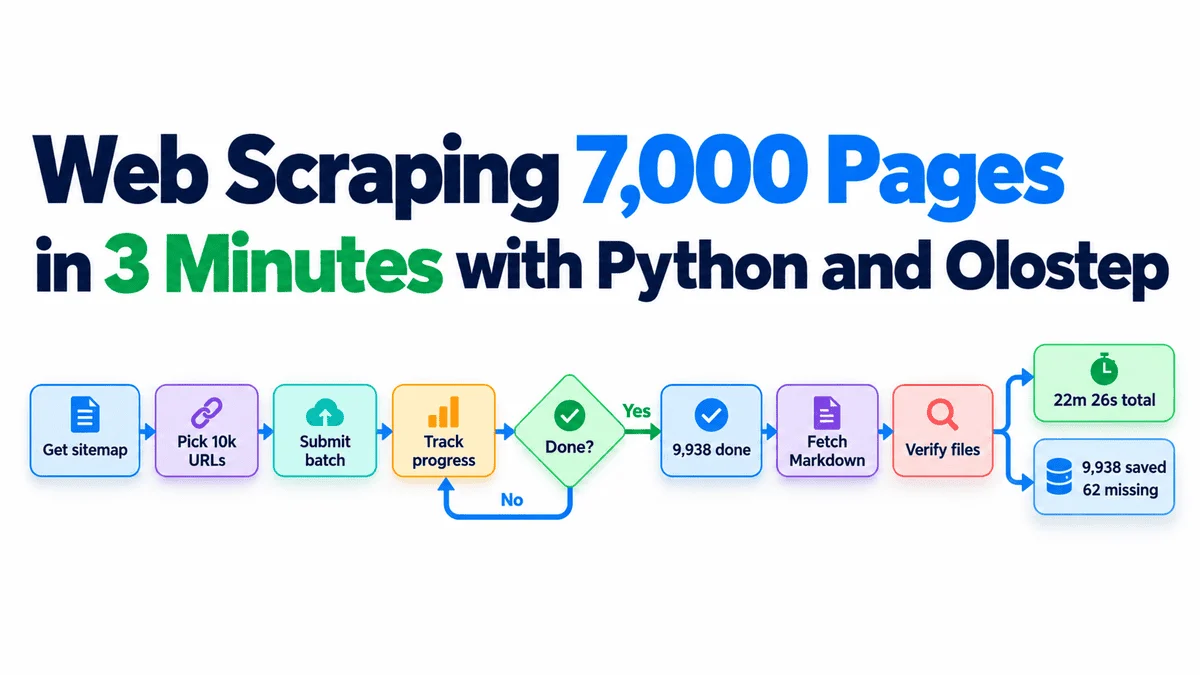
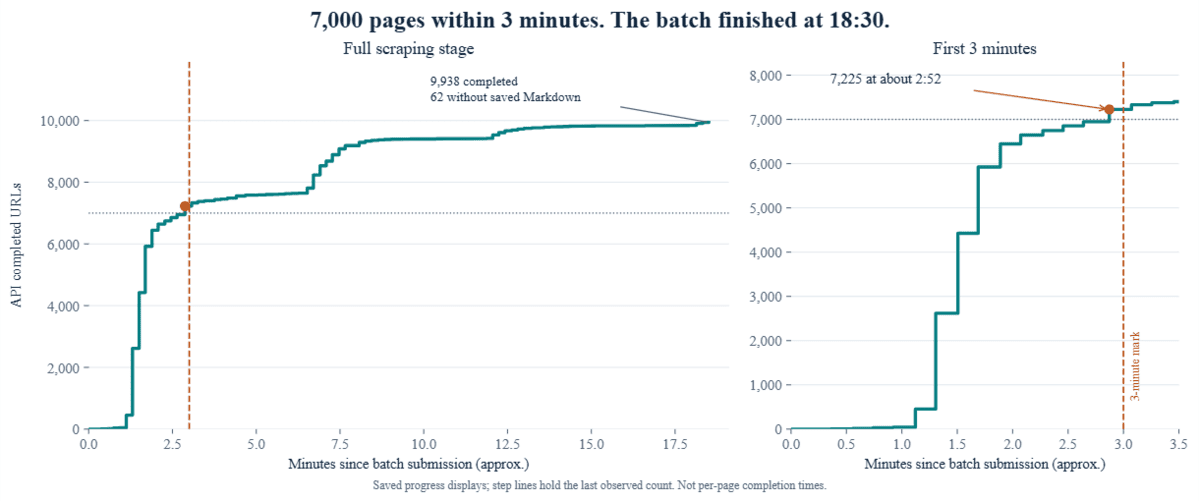
- Initial Throughput: The platform demonstrated an impressive burst capacity, processing 7,225 pages in under 3 minutes.
- Total Duration: The full lifecycle of the operation—including submission, scraping, downloading, and validation—took 22 minutes and 26 seconds.
- Success Rate: Out of the 10,000 target URLs, 9,938 were successfully transformed into high-quality Markdown files, representing a 99.38% success rate.
- Efficiency: The workflow utilized Python 3.13.15 and the Olostep SDK 1.2.2, emphasizing a developer-first approach to complex data pipelines.
The Chronology of a Large-Scale Scrape
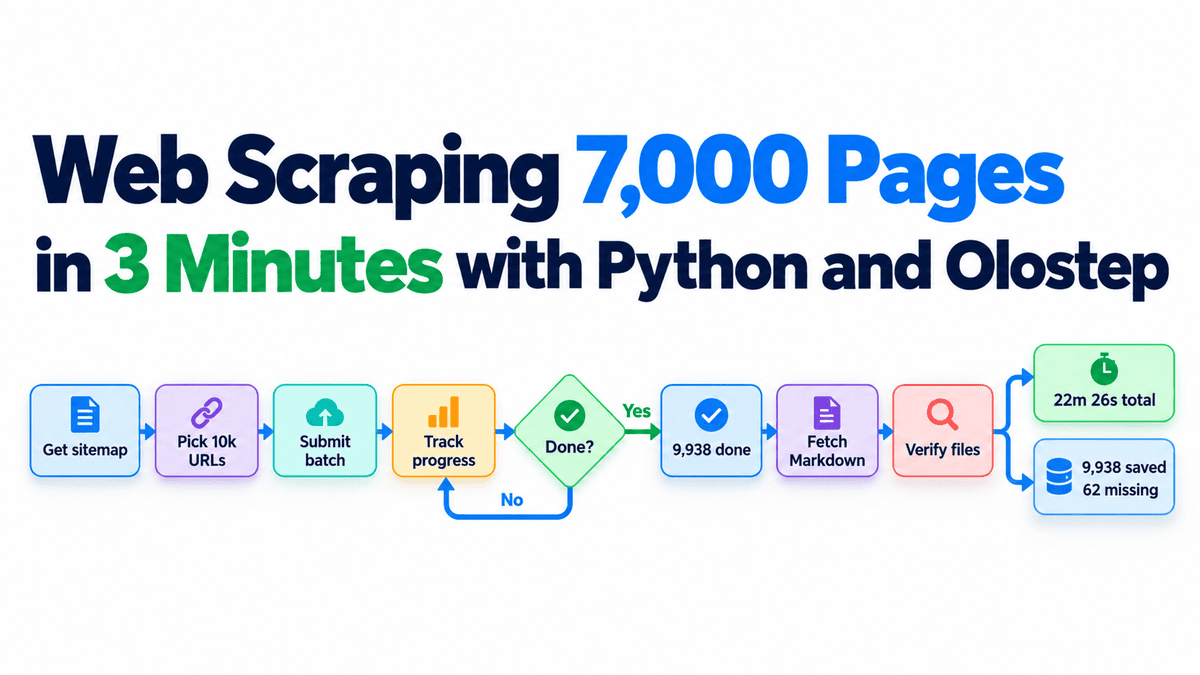
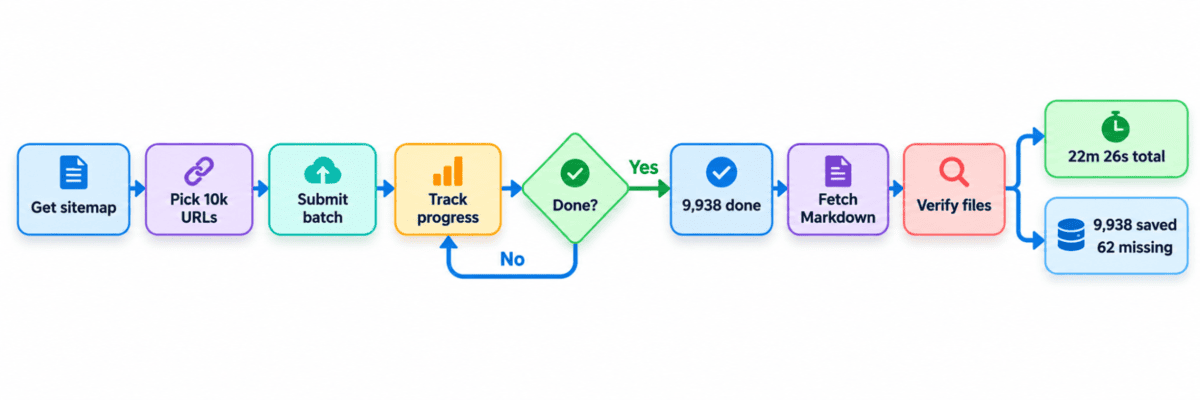
To understand the lifecycle of a 10,000-page batch, we must break the process into its operational phases. The following chronology outlines the journey from a raw sitemap to a validated local dataset.
Phase 1: Preparation and Dataset Curation
The process began with the MDN sitemap. Using Python’s requests library, the team downloaded the sitemap, filtered for relevant documentation URLs, and performed a random shuffle to ensure a representative sample. This step is critical; without proper deduplication and validation, scaling to 10,000 pages often leads to redundant requests or invalid data structures.
Phase 2: Batch Submission and Monitoring
Rather than iterating through 10,000 individual network requests—which would likely trigger rate limits or IP bans—the experiment utilized the Olostep batches.create method. By submitting the entire list in a single batch, the burden of managing concurrency and retry logic was shifted to the infrastructure layer.
Phase 3: The "Burst" and the "Long Tail"
The most striking observation was the non-linear speed of the extraction. The first 70% of the data was ingested with blistering speed (under 3 minutes). However, the remaining 30% required an additional 15+ minutes. This phenomenon suggests that while the platform likely employs massive parallelization for initial requests, the final completion phase involves handling "long-tail" latency—slower servers, retries for failed handshakes, and deeper parsing requirements for complex pages.
Phase 4: Retrieval and Markdown Transformation
Once the scraping state reached "completed," the focus shifted to retrieval. Using a semaphore-controlled asynchronous download strategy (limiting to 96 concurrent connections), the script pulled the converted Markdown content. This stage effectively converted raw HTML data into a clean, LLM-ready format.
Phase 5: Final Validation
The final step was the most crucial for data integrity. The script generated a manifest of all URLs against the successfully saved files, identifying the 62 missing pages and creating a failure report. This step proves that for enterprise applications, "scraping" is not the end; "verification" is the final mandatory hurdle.
Supporting Data: Why Speed Isn’t Everything
When analyzing the performance metrics, it is tempting to focus solely on the 3-minute mark. However, the data reveals a deeper story about resource allocation.
- The 5,000 vs. 10,000 Gap: Comparing a 5,000-page batch (16 minutes) to a 10,000-page batch (22 minutes) shows that doubling the workload does not linearly increase the time required. This indicates that the Olostep infrastructure likely scales its worker count dynamically based on the total volume of the batch.
- The Importance of Retries: The existence of 62 failed pages out of 10,000 illustrates the inherent volatility of the open web. Even with enterprise-grade infrastructure, edge cases, connection timeouts, and server-side errors are inevitable. A robust system must treat "missing data" as a standard component of the lifecycle rather than an exceptional error.
Official Perspectives and Industry Implications
Olostep is positioning itself not just as a scraper, but as a "web data infrastructure" provider. According to company leadership, the platform’s capacity to process 100,000 pages in under 25 minutes for enterprise clients is intended to solve the "data hunger" faced by AI developers.
The implications for the industry are significant:
- Shift from In-House to Infrastructure: Many companies are moving away from maintaining complex, custom-built Scrapy or Selenium clusters. The overhead of rotating proxies, managing headless browsers, and handling fingerprinting is becoming a specialized commodity.
- Focus on Data Quality: The shift is moving toward "Markdown-ready" data. By providing cleaned, readable text, these APIs allow data scientists to bypass the time-consuming "parsing phase" of the pipeline.
- The Rise of Batch Processing: For market research and product intelligence, asynchronous batching is becoming the gold standard. It allows for predictable resource scheduling and better cost management, as enterprises can budget for specific batch volumes rather than managing a persistent, idling scraping cluster.
Challenges and Future Considerations
While the results of this experiment were overwhelmingly positive, developers should remain cautious. The "long tail" of web scraping means that while you can get 95% of your data quickly, the final 5% often requires specialized handling.
The Need for Observability
As demonstrated in the tutorial, the most important part of the code wasn’t the request itself, but the progress.json tracking and the manifest.csv validation. Organizations building AI pipelines must prioritize observability. If a scraping job finishes but you lack a clear audit trail of which URLs failed, your model might be training on incomplete or biased data.
Cost vs. Value
For hobbyists, batch APIs represent an upfront cost. For enterprises, however, the "cost per page" must be calculated against the opportunity cost of developer time. If a team of engineers spends two weeks building a crawler that only achieves 90% success, the ROI of using a managed batch service becomes clear almost immediately.
Conclusion
The experiment effectively demonstrates that modern scraping tools have evolved to match the speed of the web. Moving 10,000 pages through a pipeline in less than half an hour is a feat that would have been significantly more labor-intensive only a few years ago.
However, the real lesson here is one of professional discipline: the difference between a amateur script and an enterprise pipeline lies in the final verification and the handling of the "long tail." Whether you are building a competitive intelligence engine or an LLM training set, the ability to rapidly ingest data is only as valuable as the certainty that your dataset is complete. As tools like Olostep continue to refine their infrastructure, the barrier to entry for large-scale data collection will continue to drop, further fueling the next generation of AI-driven insights.