
The global foldable smartphone market is poised for a significant resurgence, signaling the dawn of its second major growth cycle. Driven by innovative form factors, advanced premium hardware, integrated AI capabilities, and strategic financing programs, the industry is witnessing an intensified battle for market supremacy, primarily between tech giants Huawei and Samsung. This period of renewed expansion is expected to see foldable shipments more than double in the coming years, though the segment will continue to represent a small fraction of the overall smartphone landscape.
The Resurgence of Foldables: A Market Poised for Double-Digit Growth
Industry analysis from Omdia forecasts a robust annual growth rate of over 20 percent for foldable smartphone shipments through 2028, projecting a market of approximately 36 million units. This represents a substantial leap from the 18.2 million units shipped in 2025, effectively doubling the market size. By 2030, shipments are anticipated to approach 45 million units, a testament to the growing consumer interest and technological advancements in this nascent category. However, it’s crucial to note that even with this impressive growth, foldable devices are projected to constitute less than 3 percent of all global smartphone shipments by the end of the decade.
This projected growth trajectory marks a significant turnaround after a period of decelerating expansion. Following an explosive initial phase, with growth rates peaking at an astonishing 364 percent in 2020 and remaining at 151 percent in 2021, the market experienced a gradual slowdown. Growth moderated to 36 percent in 2022 and then a mere 6 percent in 2025. Omdia’s revised forecasts suggest a significant rebound, with shipments expected to surpass 22 million units in 2026, a more than 22 percent increase. This growth is anticipated to accelerate further, reaching approximately 29 percent in 2027, leading to shipments of around 36 to 36.5 million units in 2028. This doubling of the market size from 2025 levels underscores the industry’s renewed momentum.
Huawei’s Dominance in Book-Type Foldables and a New Wide-Format Frontier
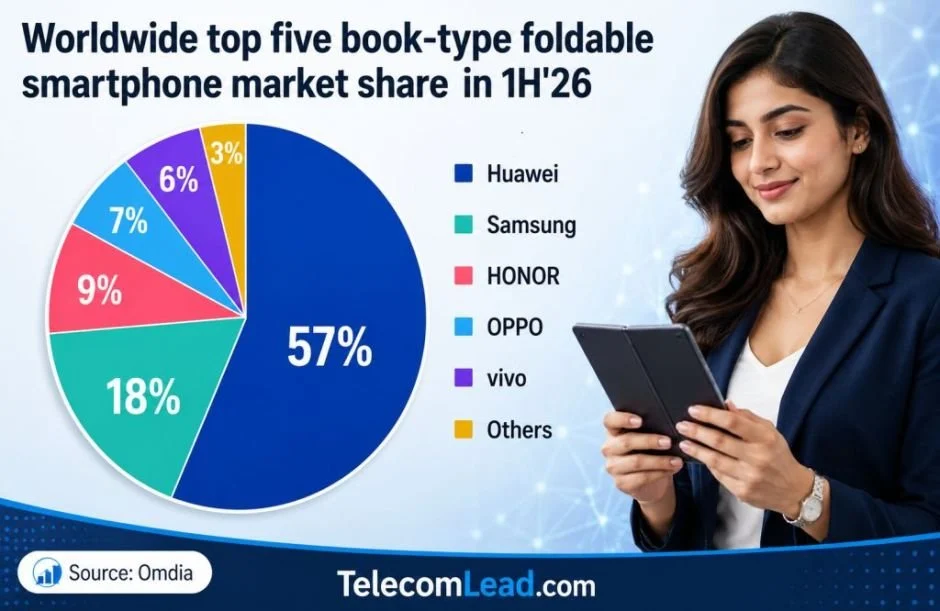
Huawei has firmly established itself as the frontrunner in the crucial "book-type" foldable smartphone segment, a design characterized by its inward-folding screen that resembles a book when closed. During the first half of 2026, the Chinese tech giant captured a commanding 57 percent of global shipments in this category. This dominance is particularly significant as book-type foldables accounted for a substantial 69 percent of all foldable shipments in the same period, highlighting their importance to the overall market.
The strength of Huawei and Samsung in this segment is paramount, as they collectively hold a staggering 75 percent share of the book-type foldable market. Samsung, while trailing Huawei, secured the second position with an 18 percent market share. Other notable players include HONOR with 9 percent, OPPO with 7 percent, and vivo with 6 percent, with the remaining 3 percent distributed among other smartphone brands.
This commanding position in book-type foldables provides Huawei with a substantial advantage as the category enters its next growth phase. However, Huawei is not resting on its laurels. The company is strategically diversifying its approach, seeking to solidify its leadership through hardware differentiation beyond conventional book-style designs. This proactive strategy was exemplified by the launch of the Huawei Pura X Max in May 2026. This device is pioneering what Omdia identifies as an emerging "wide-format" foldable smartphone category.
The Pura X Max features a shorter and wider design compared to traditional book-type foldables. This innovative form factor aims to offer a more expansive and usable viewing area while maintaining the portability inherent in foldable devices. The wider external screen is engineered to display more horizontal content, enhancing readability and multitasking. Simultaneously, the larger internal screen is optimized for immersive entertainment and enhanced productivity. Omdia suggests that this wide-format approach could become a significant growth engine for the foldable market, potentially influencing other Android smartphone manufacturers to adopt similar designs.
Samsung’s Strategic Response: A Multifaceted Approach to Market Capture
Samsung, the established leader in the broader foldable market, is responding to Huawei’s surge with a comprehensive strategy that encompasses both established and emerging form factors. The South Korean conglomerate has launched its Galaxy Z Fold8 series, a portfolio designed to cater to a diverse range of consumer needs and preferences. This series includes the Galaxy Z Fold8 Ultra, the Galaxy Z Fold8, and the Galaxy Z Flip8, demonstrating Samsung’s commitment to a multifaceted approach.
The Galaxy Z Fold8 introduces a refined and redesigned form factor, building upon Samsung’s extensive experience in the foldable space. Meanwhile, the Galaxy Z Fold8 Ultra is positioned to capture the ultra-premium market, emphasizing a focus on extreme thinness, cutting-edge performance, and enhanced productivity features. Samsung highlights the impressive specifications of the Fold8 Ultra, noting its unfolded thickness of just 4.1mm and a weight of 215g. These figures underscore the continuous efforts by foldable vendors to address consumer concerns regarding the thickness and weight of these innovative devices.
Beyond hardware innovation, Samsung is strategically employing financing programs to broaden the appeal and accessibility of its premium foldable smartphones. This tactic is crucial given the inherently higher price points associated with foldable technology. A compelling example of this strategy’s success can be seen in India, where Samsung’s latest foldable devices generated an impressive over 271,000 pre-orders within a mere 72 hours. Notably, a significant 45 percent of these pre-orders originated from Tier 2 cities and smaller markets, indicating a robust demand extending beyond India’s major metropolitan hubs.
Samsung’s aggressive financing initiatives, including a 30-month, zero-down-payment, no-cost EMI plan, allow consumers to spread the substantial cost of these premium devices over time. This approach effectively lowers the barrier to entry without necessitating drastic reductions in the headline retail prices, making foldables a more attainable option for a wider consumer base.
The Persistent Challenge of Affordability
Despite the growing interest and technological advancements, the high cost of foldable smartphones remains a significant hurdle for both Huawei and Samsung in their quest to expand the market beyond affluent early adopters. According to Omdia data, the average selling prices (ASPs) for book-type foldable smartphones remained stubbornly above $2,000 throughout 2025 and the first half of 2026. Flip-style foldables, while generally more affordable, still hovered around or above the $1,000 mark.
This price disparity is stark when compared to conventional bar-type smartphones, which maintained ASPs close to $600, and the overall global smartphone average selling price, which ranged between $600 and $650. The elevated manufacturing costs of foldable devices are attributable to a confluence of factors, including the complex engineering of flexible displays, sophisticated hinge mechanisms, specialized durable glass, and other advanced components. Consumers also face the prospect of more expensive repairs and potential hardware compromises, particularly in areas like camera performance, which may be subject to trade-offs to accommodate the foldable design.
Consequently, financing and trade-in programs are emerging as critical components of vendors’ strategies, arguably as important as hardware innovation itself, in their efforts to broaden the addressable market for foldable devices. Even other prominent players in the foldable space are maintaining premium pricing strategies. Google’s Pixel 11 Pro Fold, for instance, launched in August 2026 with a starting price of $1,899. Motorola, meanwhile, is targeting the flip-style segment with its 2026 Razr portfolio, aiming to offer a more accessible entry point into the foldable market.
Navigating the Second Growth Cycle: Data and Projections
The renewed competition between Huawei and Samsung is occurring at a pivotal moment, as the foldable smartphone industry prepares to enter what Omdia terms its "second major growth cycle." Following a period of slowing growth, the market is expected to rebound significantly.
Key Market Data and Projections:
- 2025: Global foldable smartphone shipments reached 18.2 million units, with a growth rate of only 6 percent.
- 1H26 (First Half 2026):
- Overall foldable smartphone shipments dropped 21.6 percent year-over-year to 5.1 million units.
- Flip-style foldable shipments experienced a sharp decline of 47 percent.
- Book-type foldable shipments remained broadly stable, indicating resilience.
- Huawei’s 1H26 Market Share (Book-Type Foldables):
- Huawei: 57%
- Samsung: 18%
- HONOR: 9%
- OPPO: 7%
- vivo: 6%
- Others: 3%
- 2026 Forecast: Shipments are expected to exceed 22 million units, representing growth of over 22 percent.
- 2027 Forecast: Growth is anticipated to accelerate to approximately 29 percent.
- 2028 Forecast: Shipments are projected to reach around 36 to 36.5 million units.
- 2030 Forecast: Shipments are expected to approach 45 million units, with annual growth moderating to around 6 percent.
- Overall Market Share by 2030: Foldable devices will still account for less than 3 percent of global smartphone shipments.
The resilience of book-type foldables during the challenging first half of 2026, where flip-style devices saw a significant decline, underscores the strategic importance of this form factor. Huawei’s strong performance in this segment, coupled with Samsung’s robust portfolio, positions them to capitalize on this renewed growth.
Implications for the Future of Foldable Technology
The intensified competition between Huawei and Samsung, alongside the broader industry trends, carries significant implications for the future of foldable technology. Huawei’s leadership in book-type foldables and its innovative approach with the Pura X Max’s wide-format design demonstrate a clear strategy focused on creating new, differentiated experiences. This move could set a new standard for foldable form factors, pushing competitors to explore beyond conventional designs.
Samsung’s response, with its comprehensive Galaxy Z Fold8 series and aggressive financing strategies, highlights the dual approach required to succeed in this market: offering diverse hardware options and making premium devices more accessible. The success of their financing programs in markets like India suggests a potent strategy for unlocking demand in emerging economies and beyond major urban centers.
However, the persistent challenge of affordability remains a critical factor. While hardware innovation is crucial, it is not the sole determinant of success. The industry must collectively address the underlying cost of manufacturing and find ways to bring foldable devices closer to price parity with high-end traditional smartphones. This will likely involve continued advancements in display technology, hinge mechanisms, and material science, as well as further optimization of supply chains.
Beyond hardware, software optimization and the integration of AI capabilities will play an increasingly vital role. As foldables offer larger, more versatile displays, applications and operating systems need to be tailored to take full advantage of these features, enabling seamless multitasking, enhanced productivity, and more immersive entertainment. Improved durability and a clear value proposition for consumers will also be essential for foldables to transition from a niche luxury item to a mainstream smartphone category.
The next few years will be a critical period for the foldable smartphone market. While Huawei and Samsung are leading the charge, the success of the entire ecosystem will depend on their ability to not only innovate in hardware but also to make these advanced devices more affordable, durable, and practical for a wider audience. The journey from a premium niche to broader market adoption is underway, and the ongoing battle between these tech giants will undoubtedly shape the direction of this exciting evolution in mobile technology.