The landscape of artificial intelligence is currently experiencing a paradox: while the internet is flooded with tutorials on Large Language Models (LLMs), the quality of these resources is profoundly uneven. Many guides are mere surface-level "getting started" manuals that ignore the rigorous engineering realities of modern AI, while others are relics of a bygone era—pre-dating the current standards of efficient fine-tuning and agentic workflows.
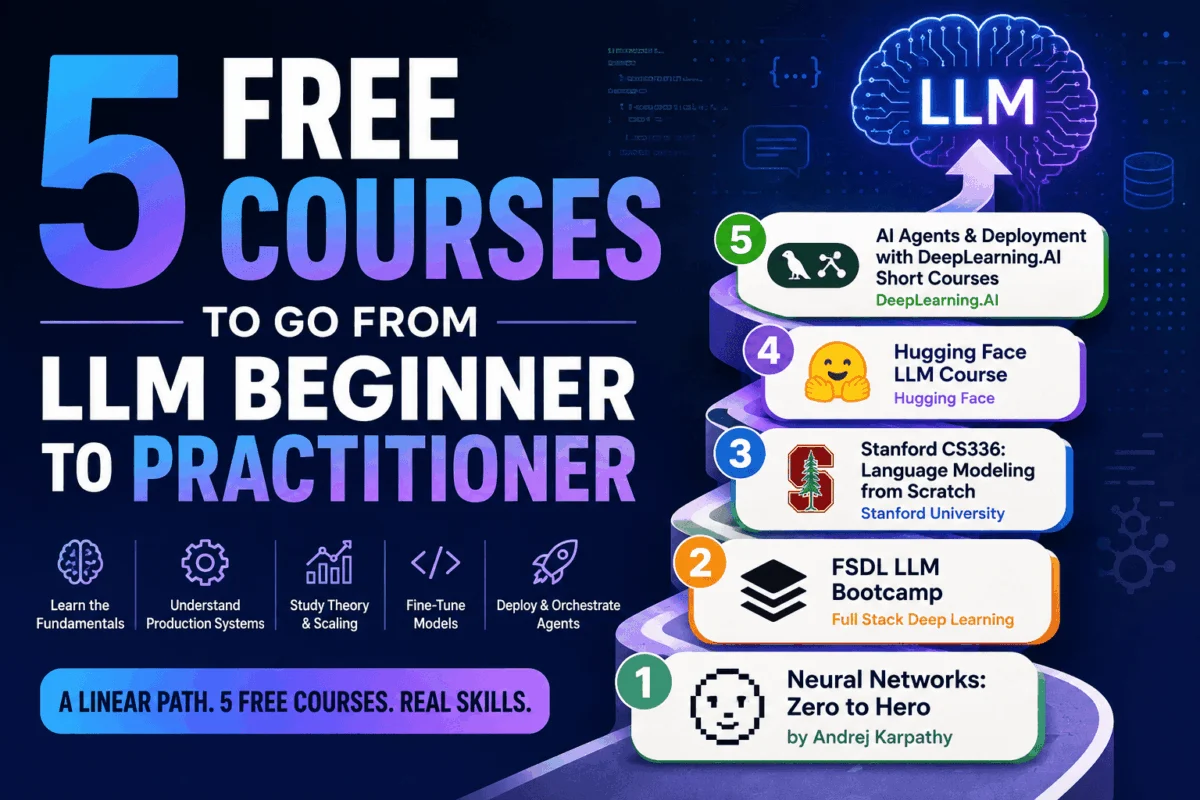
For the aspiring practitioner, this creates a significant barrier to entry. How does one progress from a novice to an engineer capable of deploying robust, scalable, and sophisticated LLM systems? This guide cuts through the noise, presenting a curated, linear pipeline of five foundational courses designed to take you from the mechanical underpinnings of neural networks to the high-level orchestration of autonomous AI agents.
The Chronology of Competence: A Structured Learning Path
To truly master LLMs, one must respect the hierarchy of knowledge. You cannot effectively fine-tune a model if you do not understand the backpropagation that creates it, nor can you build an enterprise-grade agent if you cannot navigate the latency and cost constraints of a production environment.
The following curriculum is designed as a modular progression, ensuring that each stage of learning reinforces the last.
1. Building the Foundation: Andrej Karpathy’s Neural Networks: Zero to Hero
Before interacting with massive black-box APIs, one must grasp the "atoms" of the technology. Andrej Karpathy’s Zero to Hero series stands as the gold standard for foundational education. As a founding member of OpenAI and former head of AI at Tesla, Karpathy offers an unvarnished look at how neural networks function without the crutch of high-level abstractions.
- The Approach: Students move from building
micrograd—a miniature automatic differentiation engine—to constructing a character-level language model calledmakemore. The journey culminates in the creation of a GPT-2-scale transformer, complete with a byte-pair encoding (BPE) tokenizer built from scratch. - The Takeaway: By the end of these nine lectures, backpropagation ceases to be a mysterious concept and becomes a tangible, mathematical reality that you can trace line by line.
2. Learning Production Architecture: The FSDL LLM Bootcamp
Understanding the model is only half the battle; the other half is understanding the "scaffolding" required to make it useful in a real-world setting. The Full Stack Deep Learning (FSDL) LLM Bootcamp fills the gap between theory and application.
- The Approach: This course dissects the engineering stack: prompt engineering at the systems level, LLMOps, evaluation harness design, and the difficult trade-offs between latency, cost, and accuracy.
- The Takeaway: Even though the recordings date back to 2023, the architectural principles—specifically concerning how to design a monitored, deployable AI application—remain the industry standard for production-grade engineering.
3. Going Deep on Theory: Stanford’s CS336
For those who demand academic rigor, Stanford’s CS336: Language Modeling from Scratch is the definitive resource. Taught by industry luminaries Percy Liang and Tatsunori Hashimoto, this course treats language modeling with the same gravity as an operating systems course.
- The Approach: It shifts the focus from "how to use" models to "how to build" them at scale. Students explore data provenance, tokenization strategies, scaling laws, and the complex alignment dynamics that prevent models from behaving erratically.
- The Takeaway: This is graduate-level material. It prepares practitioners for the realities of training and evaluating models on massive datasets where infrastructure costs and hardware constraints become the primary bottlenecks.
4. Developing Fine-Tuning Skills: The Hugging Face LLM Course
Practical toolsets define the modern practitioner’s day-to-day life. The Hugging Face LLM Course is a comprehensive guide to the ecosystem that dominates the open-source AI world.
- The Approach: The course covers the entire pipeline: datasets, transformer architectures, and the nuances of Supervised Fine-Tuning (SFT). It delves deeply into Low-Rank Adaptation (LoRA) via
PEFTand explores cutting-edge reasoning models using Group Relative Policy Optimization (GRPO). - The Takeaway: Mastery of the
SFTTrainerandLoraConfigworkflows allows developers to move beyond generic base models and build specialized agents tailored to specific industry domains.
5. Orchestration and Agents: DeepLearning.AI
The final frontier of the current AI wave is the "Agentic" shift—the transition from static chatbots to autonomous systems that can use tools, manage state, and execute multi-step workflows.
- The Approach: Through the DeepLearning.AI short course track, students learn to build controllable agents using
LangGraphandLangChain. The curriculum focuses on retrieval-augmented generation (RAG) and semantic routing, taught by the creators of the frameworks themselves. - The Takeaway: This is the capstone. It empowers you to bridge the gap between a model that "talks" and a system that "does."
Supporting Data: The Learning Progression Table
| Stage | Focus Area | Estimated Time |
|---|---|---|
| Mechanics | Karpathy: Zero to Hero | 20–30 hours |
| Production | FSDL LLM Bootcamp | 8–10 hours |
| Theory/Scaling | Stanford CS336 | 30–40 hours |
| Fine-Tuning | Hugging Face LLM Course | 15–20 hours |
| Agents | DeepLearning.AI Track | 10–15 hours |
Official Industry Perspective: The "Practitioner Gap"
Industry experts, including educator Vinod Chugani, emphasize that the distinction between a passive consumer of AI and a true practitioner lies in "the reps." According to Chugani, the ability to debug a training run or interpret a loss curve is far more valuable than a surface-level familiarity with prompt engineering.
The pedagogical shift reflected in these courses acknowledges that the AI industry is moving toward a professional engineering standard. As organizations transition from prototyping to production, the demand for developers who understand the underlying mechanics (Karpathy/CS336) and the operational infrastructure (FSDL/Hugging Face) will continue to outpace the supply.
Implications for Future AI Development
The implications of following this structured learning path are significant for both the individual and the broader tech ecosystem.
- Democratization of Engineering: By consolidating high-quality, free resources, the barrier to becoming a highly skilled AI practitioner is lower than ever. The gatekeeping of AI knowledge is effectively ending.
- Increased Model Utility: As more engineers move through these courses, the quality of fine-tuned and agentic applications is expected to rise. We will see a shift away from "prompt-wrapper" apps toward robust, specialized AI tools that leverage custom data and optimized training.
- Standardization of LLMOps: The adoption of these specific frameworks—such as LoRA, LangGraph, and the Hugging Face ecosystem—creates a lingua franca for AI developers. This allows for better collaboration and faster integration across different tech stacks.
Final Thoughts
To achieve proficiency in the age of AI, one must resist the urge to jump into the latest trend without first establishing a baseline of core competency. By following this pipeline—starting with the mechanics of neural networks, layering on production architecture and theory, and finishing with hands-on fine-tuning and agent orchestration—you build more than just a list of skills. You build the intuition required to navigate a field that changes daily.
As you progress through these stages, remember that the goal is not merely to finish the courses, but to internalize the logic behind the code. The practitioner who can build from the foundation up is the one who will define the next generation of AI innovation.