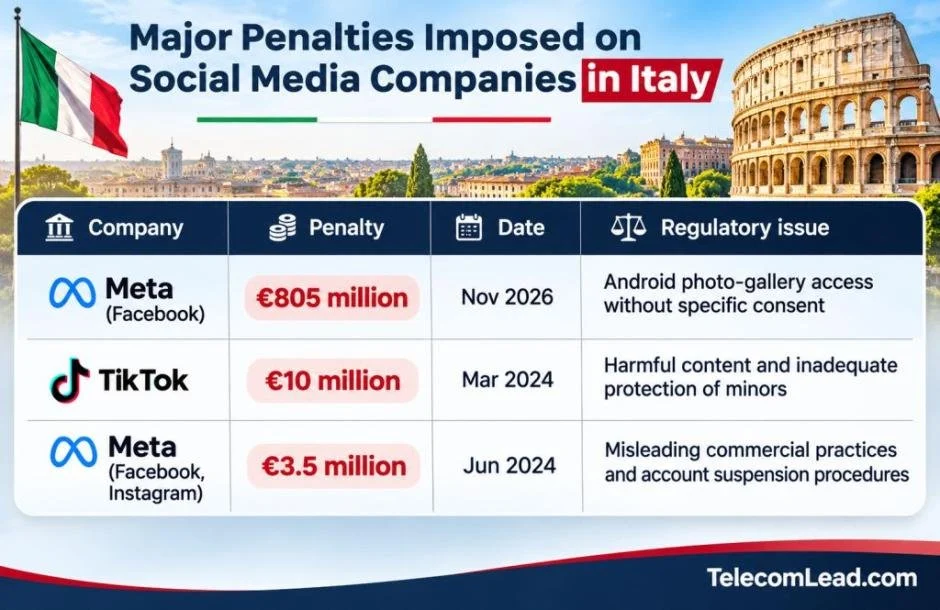
Rome, Italy – November 14, 2026 – In a landmark decision that underscores Italy’s increasingly assertive stance on digital privacy, the nation’s data protection authority has levied a staggering €805 million (approximately $887 million USD) fine against Meta Platforms. The penalty, one of the largest ever imposed on a social media giant in Italy, stems from Meta’s alleged practice of accessing photographs, videos, and associated metadata stored on Android smartphones without securing explicit user consent.
The ruling, delivered by the Italian Data Protection Authority (Garante per la protezione dei dati personali), specifically targets a feature within the Facebook application designed to offer users image and video suggestions for their posts, drawn directly from their device’s photo gallery. The authority found that Meta failed to provide sufficiently clear information to users regarding how this feature accessed their personal content and instead relied on a broad, overarching permission that encompassed multiple Facebook functionalities. This broad permission, the regulator concluded, allowed Facebook to potentially access an Android device’s entire photo archive on a continuous basis, leaving users uncertain about the extent of data being collected.
The investigation, initiated in July 2025 following a complaint lodged by a consumer protection organization in Bolzano, culminated in a comprehensive technical assessment of the Facebook application. The authority identified three core violations: the absence of specific consent for the gallery suggestion feature, inadequate disclosure of the precise purpose behind the permission request, and, critically, the feature’s activation by default. This meant that millions of Android users in Italy, estimated to be around 20 million, were potentially having their personal photo galleries accessed without a clear understanding or deliberate agreement.
A Timeline of Regulatory Scrutiny and Enforcement
The substantial penalty against Meta is not an isolated incident but rather the latest in a series of significant regulatory actions taken by Italian authorities against major social media companies. This ongoing scrutiny reflects a growing global trend of governments seeking to rein in the vast data collection and algorithmic practices of tech giants.
July 2025: The Italian Data Protection Authority officially launches its investigation into Meta’s Facebook application following a complaint from a consumer protection organization. This marks the formal beginning of the process that would eventually lead to the record-breaking fine.
March 14, 2024: In a separate but significant ruling, Italy’s competition authority, the Autorità Garante della Concorrenza e del Mercato (AGCM), imposes a €10 million fine on three ByteDance subsidiaries. This penalty was levied against TikTok for failing to adequately protect minors and vulnerable users from potentially harmful content. The AGCM’s investigation focused on TikTok’s recommendation algorithms and the dissemination of videos associated with dangerous social media challenges, such as the "French scar" challenge, finding that the platform’s system repeatedly promoted such content through algorithmic user profiling.
June 5, 2024: Italy’s competition authority again targets Meta, this time imposing a combined €3.5 million fine on Meta Platforms Ireland and Meta Platforms Inc. The penalties were issued for two distinct unfair commercial practices related to Facebook and Instagram. Users registering via Instagram’s website were found to be inadequately informed about the commercial use of their personal data. Furthermore, the AGCM identified issues with Facebook and Instagram account suspensions, citing insufficient clarity on whether these decisions were automated or human-reviewed, and inadequate information provided to users regarding their options for contesting suspensions, including a restrictive 30-day period for appeals.
July 30, 2025: Moving beyond financial penalties, Italy’s regulatory landscape expands to scrutinize Meta’s artificial intelligence initiatives. The AGCM opens an antitrust investigation into Meta’s integration of Meta AI with WhatsApp. The authority expressed concerns that Meta had introduced its AI assistant into WhatsApp without a prior user request, prominently positioning it within the messaging app’s interface and search functionality. This move raised alarms about Meta potentially leveraging its substantial WhatsApp user base to bolster its position in the nascent AI assistant market, potentially at the expense of competitors. This investigation, conducted under Article 102 of the Treaty on the Functioning of the European Union concerning the abuse of a dominant market position, is distinct from any imposed financial penalties.
November 14, 2026: The Italian Data Protection Authority delivers its landmark decision, fining Meta Platforms €805 million for unconsented access to user photos on Android devices. This ruling significantly eclipses previous penalties in both magnitude and the nature of the privacy violation.
Supporting Data and the Core of the Violation
The investigation by the Italian Data Protection Authority centered on Facebook’s "Get suggestions from gallery when browsing Facebook" feature, a functionality introduced in 2023. This feature was designed to proactively suggest photographs and videos stored on users’ Android devices as potential content for their Facebook posts.
The authority’s meticulous examination revealed a critical flaw in Meta’s approach to user consent. Italian regulators found that Facebook requested a single, broad permission that covered multiple application functions, rather than obtaining separate, granular consent specifically for accessing personal photo galleries. This practice was deemed insufficient and misleading under Italian and European Union privacy regulations, particularly Article 122 of Italy’s Privacy Code, which implements the EU’s ePrivacy rules.
The regulator highlighted three key violations that underpinned their decision:
- Absence of Specific Consent: Users were not given a clear opportunity to consent specifically to the gallery suggestion feature accessing their photos. The permission granted was generic and encompassed a wider range of app functionalities.
- Inadequate Disclosure: The purpose for requesting access to the photo gallery was not clearly and transparently communicated to users. They were not fully informed about how their images and videos would be utilized by the feature.
- Default Activation: The gallery suggestion feature was activated by default. This meant that even if users were unaware of the feature or had not explicitly agreed to it, their photo galleries could still be accessed without their active intervention.
The authority’s ruling emphasized the potential implications of such broad permissions: "a broadly granted permission could allow Facebook to access an Android device’s entire photo archive on a continuing basis, without users being able to establish precisely which information the application accessed." This lack of transparency and granular control over personal data is a cornerstone of modern privacy regulations.
In determining the €805 million penalty, the regulator took several factors into account. The estimated 20 million affected users in Italy represented a significant portion of the Italian Android user base. The duration of the infringement also played a role, as did a previous regulatory action against Meta in 2019, indicating a potential pattern of non-compliance. Furthermore, the authority cited Meta’s "insufficient cooperation during the investigation" as a contributing factor to the severity of the fine. The €805 million fine represents approximately 0.47 percent of Meta’s worldwide revenue, demonstrating the substantial financial impact of this regulatory action.
It is important to note that the investigation did not establish whether the accessed photographs or videos were used to train Meta’s artificial intelligence models, a practice Meta has consistently denied. However, the regulator explicitly reserved the right to investigate a separate feature introduced in 2026 that permits cloud processing of gallery content, indicating that Meta’s data handling practices remain under close observation.
Official Responses and Meta’s Mandated Changes
The Italian Data Protection Authority’s decision is not merely punitive; it also includes clear directives for Meta to rectify its practices. The company has been ordered to modify the gallery suggestion feature and implement a separate, explicit consent mechanism.
Key mandates include:
- Disabling the feature by default: Meta must ensure that the gallery suggestion feature is turned off by default for all users, including those who may have previously granted general photo-gallery access.
- Clear and transparent communication: The company must provide users with clear explanations regarding why Facebook requests access to their photographs and videos, how this information is used, and how they can deactivate the functionality at any time.
- Implementation timeline: Meta has been given a strict 60-day deadline to implement these changes. The company is required to report initial corrective initiatives within 30 days and communicate the full scope of measures adopted within 90 days.
Meta has not yet issued an immediate public statement in response to the fine, according to Reuters reports. This silence is not uncommon in the immediate aftermath of significant regulatory rulings, as companies typically undertake internal reviews and formulate their official responses.
Broader Implications for Social Media Data Collection
The €805 million fine against Meta represents a significant escalation in Italy’s regulatory enforcement and sends a powerful message to the entire social media industry. Unlike previous penalties that focused on commercial transparency, account management, and content recommendation systems, this latest action directly addresses the sensitive issue of accessing personal data stored on users’ devices.
This ruling underscores a growing demand for greater user control and transparency regarding how platforms collect and utilize personal information. The emphasis on explicit, granular consent for specific data access points, rather than relying on broad, all-encompassing permissions, is likely to become a benchmark for future regulatory actions across Europe and potentially globally.
Furthermore, the Italian regulator’s ongoing scrutiny of Meta’s AI integration with WhatsApp signals a proactive approach to anticipating and addressing potential abuses of market dominance in emerging technological fields. The investigation into Meta AI and WhatsApp, while not a financial penalty, highlights the increasing focus on how dominant tech companies leverage their existing user bases to gain advantages in new markets.
The Italian Data Protection Authority’s decisive action demonstrates a commitment to upholding citizens’ privacy rights in the digital age. The substantial fine imposed on Meta, coupled with the clear directives for future compliance, establishes a significant compliance obligation for Meta’s Android application and sets a precedent for how data protection authorities will approach similar violations involving access to personal device content. The separate consideration of cloud-based gallery processing also indicates that Meta’s data-handling practices will likely remain under intense scrutiny. This enforcement action by Italy is a clear signal that the era of permissive data collection by social media giants is facing a significant reckoning.