The global telecommunications landscape is undergoing a profound transformation, with mobile operators facing a significant erosion of revenue from traditional SMS-based authentication services. As enterprises increasingly embrace passwordless login, advanced verification platforms, and the power of network-based APIs, the era of SMS One-Time Passwords (OTPs) as a primary revenue driver is rapidly drawing to a close. A pivotal report by GSMA Intelligence forecasts a dramatic decline in SMS OTP traffic and spending, while simultaneously highlighting a burgeoning $14 billion revenue opportunity by 2030 in the realm of authentication and fraud prevention network APIs.
The comprehensive analysis, titled "SMS OTP and Network APIs: Defending Today’s Revenues, Capturing Tomorrow’s Growth," meticulously details the challenges and opportunities confronting mobile network operators. It underscores the urgent need for telcos to not only safeguard their existing Application-to-Person (A2P) messaging revenue streams but also to proactively cultivate new business ventures centered around Phone Number Verification, SIM Swap detection, and sophisticated network-based digital identity services. This strategic pivot is no longer a matter of foresight but a pressing imperative for sustained profitability in the evolving digital economy.
The Fading Dominance of SMS OTP: A Stark Forecast
The report paints a stark picture of the future for SMS OTP, a service that has long been a reliable, albeit increasingly vulnerable, revenue source for mobile operators. Leveraging existing mobile network infrastructure and requiring minimal incremental investment, SMS OTP has historically represented a low-hanging fruit for authentication solutions. Juniper Research, for instance, estimated that SMS constituted over 70 percent of global mobile authentication spending in 2025, illustrating its entrenched position.
However, this comfortable status quo is being systematically dismantled by a confluence of factors. The GSMA Intelligence report projects a substantial downturn in global A2P SMS authentication traffic. From a colossal 1.43 trillion messages in 2024, the volume is expected to plummet to approximately 838 billion messages by 2029, a staggering reduction of roughly 41 percent. This sharp decline in traffic is mirrored by a significant dip in enterprise spending. The projected expenditure on SMS authentication is forecast to fall from $17.6 billion in 2024 to $9.6 billion by 2029, a decrease of approximately 45 percent.
Table: SMS Authentication: A Declining Trajectory
| SMS Authentication Indicator | 2024 | 2029 Forecast | Change |
|---|---|---|---|
| Global Authentication SMS Traffic | 1.43 trillion | 838 billion | -41% |
| Enterprise SMS Authentication Spending | $17.6 billion | $9.6 billion | -45% |
This erosion of SMS OTP’s commercial viability is attributed to several persistent challenges. Artificially inflated traffic (AIT), coupled with downward pressure on SMS termination pricing, has long squeezed margins. Furthermore, the persistent threat of phishing attacks, which often exploit SMS as a vector, erodes user trust. Perhaps most significantly, the rapid proliferation and widespread adoption of over-the-top (OTT) messaging applications, such as WhatsApp, are presenting a formidable competitive challenge. In markets where enterprises already leverage these platforms for customer engagement, the allure of SMS OTP diminishes further.
The Dawn of Network APIs: A Multi-Billion Dollar Horizon
In stark contrast to the dimming prospects of SMS OTP, the GSMA Intelligence report shines a bright light on the immense potential of network authentication and fraud prevention APIs. These advanced solutions leverage the inherent capabilities of mobile networks to offer more secure, efficient, and seamless verification experiences for both enterprises and end-users. By 2030, the report forecasts that these network APIs could unlock a staggering $14 billion in annual revenue for mobile operators.
The projected revenue streams are segmented across several key areas. Phone Number Verification APIs are anticipated to generate between $4 billion and $6 billion in annual revenue by 2030. These APIs enable enterprises to confirm the validity of a mobile number and its association with the SIM card in a customer’s device without requiring the customer to manually enter any verification codes. This capability is a game-changer for a wide array of digital services, including digital banking, fintech applications, e-commerce platforms, customer onboarding processes, account recovery mechanisms, and robust fraud prevention strategies.
Beyond Phone Number Verification, a suite of other authentication and fraud prevention APIs, including SIM Swap detection and Number Recycling services, are expected to contribute an additional $8 billion to the overall revenue opportunity. The combined force of these network-based services presents a compelling and substantial new avenue for growth, with their contribution to overall mobile service revenue projected to surge from less than 0.5 percent currently to a significant 4 percent by 2030. This stands in sharp contrast to the current reality where most operators generate approximately 2-4 percent of their mobile service revenue from A2P SMS.
The Rise of GSMA Open Gateway and CAMARA APIs
The burgeoning ecosystem of network APIs is being significantly propelled by initiatives like the GSMA Open Gateway. This ambitious program aims to standardize and simplify access to operator network capabilities through programmable APIs, fostering innovation and accelerating the development of new services. As of March 2026, the initiative had achieved remarkable traction, with 86 telecom operator groups, representing over 300 mobile networks and a commanding 80 percent of global mobile connections, joining the effort.
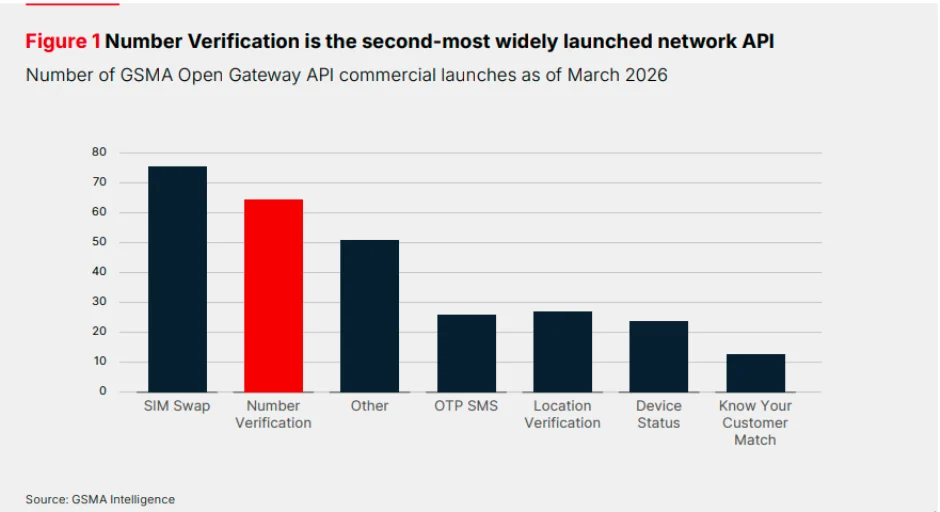
The commercialization of GSMA Open Gateway has already yielded substantial results, with more than 300 commercial deployments recorded across 65 markets, utilizing 20 CAMARA APIs. Among these, Number Verification has emerged as a leading API, accounting for 64 commercial deployments by March 2026, making it the second most widely launched network API after SIM Swap. This rapid adoption underscores the market’s readiness for these advanced authentication solutions.
The momentum continues to build. By September 2026, 20 individual European operators had already launched Version 2 of the Number Verification API, demonstrating a commitment to advancing these capabilities. Notable deployments include Vodafone’s introduction of the upgraded service in Germany, the Netherlands, and the UK in July 2026, and Aduna’s announcement of support across major US carriers AT&T, T-Mobile, and Verizon. In Indonesia, Telin reported an impressive milestone of over 1 million verification transactions through its Mobile Number Verification platform in May 2026, signaling strong market demand.
Google Firebase: A Harbinger of Competition and Cost-Effectiveness
The competitive landscape for authentication services is further illuminated by the pricing strategies of technology giants like Google. Google’s Firebase Phone Number Verification service offers developers a compelling alternative to traditional SMS-based authentication. A GSMA report, analyzing pricing from July 2026, revealed that Phone Number Verification was more cost-effective than SMS OTP in six out of seven examined countries.
Table: Firebase Phone Number Verification vs. SMS OTP Pricing (July 2026 Historical Data)
| Country | Phone Number Verification | SMS OTP |
|---|---|---|
| Finland | $0.08 | $0.08 |
| France | $0.05 | $0.07 |
| Germany | $0.09 | $0.10 |
| Indonesia | $0.14 | $0.35 |
| Malaysia | $0.08 | $0.25 |
| Pakistan | $0.11 | $0.20 |
| Spain | $0.03 | $0.04 |
Source: GSMA Intelligence, July 2026 pricing comparison. Prices are historical, not current quotations.
Google’s pricing model, which now includes volume-based rates and billing tied to successful phone number retrieval, further incentivizes developers to adopt these more efficient verification methods. The GSMA survey indicated that a significant 80 percent of telecom operators anticipate pricing their Phone Number Verification services at or below SMS OTP rates, with all surveyed channel partners expecting similar or lower pricing. This price parity or advantage is a critical factor in the accelerating shift away from SMS.
Navigating the Investment and Technology Landscape
The transition to network API-based authentication, while promising, does necessitate strategic investment and technological adaptation from mobile operators. Deploying advanced services like Phone Number Verification Version 2 requires upgrades to entitlement servers, robust network integration, sophisticated API management platforms, enhanced security protocols, and streamlined billing systems.
Estimates from Amdocs suggest that adapting legacy entitlement servers for new devices or services can incur costs ranging from $1 million to $2 million or more per development cycle, with implementation timelines spanning 12-18 months. However, the report also points to more cost-effective alternatives, including the adoption of cloud-based entitlement platforms and managed network API services.
Several technology vendors are playing a crucial role in enabling this transition. Motive, for instance, supplies entitlement server technology utilized by major operators like Telefónica. The GSMA, in collaboration with NetLync, is developing cloud-based entitlement services, while U2opia offers its managed authentication platform, SilentAuth+. Other key suppliers and partners in this evolving ecosystem include IPification, Vodafone, Aduna, Google, and Bridge Alliance.
The CAMARA Number Verification specification itself is designed to facilitate silent mobile authentication, eliminating the need for customer interaction. Version 2 further enhances this by introducing SIM-based verification over Wi-Fi, although successful deployment remains contingent on robust operating system and network support.
A Dual Strategy: Embracing the Future While Securing the Present
The GSMA Intelligence report strongly advocates for a dual-pronged strategy for mobile operators: continue supporting SMS OTP while aggressively expanding their portfolios of network authentication services. SMS OTP will retain its relevance for specific use cases, such as account recovery processes, as a fallback authentication mechanism, and for customers who continue to use basic mobile devices that may not fully support newer API-based verification methods.
However, the true growth frontier lies in network APIs. These services unlock the potential to generate revenue from authentication events that previously would not have justified the cost and complexity of sending an SMS. The GSMA’s comprehensive authentication and fraud prevention API portfolio, encompassing Number Verification, SIM Swap, Number Recycling, and other network intelligence services, offers a powerful suite of tools that can be seamlessly integrated into enterprise security applications.
A significant challenge identified in the report is enterprise distribution. Approximately 80 percent of surveyed operators cited limited enterprise awareness as a primary barrier to the adoption of Phone Number Verification. To address this, the GSMA Open Gateway initiative has attracted over 60 channel partners by March 2026, including hyperscalers, aggregators, and communications platform providers, who are crucial in bridging the gap between operators and enterprise customers.
In conclusion, the telecommunications industry stands at a critical juncture. Mobile operators must navigate the projected decline in SMS OTP spending, a decrease from $17.6 billion in 2024 to $9.6 billion in 2029, by strategically investing in and promoting their network authentication and fraud prevention services. The potential to generate approximately $14 billion annually by 2030 from these innovative solutions offers a compelling vision for the future, one that promises enhanced security, improved user experience, and sustained revenue growth in the rapidly digitizing world. The time for decisive action and strategic adaptation is now.