Gandhidham, Gujarat – September 2026 – Reliance Jio has cemented its position as the leading mobile network provider in Gujarat, demonstrating exceptional performance across key metrics including data speed, network coverage, and voice call reliability. A comprehensive drive test, conducted by the Telecom Regulatory Authority of India (TRAI) in July 2026, along the critical Gandhidham–Santhalpur section of National Highway 27 (NH-27) has revealed a significant performance gap, with Jio consistently outperforming its competitors, Bharti Airtel, Vodafone Idea (Vi), and Bharat Sanchar Nigam Limited (BSNL).
The TRAI’s rigorous testing, spanning 149.1 kilometers of the vital highway, paints a clear picture of the current mobile network landscape in this strategically important region. The study, which meticulously assessed network coverage, dropped calls, call-silence instances, and mobile download and upload speeds across all available network technologies (2G, 3G, 4G, and 5G), underscores Jio’s technological prowess and its commitment to delivering a superior user experience.
TRAI Drive Test: A Deep Dive into Network Performance
The independent drive test, executed on July 1, 2026, aimed to provide an objective assessment of the mobile network performance experienced by consumers traveling along the NH-27. This particular stretch of highway is crucial for both freight and passenger movement, making reliable mobile connectivity a necessity for businesses and individuals alike. The TRAI’s methodology involved collecting extensive data points to ensure a statistically significant and accurate representation of the network conditions.
The tests evaluated four primary areas:
- Network Coverage: The ability of the network to maintain a signal across the entire tested route.
- Voice Call Reliability: Measured by the incidence of dropped calls and instances of silence during active conversations.
- Mobile Data Speeds: Both download and upload speeds, critical for a seamless internet experience.
The findings indicate a pronounced disparity between the operators, with Reliance Jio emerging as the undisputed leader in multiple categories.
Reliance Jio Sets New Benchmarks in Data Speeds
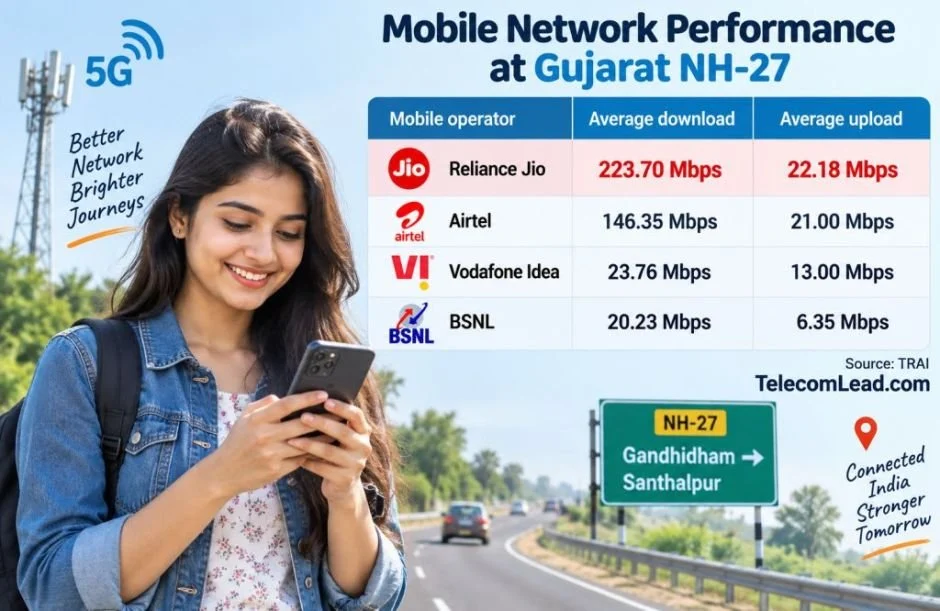
The most striking revelation from the TRAI drive test is Reliance Jio’s commanding lead in mobile data speeds. The operator recorded an astonishing average download speed of 223.70 Mbps, a figure that significantly eclipses its competitors. This exceptional performance not only highlights Jio’s robust infrastructure but also its ability to deliver high-speed data services that far exceed user expectations.
Bharti Airtel secured the second position, achieving an impressive average download speed of 146.35 Mbps. While a strong performance, it still trails Jio by a considerable margin. Vodafone Idea (Vi) and BSNL lagged significantly behind, with Vi managing an average download speed of 23.76 Mbps and BSNL registering the lowest speed at 20.23 Mbps.
To put these figures into perspective, Jio’s download speed was approximately 53 percent faster than Airtel’s. Compared to Vodafone Idea, Jio’s performance was more than nine times superior, and it was approximately eleven times faster than BSNL’s. This substantial difference is attributed, in part, to the advanced network capabilities of Jio and Airtel, both of which benefit from infrastructure supporting up to 5G technology. Vi was also tested in an auto-selection mode capable of accessing 5G, but its performance did not match that of the leading operators.
Superior Upload Speeds Bolster Comprehensive Data Experience
The competition tightened considerably when it came to upload speeds, though Jio again maintained its leadership. Reliance Jio recorded the highest average upload speed at 22.18 Mbps, narrowly ahead of Bharti Airtel, which clocked in at 21.00 Mbps. Vodafone Idea achieved an upload speed of 13.00 Mbps, while BSNL recorded 6.35 Mbps.
These upload speeds are crucial for users engaging in activities such as video conferencing, uploading large files, and social media sharing. Jio’s superior performance in this area further enhances its appeal to users who rely heavily on these functions.
Exceeding Declared Speeds: A Testament to Network Prowess
The TRAI report also drew a compelling comparison between the measured speeds and the typical speeds declared by the operators. In this regard, Reliance Jio delivered a truly outstanding performance. The company had declared typical download and upload speeds of 15 Mbps and 7 Mbps, respectively. However, the drive test revealed that Jio’s actual measured averages soared to an impressive 223.70 Mbps for downloads and 22.18 Mbps for uploads. This indicates that Jio is not only meeting but significantly exceeding its self-reported performance benchmarks.
Bharti Airtel also demonstrated strong performance relative to its declared speeds, with measured download speeds of 146.35 Mbps and upload speeds of 21 Mbps, compared to its declared figures of 18 Mbps download and 8 Mbps upload. Vodafone Idea declared 15 Mbps download and 8 Mbps upload, while BSNL declared 5 Mbps download and 3 Mbps upload. The substantial discrepancy between declared and measured speeds for Jio and Airtel highlights their advanced network capabilities and efficient spectrum utilization.
Unparalleled Coverage: Jio Minimizes Signal Blackspots
Network coverage is a critical factor for any mobile user, particularly along extensive highway routes. The TRAI drive test revealed that Reliance Jio offers the most consistent and reliable coverage along the Gandhidham–Santhalpur NH-27 section.
TRAI collected a total of 17,324 data samples for Jio. Of these, a mere 225 samples indicated poor signal strength, representing an exceptionally low incidence of approximately 1.3 percent. This demonstrates Jio’s commitment to providing seamless connectivity even in areas that might pose challenges for other networks.
Bharti Airtel, while performing well in other areas, recorded a higher incidence of poor signal strength. Out of 17,251 samples, 1,253 showed a weak signal, equating to around 7.3 percent. Vodafone Idea was not far behind Airtel, with 1,239 poor-signal samples out of 17,241, or approximately 7.2 percent.
Bharat Sanchar Nigam Limited (BSNL) presented the most significant challenges in terms of coverage. Out of its 14,269 samples, a substantial 2,246 samples, or approximately 15.7 percent, exhibited poor signal strength. More critically, BSNL recorded 1,517 samples with limited service or no coverage whatsoever. In stark contrast, Airtel, Jio, and Vi recorded zero instances of limited service or no coverage during the entire test period. This critical finding underscores Jio’s superior network planning and deployment in ensuring uninterrupted service.
NH-27 Coverage Performance Snapshot:
| Operator | Total Samples | Poor Signal | Poor-Signal Share | No Coverage/Limited Service |
|---|---|---|---|---|
| Jio | 17,324 | 225 | 1.3% | 0 |
| Vi | 17,241 | 1,239 | 7.2% | 0 |
| Airtel | 17,251 | 1,253 | 7.3% | 0 |
| BSNL | 14,269 | 2,246 | 15.7% | 1,517 |
These figures unequivocally demonstrate that Jio offers the most robust and dependable coverage along the tested highway section, minimizing the frustration of signal loss for its users.
Voice Call Reliability: Zero Dropped Calls for Jio and Airtel
In an era where seamless communication is paramount, voice call reliability is a non-negotiable aspect of mobile network performance. The TRAI drive test highlighted a significant distinction among the operators in this critical area.
Both Reliance Jio and Bharti Airtel emerged as leaders, achieving the remarkable feat of zero dropped calls. Jio successfully established 86 calls during the test with no drops, while Airtel established 85 calls, also without a single drop. This exceptional performance from both operators signifies a high level of network stability and call handling capability.
Vodafone Idea experienced a minor setback, recording one dropped call out of 86 successfully established calls, resulting in a drop rate of approximately 1.2 percent. BSNL, unfortunately, faced the most significant challenges, recording 11 dropped calls from 76 successfully established calls, translating to a substantial drop rate of approximately 14.5 percent. This performance metric further emphasizes Jio’s and Airtel’s superior voice call quality.
Minimizing Call Silence: Jio Leads in Clearer Conversations
Beyond dropped calls, the TRAI also assessed instances of call silence lasting more than three seconds, a phenomenon that can severely disrupt conversations and cause user frustration. Here too, Reliance Jio demonstrated its commitment to superior voice quality.
Jio recorded an exceptionally low number of silence instances, with only one such instance occurring across 82 established calls. This near-perfect performance ensures that users experience clear and uninterrupted conversations.
Bharti Airtel recorded seven silence instances across 86 calls, while Vodafone Idea registered five instances across 83 calls. BSNL, unfortunately, recorded the highest number of silence instances, with nine occurrences across 67 established calls. Jio’s minimal call-silence instances further solidify its position as a provider of high-quality voice communication.
Implications of the Gujarat NH-27 Test Results
The findings from the July 2026 TRAI drive test along the Gandhidham–Santhalpur NH-27 route offer valuable insights into the competitive landscape of mobile network services in Gujarat. The results provide a clear benchmark for consumers and industry stakeholders alike, highlighting the strengths and weaknesses of each operator in a real-world scenario.
Reliance Jio’s dominant performance across multiple critical parameters – fastest download and upload speeds, lowest poor-signal incidence, zero dropped calls, and minimal call-silence instances – positions it as the undisputed leader for mobile connectivity along this vital highway. This comprehensive superiority is a testament to Jio’s ongoing investments in network infrastructure and its strategic focus on delivering an unparalleled customer experience.
Bharti Airtel emerges as a strong second-place contender, showcasing excellent performance in speed and voice call reliability, and demonstrating significant improvements in its network. Its consistent efforts to enhance its network capabilities are evident in its competitive results.
Vodafone Idea, while facing some challenges in data speeds and coverage compared to the leaders, has managed to maintain continuous service and a low dropped call rate. The company will need to focus on upgrading its network infrastructure to compete more effectively in terms of data speeds and coverage consistency.
BSNL, while offering a vital service, faces significant challenges in terms of data speeds, coverage reliability, and voice call stability on this particular route. The operator will need to undertake substantial network modernization efforts to bridge the performance gap.
It is important to note, as TRAI cautions, that independent drive test findings represent operator performance only in the tested area and at the specific date and time of testing. However, the detailed data collected from the Gujarat NH-27 test provides a robust and credible snapshot of mobile network performance. For consumers, these results serve as a crucial guide when making informed decisions about their mobile service providers, especially for those who frequently travel this important national highway. For the operators, this serves as a clear indicator of areas requiring further investment and strategic focus to meet the evolving demands of mobile users in India. The continued commitment to such independent assessments by TRAI is vital for fostering a competitive and customer-centric telecommunications sector.