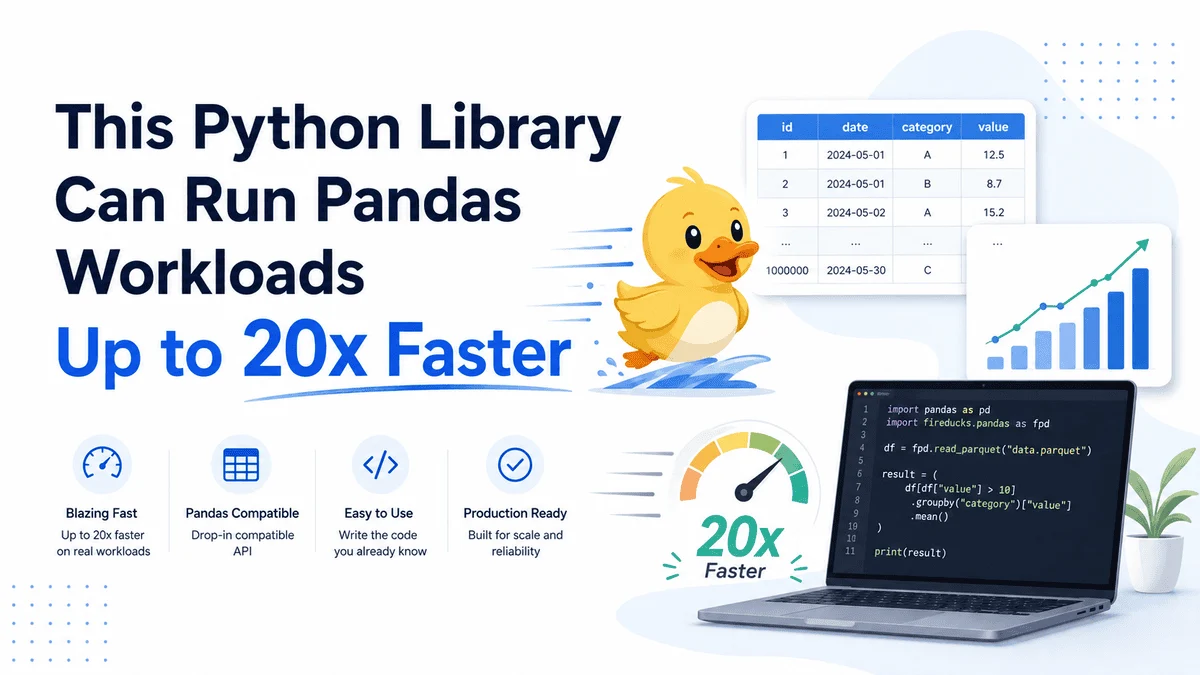
For over a decade, Pandas has stood as the undisputed heavyweight champion of the Python data ecosystem. It is the first tool a data scientist reaches for when tasked with cleaning, transforming, or analyzing tabular data. Its intuitive API, vast community support, and seamless integration with libraries like Scikit-Learn and Matplotlib have made it a cornerstone of modern analytics.
However, as datasets transition from thousands of rows to tens of millions, the limitations of Pandas become painfully apparent. Because Pandas is designed for single-core execution and follows an eager execution model, operations that are instantaneous on small files—such as sorting, grouping, or joining—can stretch into agonizing wait times on large-scale data.
Enter FireDucks, a high-performance, compiler-accelerated DataFrame library developed by the engineers at NEC. By marrying a familiar Pandas-compatible API with advanced backend optimizations like lazy execution and multi-threaded processing, FireDucks promises to bridge the performance gap for data professionals. Recent benchmarks suggest that this library can accelerate common workloads by up to 20x, sparking a significant conversation about the future of high-performance Python data processing.
The Technical Genesis: How FireDucks Outpaces Pandas
The fundamental architectural difference between Pandas and FireDucks lies in their execution philosophies. Pandas operates on an "eager" basis; every command is executed immediately as it is written. While this makes for excellent debugging and interactive development, it is inefficient for complex workflows. It prevents the engine from seeing the "big picture" of the data processing pipeline, forcing it to perform redundant intermediate calculations and memory allocations.
FireDucks, conversely, utilizes a lazy execution model. When a user executes a chain of commands—filtering a dataset, joining it with a lookup table, and grouping by a specific feature—FireDucks does not immediately perform these actions. Instead, it captures the series of operations to construct a logical execution plan. Once the user requests an output (such as calling print() or saving to a file), the engine analyzes the plan, optimizes the sequence of operations to minimize overhead, and parallelizes the task across all available CPU cores.
This approach—similar to the internal mechanics of Apache Spark or DuckDB—allows FireDucks to bypass the bottlenecks of single-threaded Python execution. By offloading the heavy lifting to a compiler-accelerated backend, FireDucks transforms standard Python code into a high-performance machine.
Chronology: From Academic Research to Enterprise Adoption
The development of FireDucks by NEC represents a strategic pivot toward addressing the "Big Data" needs of enterprise users who prefer the simplicity of the Python data stack over more complex distributed computing frameworks.
- Early Development: NEC began researching compiler-based acceleration for Python to improve the efficiency of their internal data analysis workflows. The goal was to maintain the simplicity of the Pandas API while leveraging the massive parallel processing power of modern server-grade CPUs.
- The Alpha Release: Upon its initial public release, FireDucks gained immediate traction among power users who were frustrated by the slow performance of Pandas on datasets exceeding the 5-million-row threshold.
- Performance Validation: Independent benchmarks began appearing throughout 2023 and 2024. These tests, ranging from personal blog experiments to enterprise-grade validations, consistently showed that for compute-intensive tasks, FireDucks significantly outperformed standard Pandas.
- Corporate Validation: The technology reached a milestone when the Toyota Technical Development Corporation (TTDC) incorporated it into their internal AI framework. Their internal audit reported a 60% reduction in data-analysis time, signaling that FireDucks was not merely a niche hobbyist tool but a viable solution for production-grade data pipelines.
Empirical Evidence: Benchmarking the Performance Gap
To understand the actual impact of FireDucks, a rigorous comparative analysis was conducted. Using a 10-million-row dataset and a 2-million-row lookup table, seven distinct data-processing workloads were measured. The goal was to provide a realistic simulation of a production data pipeline.
The Methodology
Each test involved a warm-up phase to ensure JIT (Just-In-Time) compiler stability, followed by five measured iterations to calculate the median execution time. Crucially, the FireDucks code utilized explicit materialization (._evaluate()) to ensure that the benchmark captured the total time from start to finish.
Performance Breakdown
The results, summarized below, highlight where FireDucks excels:
| Operation | Pandas Median | FireDucks Median | Speedup |
|---|---|---|---|
| Parquet Read | 0.3243s | 0.1220s | 2.66x |
| Filter Columns | 0.5159s | 0.0444s | 11.63x |
| Low-Cardinality Groupby | 0.9061s | 0.0587s | 15.44x |
| High-Cardinality Groupby | 2.1634s | 0.3765s | 5.75x |
| Sort Full Dataset | 15.2674s | 0.7352s | 20.77x |
| Join (2M rows) | 1.6886s | 0.5271s | 3.20x |
| Chained Pipeline | 1.0418s | 0.1754s | 5.94x |
The data is telling. Sorting, which is notoriously slow in standard Pandas, saw a massive 20.77x improvement. Filtering and grouping, which are core components of any ETL (Extract, Transform, Load) task, also saw double-digit speed improvements. Even in more complex scenarios, like joining massive tables, FireDucks consistently maintained a significant lead.
Official Responses and Industry Outlook
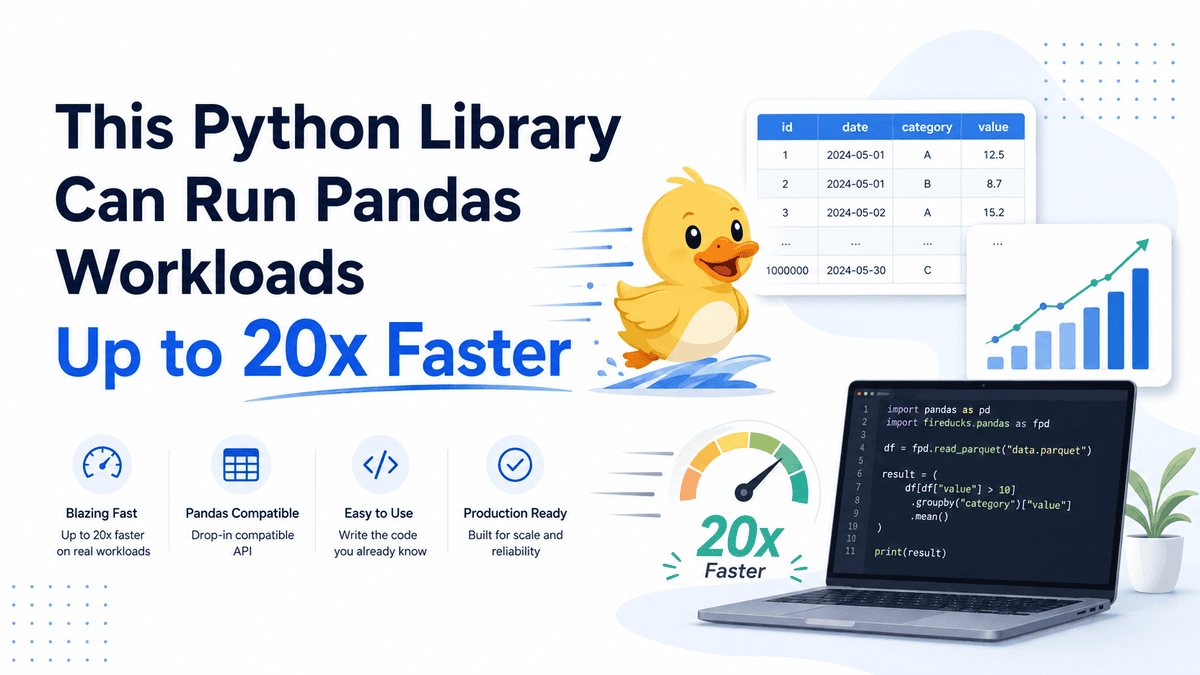
The industry reaction has been largely positive, centered on the library’s "drop-in" nature. Because the API is designed to be highly compatible with Pandas, the barrier to entry is virtually zero. Developers are not asked to learn a new syntax or migrate to a SQL-based language; they are simply asked to change a single import statement: import fireducks.pandas as pd.
However, industry experts caution against viewing FireDucks as a universal panacea. NEC has been transparent about the fact that FireDucks is not a complete 1:1 replacement for every niche function in the sprawling Pandas library. Users who rely heavily on extremely obscure Pandas methods or specific third-party integrations may encounter compatibility hurdles.
Nonetheless, for the vast majority of standard data science tasks—filtering, aggregating, and joining—the consensus is that FireDucks offers a low-risk, high-reward optimization strategy.
Implications for Data Engineering and Data Science
The emergence of libraries like FireDucks has profound implications for the data science field:
1. Reduced Computational Costs
In an era where cloud compute costs can balloon quickly, performance is no longer just a technical metric; it is a financial one. By reducing execution time by an average of 7x, organizations can significantly shrink their AWS or GCP bills associated with large-scale data processing jobs.
2. Accelerated Experimentation Cycles
Data science is an iterative process. When a modeler can run a complex pipeline in seconds rather than minutes, they can iterate faster, test more features, and arrive at insights in a fraction of the time. This "feedback loop" speed is often the difference between a successful project and one that loses momentum.
3. Democratization of High-Performance Computing
Historically, processing large datasets required a deep knowledge of distributed systems like Spark or Dask. FireDucks allows a standard data analyst, working on a single laptop, to achieve performance speeds that were previously reserved for multi-node clusters. It brings the power of "Big Data" engineering to the desktop.
4. The Future of the Python Ecosystem
FireDucks is part of a broader trend of "modernizing" the Python data stack. As projects like Polars, DuckDB, and FireDucks compete to solve the inherent speed limitations of early-generation data tools, the end user benefits from a more robust, efficient, and scalable environment.
Conclusion: Is It Time to Switch?
For any professional working with datasets in the millions of rows, the answer is a resounding yes. FireDucks represents a pragmatic evolution of the Pandas experience. It respects the years of muscle memory built by the data science community while providing the modern, multi-threaded, and compiler-optimized performance required by modern data volumes.
While you may not see a 20x speedup in every single script, the geometric mean of 7x improvement is transformative. By simply swapping your import, you gain access to a library that treats your data with the efficiency it deserves. As the ecosystem continues to mature, tools like FireDucks will likely become standard in the data scientist’s toolkit, ensuring that Python remains the dominant language for high-performance analytics in the years to come.
If you are ready to experiment, installation is as simple as pip install -U fireducks. It is a small change that could save you hundreds of hours of waiting time in the long run.