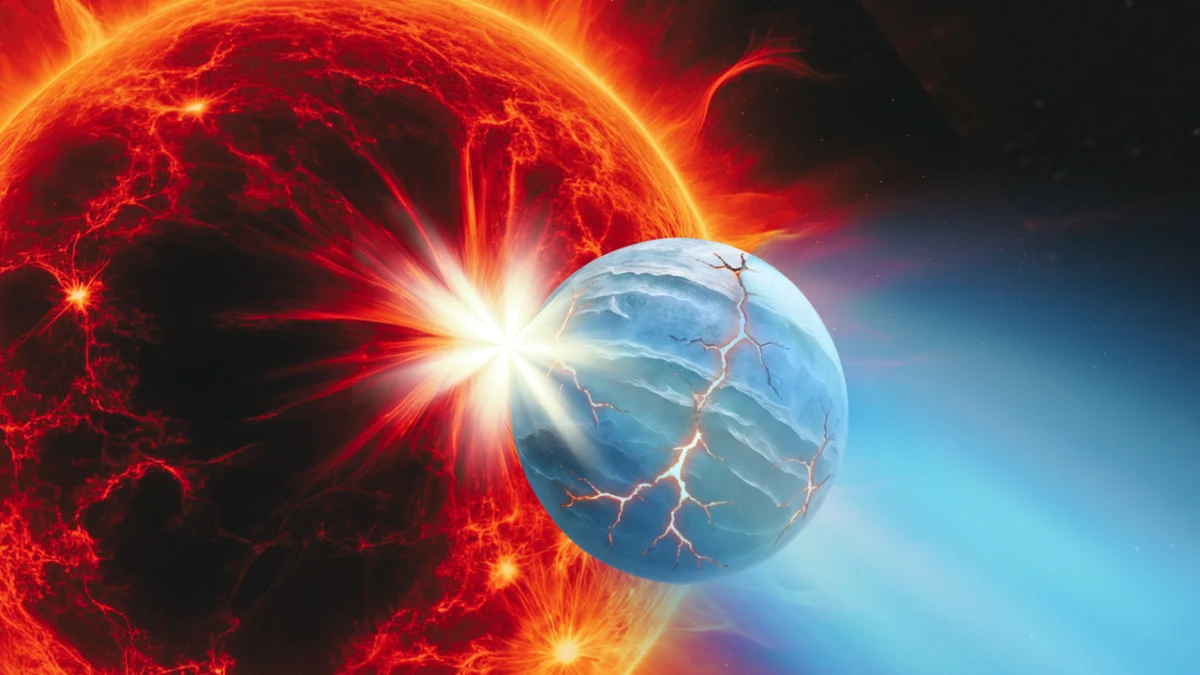
In the vast, silent theater of the Milky Way, astronomers have recently cast a spotlight on a celestial tragedy in the making. A newly discovered exoplanet, designated HD 176071 b, is currently locked in a "death spiral" around its host star. Located approximately 335 light-years from Earth, this world is not only a scientific curiosity due to its composition—which suggests it is roughly 50% water—but also because of the innovative, unconventional methods researchers used to detect it.
The Anatomy of an Alien Ocean World
HD 176071 b is a world of superlatives and extremes. With a radius approximately 2.5 times that of Earth and a mass nearly 8.5 times greater, it falls into the category of "super-Earths" or "sub-Neptunes." However, its density profile reveals a startling reality: the planet is likely composed of half rock and half water.
Orbiting at a scorching proximity of just 1.5 million miles from its host star—a mere 1.6% of the distance between the Earth and our sun—the planet completes a full orbital revolution in just 14 hours. In such a high-temperature environment, the water on this world does not exist in the familiar liquid oceans of Earth. Instead, it likely exists in exotic phases, potentially as supercritical fluids or dense, steam-shrouded atmospheres, making it a definitive, albeit hellish, "hot water world."
A Chronology of Discovery: From Kepler to TESS
The story of HD 176071 b is one of technological evolution. The search for exoplanets has long been dominated by the "transit method," which relies on a planet passing directly between its star and Earth, causing a measurable dip in starlight. However, this method is highly restrictive, as it only works for planets whose orbital planes are perfectly aligned with our line of sight.
The discovery of HD 176071 b began with archival data from the Kepler Space Telescope, which was then cross-referenced with modern, high-precision observations from NASA’s Transiting Exoplanet Survey Satellite (TESS). The researchers, led by Sylvain N. Breton of the Italian National Institute for Astrophysics (INAF), noticed something that had been missed in earlier, less sensitive analyses: an unexpected "phase shift" in the modulation of the reflected light coming from the system.
This phase shift proved that the planet does not transit its star from our perspective. Instead, the researchers were able to detect the planet by measuring the subtle, rhythmic changes in light as the planet’s tidally locked hemispheres rotated in and out of view. By comparing data collected six years apart, the team confirmed that the light fluctuations were not noise, but the signature of a dynamic, evolving atmosphere.
Supporting Data: Why This World Defies the "Neptunian Desert"
One of the most compelling aspects of HD 176071 b is its location within what astronomers call the "Neptunian Desert." This is a region in orbital space very close to stars where Neptune-sized planets are rarely found. The prevailing theory suggests that the intense radiation from a host star should strip away the gaseous layers of such planets, leaving behind only a small, rocky core.
HD 176071 b, however, appears to be an outlier. Despite the intense stellar wind and radiation it faces, it has retained a robust and changing atmosphere. Breton’s team observed that the light reflection modulation is inconsistent with a static, barren rock. Rather, it indicates the presence of dense, highly reflective clouds that form, drift, and dissipate along the planet’s terminator—the line separating the permanent day-side from the permanent night-side.
Tidal Forces and the Path to Oblivion
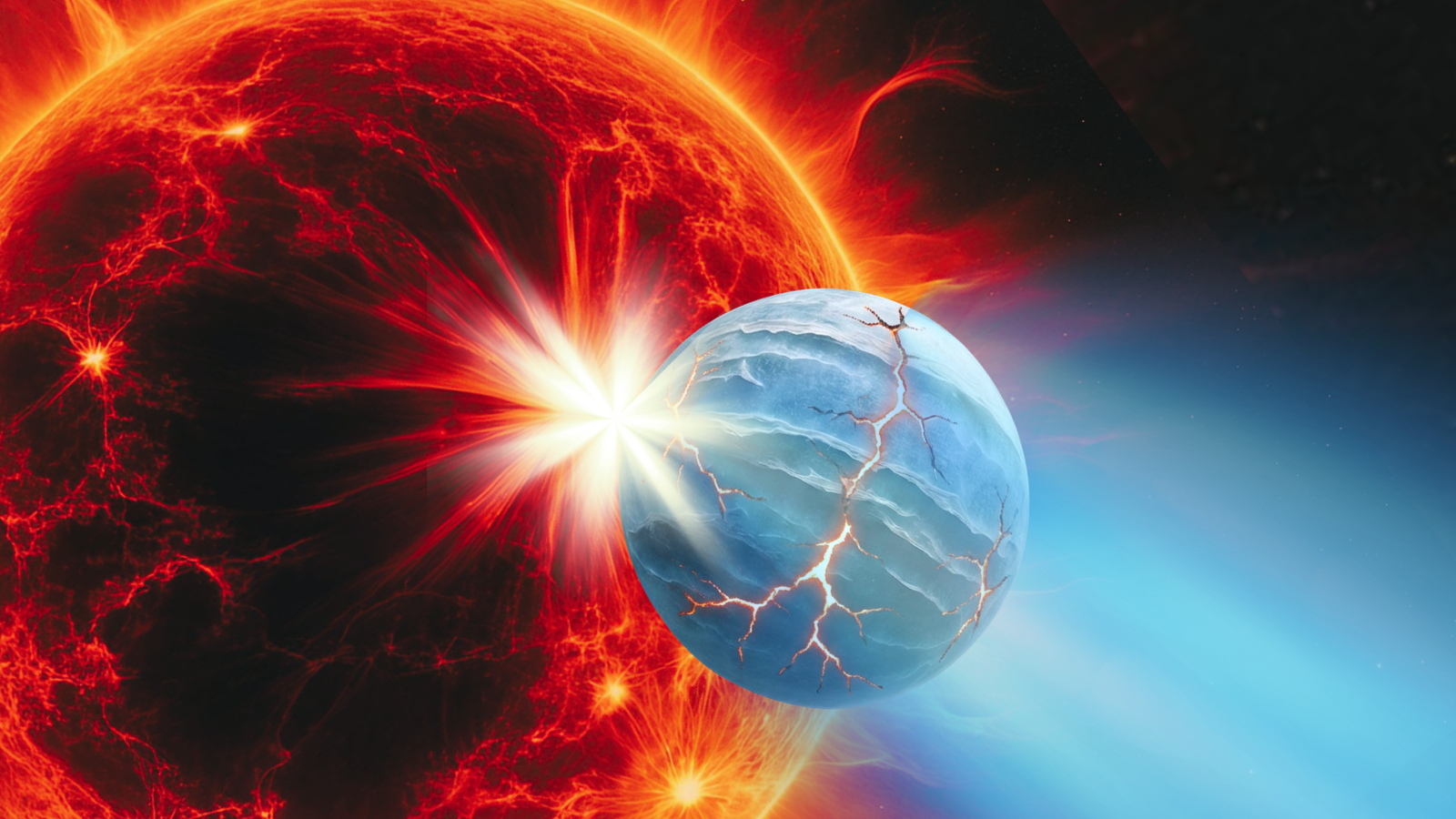
The planet’s fate is as dramatic as its environment. Because it orbits so close to its parent star, it is subjected to immense tidal forces. These gravitational interactions are not merely stretching the planet’s crust; they are bleeding off its orbital energy. This causes the planet to spiral slowly inward, destined for a final, violent collision with its host star. While this process is slow on a human timescale, in cosmic terms, it is a rapid descent toward destruction.
Perspectives from the Scientific Community
The research, published in the journal Astronomy & Astrophysics on August 25, has sent ripples through the exoplanetary research community. It validates a new, "non-transit" detection paradigm that significantly expands the search area for habitable or interesting worlds.
"Thanks to the dataset acquired with the HARPS-N instrument on the Galileo National Telescope, we have managed to overcome this geometric obstacle," said Sylvain N. Breton in an official statement. "By measuring with extreme precision how the light reflected by the planet varies throughout its orbital journey, we can not only detect these elusive worlds, but also begin to characterize their structure and atmosphere, opening a fundamental window onto previously almost inaccessible planetary populations."
The ability to analyze a planet that does not transit represents a major "level-up" for modern astronomy. Previously, scientists were essentially "blind" to the vast majority of planets that did not cross their stars from our perspective. This new technique effectively turns the entire sky back into a viable hunting ground.
Implications: The Future of Exoplanet Characterization
The discovery of HD 176071 b carries profound implications for our understanding of planetary evolution. If a planet can survive in the "Neptunian Desert" while retaining a significant water-rich atmosphere, it forces theorists to revisit their models of atmospheric stripping and planetary formation.
1. Expanding the Census
NASA’s current catalog of confirmed exoplanets sits at over 6,000, but the vast majority were discovered via the transit method. By utilizing phase-modulation of reflected light, we can now potentially identify thousands of "invisible" planets that were previously ignored.
2. Atmospheric Dynamics
The "living and changing" nature of the atmosphere on HD 176071 b demonstrates that even in extreme environments, planetary weather systems can be complex. This gives scientists a laboratory to test fluid dynamics and atmospheric chemistry under conditions impossible to replicate on Earth.
3. The Lifecycle of Planets
The study of HD 176071 b offers a rare look at the end-stage of a planet’s life. Understanding how tidal forces influence the stability of water-rich worlds will help astronomers better predict the longevity of other systems, including those that might harbor life in more temperate zones.
Conclusion: A Window Into the Unknown
HD 176071 b is more than just a doomed world; it is a pioneer in the field of observational astronomy. Its discovery proves that we are no longer limited to finding only those planets that happen to cross our path. By reading the subtle flickers of light reflected from the dark, the scientific community is beginning to pull back the curtain on the thousands of silent worlds that have been hiding in the glare of their parent stars since the dawn of time.
As we look toward the next generation of space telescopes, the techniques refined by Breton and his colleagues will be essential. They provide a new key to unlocking the secrets of the galaxy, one reflection at a time, ensuring that even the most fleeting and doomed worlds contribute to our broader understanding of the universe. While HD 176071 b may eventually be consumed by its star, the knowledge gained from its study will endure, serving as a beacon for future discoveries in the deep, dark reaches of space.