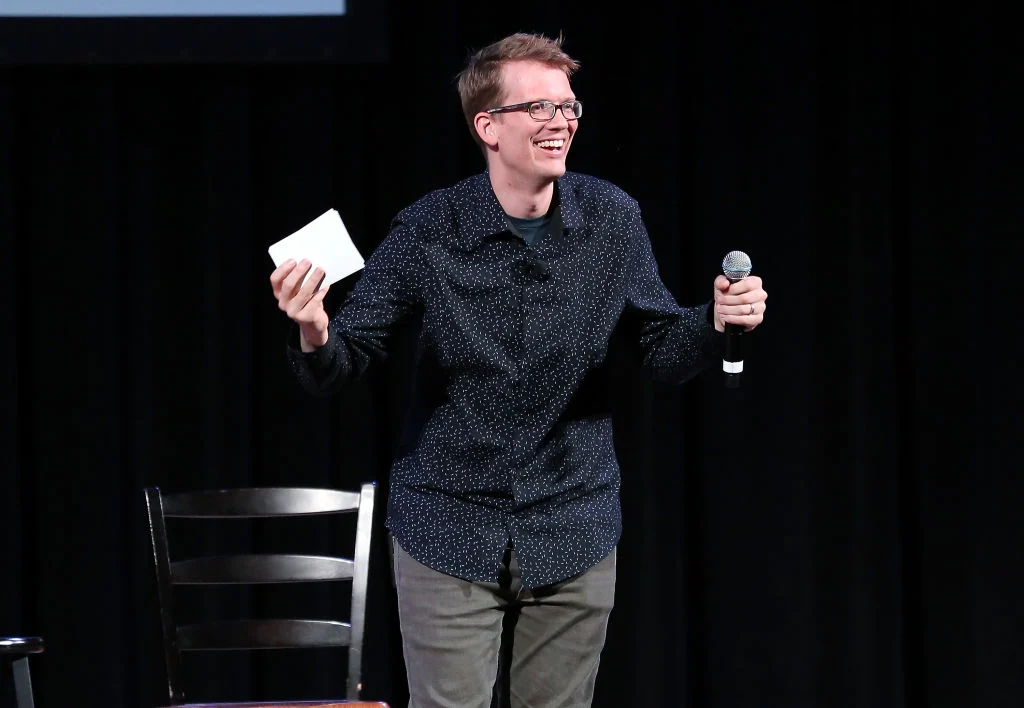
In the hyper-accelerated landscape of modern digital content creation, the line between "efficiency" and "authenticity" has never been thinner. For Hank Green—the polymath novelist, comedian, and educator who has built a 3.2-million-subscriber empire on YouTube—that line was crossed in a moment of unintended transparency. Following a wave of backlash sparked by a stray, automated-sounding phrase in an educational video, Green has issued a series of candid apologies, marking a significant pivot in his career and sparking a broader conversation about the role of Large Language Models (LLMs) in the creative arts.
The Catalyst: A Glitch in the Script
The controversy erupted during a recent installment of an educational video hosted on the channel Complexly. Viewers, known for their meticulous attention to detail, quickly noticed a jarring incongruity: in the middle of a dense informational segment, Green uttered the phrase, "I appreciate the pushback."
The phrasing struck a chord of dissonance with the audience. To the seasoned internet viewer, the tone was unmistakable—it carried the mechanical, conciliatory "hallmark" of a ChatGPT response. The immediate suspicion was that Green had not only utilized AI to assist in his scriptwriting but had, in a lapse of focus, accidentally read the chatbot’s meta-commentary aloud as part of his final dialogue.
This minor slip became the focal point for a larger, simmering frustration among his fanbase: the fear that the creator they had trusted for years to provide human-centric, thoughtful synthesis was becoming increasingly reliant on the very algorithms that many of his followers view with deep skepticism.
Chronology of a Public Apology
The trajectory of the ensuing controversy moved from public confusion to a deliberate, multifaceted apology.
- The Initial Outburst: Following the video’s release, the online discourse turned hostile. Initially, Green attempted to address the issue on X (formerly Twitter). He admitted to working "under a ton of pressure" and confirmed he had used ChatGPT for research purposes. Regarding the specific "pushback" phrase, he claimed it was an authentic response to a guest appearing in the video.
- The Deletion and Reflection: Recognizing that his initial defensive stance on X did not resonate with his audience, Green deleted the post. He moved to a more reflective space—the Reddit community r/nerdfighters—to issue a more substantive mea culpa.
- The Admission of "Dilution": In his Reddit post, Green expressed feeling "mortified" that he had let his audience down. He conceded that while his "takes" and final words remained his own, his reliance on AI to structure and research his work had effectively "diluted" his personal process.
- The Strategic Shift: Green announced a fundamental change in his professional output. He pledged to reduce his overall video production, aiming to move away from the high-velocity, high-stress cycle of constant content creation in favor of more intentional, "slow-made" media.
The Paradox of AI in Creativity
The core of Green’s struggle lies in the seduction of the "dopamine loop." By his own admission, the use of LLMs provided an intoxicating level of efficiency. "The level of dopamine I’ve been getting from interacting with LLMs… with doing more and more and more and more—is not healthy for me or good for the world," Green wrote.
The Efficiency Trap
For a creator like Green, whose brand is built on synthesizing complex scientific and social concepts into digestible narratives, LLMs offer a tempting shortcut. They can scour academic databases, summarize lengthy papers, and suggest structural frameworks in seconds. However, this convenience comes at a cost: the erosion of the "creative friction" that often defines a unique voice. When a writer stops struggling with the structure of a thought, they risk losing the nuances that define their perspective.
Ethical and Environmental Concerns
Green’s apology went beyond his personal workflow, touching upon the broader ethical concerns surrounding AI. He specifically cited the environmental impact of training and running large models—a growing concern in the tech sector—and the aggressive consolidation of economic power by the corporations controlling these tools. By admitting his own reliance, he acknowledged a form of hypocrisy: he was feeding a system he philosophically questioned, simply because the pressure to maintain his content cadence was too great to ignore.
The "Human-First" Pivot: Moving Forward
What does this mean for the future of the Complexly network and Green’s various channels? The creator has indicated a move toward a "less is more" philosophy.
A Return to "Slow Media"
Green highlighted his recent meditative video as the blueprint for his future work. In that instance, he noted, "the writing was the whole thing and I felt it all the way down." This suggests a pivot away from the "info-dump" style of educational content toward pieces that require deep, sustained cognitive effort from the creator.
The Value of the "Unscripted"
Perhaps most notably, Green expressed a desire to return to "dumb unscripted straight-to-camera thoughts." This is an attempt to strip away the artifice that AI-assisted scriptwriting inevitably introduces. By removing the polished, synthesized sheen of AI-driven research, he hopes to re-establish the parasocial bond of trust that exists between a creator and their audience—a bond that relies on the belief that the person on screen is actually thinking, rather than just reciting.
Implications for the Creator Economy
Green’s situation serves as a bellwether for the creator economy at large. As AI tools become standard in creative suites, creators are facing a "Turing test" of their own: how much of their process can be automated before they cease to be "creators" and become mere "curators" or "editors" of machine-generated content?
The Crisis of Authenticity
The audience reaction suggests that consumers are becoming increasingly sensitive to the "flavor" of AI. Even when the final product is high quality, the lack of human struggle in the production process is becoming a detectable variable. Audiences are increasingly valuing the "messy" human process—the pauses, the tangents, and the imperfect structures—as markers of authenticity.
The Sustainability of High-Frequency Content
The pressure to maintain a high volume of content is the primary driver of this crisis. Green’s admission that he was "not managing my impulses well" is a critique of the platform algorithms themselves, which reward creators who post frequently. If a prominent creator like Hank Green feels the need to use AI to survive the grind, the standard for the entire industry is likely skewed toward an unsustainable, and perhaps undesirable, pace.
Conclusion: Reclaiming the Creative Process
Hank Green’s candid admission is, in many ways, an act of professional bravery. It is rare for a creator with millions of subscribers to pull back the curtain on their failures, especially regarding the integrity of their work.
"Ultimately, what I am most scared of is ruining myself for people, but I have not been managing my impulses well," Green stated. His commitment to slowing down is not just a personal resolution; it is a signal to the industry that the "AI-first" approach is not a universal panacea.
As we move forward, the definition of a "creator" will likely bifurcate. On one hand, there will be the high-volume, AI-augmented content machines. On the other, there will be a resurgence of creators who lean into the limitations of their own minds, prioritizing the "feeling" of the work over the "efficiency" of the output.
For Green, the road ahead involves a deliberate period of introspection. By stepping back, he is attempting to ensure that when he does speak, his words are, as he insisted, "his." In a world increasingly saturated with synthetic intelligence, that guarantee of humanity may prove to be the most valuable currency a creator can possess. Whether the audience will follow him into this slower, more intentional era remains to be seen, but the conversation he has started is a necessary one for the future of digital media.