
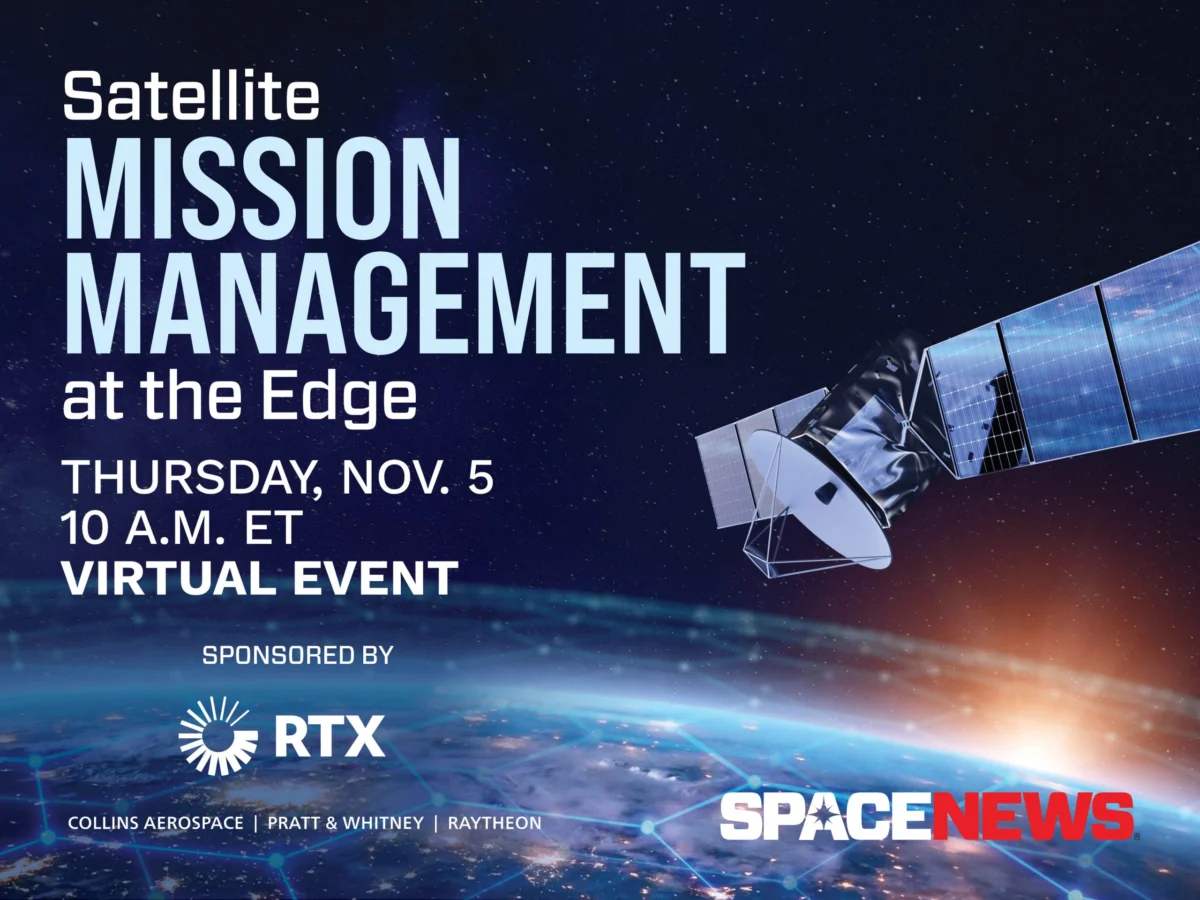
ARLINGTON, Va. — As orbit grows increasingly congested and contested, national security operators face an imperative to transform how satellite systems are controlled, updated, and deployed. In response to these complex operational demands, SpaceNews and defense technology giant RTX will co-host an upcoming virtual industry forum on November 5, focused on the integration of edge computing, automation, and cloud-native architectures into national security space missions.
The event, titled "Satellite Mission Management at the Edge," brings together space sector experts to address the critical challenges of maintaining security and control while rapidly fielding commercial technologies. The executive discussion will highlight how modular software frameworks and on-orbit processing can deliver faster decision-making, greater system resilience, and enhanced affordability across modern satellite constellations.
Main Facts: The Operational Push Toward Edge-Based Mission Management
Modern satellite operations are undergoing a structural shift driven by the rapid growth of space assets and an increasingly dynamic threat environment. Traditional satellite command-and-control architectures—which rely heavily on centralized, ground-based processing—are encountering severe operational bottlenecks. As the volume of space-based data explodes, national security missions require faster processing times, improved resilience, and the capacity to adapt operational parameters directly while on-orbit.
To address these requirements, satellite mission management is increasingly shifting toward edge computing—processing critical data aboard the spacecraft itself rather than transferring raw data back to earth control centers for analysis.
+-----------------------------------------------------------------------+
|                 TRANSITION IN SATELLITE OPERATIONS                    |
+-----------------------------------------------------------------------+
|  TRADITIONAL ARCHITECTURE           NEXT-GENERATION EDGE ARCHITECTURE |
|  - Ground-centric command & control   - On-orbit edge computing        |
|  - Raw data downlink latency          - Local real-time data processing|
|  - Monolithic payload design          - Cloud-native, modular software |
|  - High downlink bandwidth reliance   - Reduced bandwidth dependency   |
+-----------------------------------------------------------------------+
Key Technical Pillars of Modern Mission Operations
- Edge Computing on Orbit: By executing analytical tasks directly on board the satellite, spacecraft can process sensor data in real time. This minimizes downlink latency, reduces bandwidth consumption, and enables autonomous responses to time-sensitive tactical situations.
- Automation and Cloud-Native Architectures: Incorporating cloud-native platforms allows software updates, bug fixes, and mission adaptations to be deployed seamlessly across entire satellite fleets, matching the flexibility standard in terrestrial enterprise computing.
- Modular Systems Integration: Adopting open, modular hardware and software frameworks enables operators to execute rapid technology refresh cycles. Hardware components and software stacks can be upgraded without necessitating a complete overhaul of ground control infrastructures.
- Maintaining Operational Control and Security: Modernization efforts must prioritize rigorous cybersecurity standards and mission assurance. Modern software architectures are designed to ensure that enhanced autonomy does not undermine ground-based authority or introduce new attack vectors.
Chronology and Event Overview: Scheduling the Nov. 5 Executive Forum
The collaborative virtual forum is structured to offer space industry stakeholders, military leadership, and commercial technology developers an actionable blueprint for modernizing legacy satellite operations.
+-----------------------------------------------------------------------+
|                           EVENT TIMELINE                              |
+-----------------------------------------------------------------------+
|  DATE:           Thursday, November 5                                 |
|  TIME:           10:00 a.m. – 10:45 a.m. Eastern Time (ET)            |
|  FORMAT:         Live Interactive Virtual Seminar (via Zoom)           |
|  ORGANIZERS:     SpaceNews in collaboration with RTX                  |
|  ACCESSIBILITY:  On-demand recording published following conclusion    |
+-----------------------------------------------------------------------+
Event Program and Key Discussion Themes
The 45-minute live session will examine the operational and technical trade-offs inherent in updating national security space systems. Key panel topics include:
- Bridging Legacy Infrastructure and Next-Gen Edge Tools: How defense organizations can integrate edge processing and cloud-native software into existing ground networks without compromising legacy system reliability.
- Accelerating Software Deployments: The operational mechanics of deploying iterative software updates directly to operational payloads while preserving high levels of mission assurance.
- Cost Reduction Through Modular Architecture: How open-architecture standards allow defense agencies to break away from proprietary, single-use satellite designs, thereby improving affordability across large-scale constellations.
- Strengthening Resilience and Autonomy: Strategies for ensuring satellite constellations maintain mission functionality during communications-denied or degraded operational environments through on-orbit decision-making.
Registrants will receive access to the live Zoom stream, with a complete event recording archived on the SpaceNews platform shortly following the session’s conclusion.

Supporting Data: RTX Corporate Profile and Financial Foundation
The push to modernize mission management is backed by significant research, development, and industrial capacity across the defense industrial base. As the primary sponsor of the event, RTX brings substantial technical and financial resources to bear on next-generation space architectures.
+-----------------------------------------------------------------------+
|                    RTX AT A GLANCE (METRIC BRIEF)                     |
+-----------------------------------------------------------------------+
|  Headquarters:           Arlington, Virginia                          |
|  Global Workforce:        180,000+ employees                          |
|  2025 Projected Sales:   >$88 Billion                                 |
|  Core Competencies:      Aviation, Integrated Defense Systems,         |
|                          Next-Generation Space & Tech Solutions       |
+-----------------------------------------------------------------------+
Headquartered in Arlington, Virginia, RTX maintains a global workforce exceeding 180,000 employees focused on advancing aviation, defense, and space technologies. With 2025 sales exceeding $88 billion, RTX ranks among the world’s largest aerospace and defense contractors.
The enterprise specializes in engineering integrated defense systems, advanced sensors, intelligence solutions, and secure communication networks tailored for multi-domain operations. RTX’s investments in edge computing, software-defined payloads, and automated ground management systems highlight the defense industry’s broader pivot toward agile, software-centric military space capabilities.
Official Positions: Balancing Security, Innovation, and Legacy Architecture
Industry leaders and defense officials recognize that modernizing mission management requires balancing technological innovation with operational risk management. According to event background details provided by SpaceNews and RTX, the defense space sector faces an urgent imperative to field responsive, resilient capabilities without eroding the reliability of active systems.
The Modernization Challenge
                         THE DUAL IMPERATIVE

    SPEED & FLEXIBILITY                      SECURITY & CONTROL
  -----------------------                  -----------------------
  • Cloud-native platforms                 • Zero-trust cybersecurity
  • Rapid software updates                 • Strict mission assurance
  • Autonomous edge processing             • Ground operator oversight
"Today’s operators must modernize mission management, integrate new technologies and deliver capabilities without compromising security, reliability or operational control," notes the event announcement.
Industry organizers emphasize that the primary goal of adopting edge architectures is not to bypass human command, but to streamline the data flow between orbit and ground stations. By shifting routine processing tasks to edge processors on board the satellite, human operators can focus on strategic decision-making rather than sifting through vast quantities of raw telemetry and sensor data.
Furthermore, industry representatives highlight modularity as the foundational enabler of sustainable modernization. Traditional defense acquisitions historically produced tailored, deeply integrated hardware-software bundles that were difficult and expensive to upgrade. Transitioning to open architectures and standardized software interfaces allows military software teams to push capabilities to orbit rapidly, keeping pace with evolving threats while managing long-term lifecycle costs.

Strategic Implications for National Security Space Operations
The shift toward edge computing and cloud-native management carries significant long-term implications for how national security space assets are built, deployed, and defended.
1. Compression of the Sensor-to-Shooter Loop
By enabling satellite payloads to perform initial data reduction and target identification directly on board, tactical information can be routed immediately to forces in the field. Eliminating the need to send raw sensor data to ground stations for processing drastically cuts latency, shortening the decision cycle for time-sensitive missions.
2. Operational Survivability in Contested Environments
In contested space environments where ground-to-satellite communications may be jammed, degraded, or intercepted, satellites equipped with automated edge computing can continue operating independently. Onboard algorithms allow spacecraft to maintain precise orientation, reconfigure sensor payloads, perform threat avoidance maneuvers, and prioritize operational tasks autonomously until ground connectivity is restored.
3. Transition from Hardware-Centric to Software-Defined Fleets
Adopting modular, cloud-native frameworks enables a shift toward software-defined satellites. Instead of building specialized hardware for every unique mission requirement, defense agencies can deploy standardized satellite buses running specialized software applications. Capability enhancements can be pushed remotely over the air, extending the operational relevance and lifespan of orbiting constellations.
4. Economic Efficiency and Lower Entry Barriers
Modular architectures reduce overall program lifecycle costs by avoiding single-vendor lock-in and allowing commercial tech vendors to contribute specialized software modules. This lower cost structure enables defense agencies to field resilient, proliferated low-Earth orbit (pLEO) constellations, replacing legacy reliance on small numbers of high-cost, vulnerable satellite assets.
Forum Registration and Access Details
Participation in the "Satellite Mission Management at the Edge" virtual event is open to defense professionals, space industry executives, technology developers, and media representatives.
- Date: Thursday, Nov. 5
- Time: 10:00 a.m. – 10:45 a.m. ET
- Platform: Zoom (Virtual Seminar)
- Registration: Attendees can register online via the SpaceNews event portal. Unique login details are issued upon registration confirmation.
- Post-Event Access: A full, downloadable video recording and summary report will be published on SpaceNews.com following the live broadcast.