In the rapidly evolving landscape of 2026, the barrier to entry for mastering Artificial Intelligence has theoretically never been lower. Yet, paradoxically, the "signal-to-noise" ratio has never been more distorted. A cottage industry of overpriced AI bootcamps and subscription-based masterclasses has emerged, promising career-altering transformations for thousands of dollars. However, the most rigorous, industry-recognized, and intellectually demanding AI education is entirely free.
The organizations currently defining the frontier of artificial intelligence—Google, Harvard, Hugging Face, and individual luminaries like Andrej Karpathy—have open-sourced the very materials used to train their own internal talent. If you possess a baseline proficiency in Python and the discipline for self-directed study, you do not require a graduate degree or a five-figure tuition bill to transition into an AI practitioner. You simply need the right roadmap.
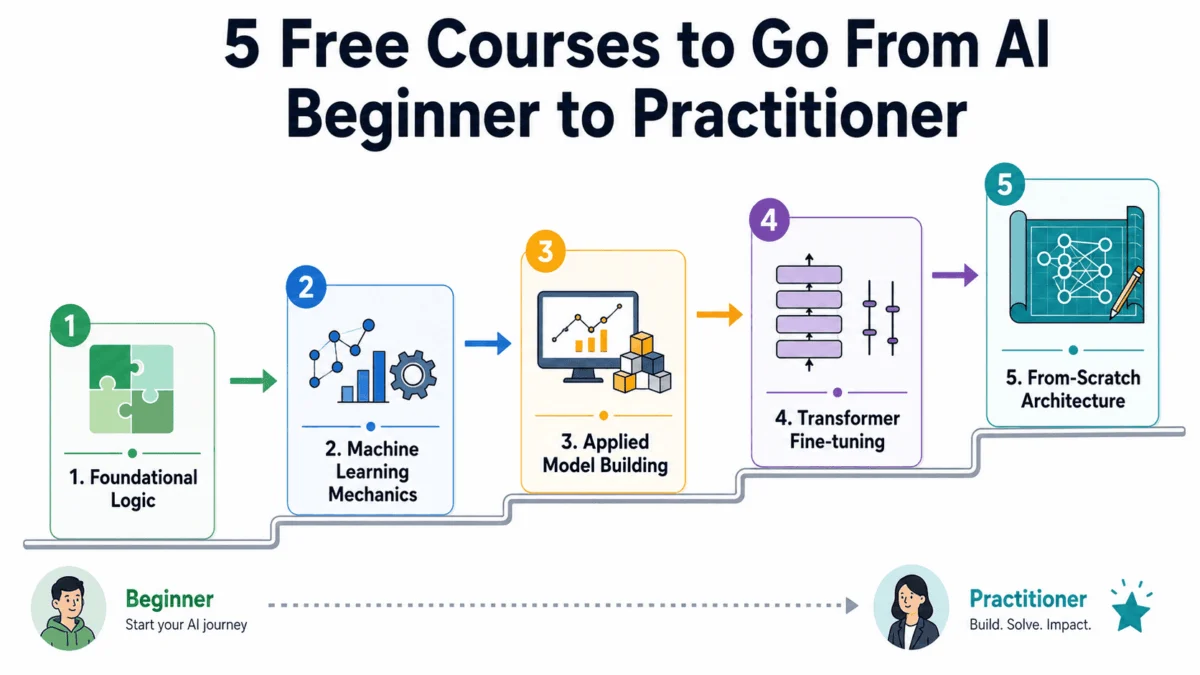
The Strategic Roadmap: A Five-Course Progression
To transition from a software engineer to an AI practitioner, one must follow a logical, hierarchical progression. This roadmap is designed to move the learner from the abstract logic of AI reasoning to the granular implementation of Large Language Models (LLMs) built from first principles.
Phase 1: The Logical Foundation (CS50 AI)
Before attempting to leverage neural networks, a practitioner must understand how machines model uncertainty and decision-making. Harvard’s CS50: Introduction to AI with Python serves as the definitive starting point. It bridges the gap between procedural programming and probabilistic AI logic.
- Key Focus: Graph search algorithms, classification, optimization, and reinforcement learning.
- Why it matters: Many self-taught developers jump straight into high-level APIs, neglecting the underlying algorithmic logic. This course ensures you understand how AI systems "think" before you teach them how to "learn."
Phase 2: Mathematical Mechanics (Google’s Machine Learning Crash Course)
With the logic in place, the focus shifts to the data. Google’s Machine Learning Crash Course is the gold standard for understanding the mathematics that govern modern ML. It is the curriculum Google utilizes to upskill its internal engineering teams, making it a highly respected credential on any technical resume.
- Key Focus: TensorFlow APIs, loss functions, gradient descent, and feature engineering.
- Why it matters: This course strips away the "magic" of AI, replacing it with the statistical reality of how models minimize error to improve performance.
Phase 3: The Practitioner’s Leap (Fast.ai)
The most significant hurdle for new students is the "theory-to-practice" gap. Jeremy Howard’s Practical Deep Learning for Coders (fast.ai) utilizes a "top-down" pedagogical approach. Instead of spending weeks on calculus, you build a state-of-the-art computer vision model in the first lesson.
- Key Focus: Rapid prototyping, fine-tuning, and modern deep learning architecture.
- Why it matters: It shifts the learner’s mindset from "student" to "engineer," emphasizing the ability to deploy working models on real-world datasets.
Phase 4: The Generative Ecosystem (Hugging Face)
In the current era of LLMs, the Hugging Face ecosystem is the industry’s "GitHub for AI." Their official NLP Course is not merely a tutorial; it is an onboarding into the modern professional workflow.
- Key Focus: Transformers, tokenization, fine-tuning, and the utilization of the Hugging Face Hub.
- Why it matters: By the end of this course, you will understand how to interface with the models that power modern generative AI, allowing you to build production-grade applications.
Phase 5: From Practitioner to Architect (Neural Networks: Zero to Hero)
The final stage of development is moving from "framework user" to "architect." Andrej Karpathy’s Neural Networks: Zero to Hero series is widely considered the most valuable free educational resource in the field. It requires the learner to reconstruct the architecture of a GPT-level model from scratch, using only foundational libraries like PyTorch.
- Key Focus: Backpropagation, micrograd, and the transformer architecture from first principles.
- Why it matters: This is the "clarification" phase. Once you have built a transformer from scratch, the abstractions provided by high-level libraries no longer seem like black boxes, but rather like tools you fully control.
Chronology of Learning: A Sustainable Path
For the motivated learner, the recommended pace is a three-to-five-month commitment. Rushing the curriculum is the most common failure point. The following timeline provides a balanced approach to internalizing these complex concepts:
- Months 1-1.5: Focus exclusively on the CS50/Google sequence. Do not proceed to deep learning until you are comfortable with the mathematical mechanics of loss functions and basic optimization.
- Months 2-3: Engage with Fast.ai. Dedicate your weekends to the Jupyter notebooks, focusing on creating at least one unique project using an open dataset.
- Months 3.5-4.5: Dive into the Hugging Face ecosystem. Learn to navigate the hub and understand the trade-offs between different model architectures.
- Month 5 and Beyond: The Karpathy series. This is deep work. Treat it as a "capstone project" phase where your goal is to understand the code on a line-by-line basis.
Supporting Data: Why "Free" Beats "Expensive"
The industry is currently experiencing a correction regarding AI certifications. Hiring managers in top-tier tech firms—including OpenAI, Anthropic, and Google—have consistently noted that bootcamps often teach outdated abstraction layers. Conversely, the open-source materials listed here are updated by the very engineers building the infrastructure.
Data from technical interview platforms suggest that candidates who demonstrate a fundamental understanding of "Zero to Hero" concepts—such as the mechanics of attention mechanisms or the nuances of weight initialization—perform significantly better in technical assessments than those who only know how to call an API. The ROI (Return on Investment) for these free courses is infinite, as the only cost is time and intellectual rigor.
Official Industry Perspectives
Prominent voices in the field, including researchers at the Allen Institute for AI and lead engineers at major tech hubs, emphasize that the barrier to "AI Literacy" is moving from knowing what tools to use to knowing why they work.
As noted by industry experts, the era of the "AI Generalist" is fading. Companies are now looking for "AI Engineers"—individuals who can troubleshoot a model that is failing to converge, optimize a tokenization pipeline, or understand why a specific model architecture is ill-suited for a particular dataset. These skills are explicitly taught in the latter two phases of this roadmap.
Implications for Your Career
The democratization of AI education creates a meritocratic landscape. When everyone has access to the same world-class curriculum, the differentiator becomes the quality of your portfolio and your depth of understanding.
By following this sequence, you are not just checking boxes on a resume; you are building a foundational mental model that will remain relevant even as the tools themselves evolve. While others spend their time navigating the marketing fluff of overpriced certificates, you will be building, debugging, and deploying.
A Note from the Author
Vinod Chugani, an AI and data science educator, emphasizes that the transition into the AI industry requires a shift in mindset. "The goal is not to memorize syntax, but to develop the analytical intuition of a scientist," says Chugani. His career-long focus on bridging the gap between quantitative finance and machine learning has taught him that the most successful practitioners are those who never stop returning to first principles.
In conclusion, the path to becoming an elite AI practitioner is open to anyone with an internet connection and the fortitude to stay the course. Start with the foundations, respect the mathematics, and never stop building. The roadmap is set; the rest is up to you.