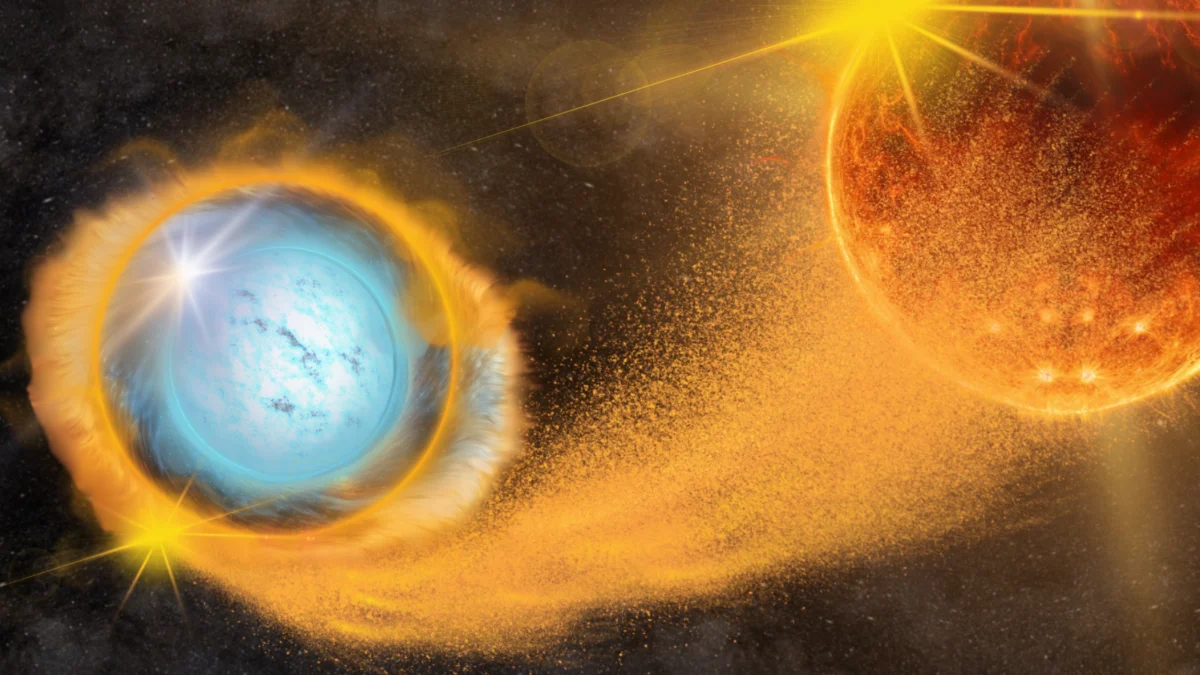
In the vast, silent reaches of our galaxy, a cosmic drama of epic proportions has been unfolding for over two decades. Deep within the constellation Puppis, an enigmatic stellar system known as V445 Puppis has long baffled the astronomical community. Following a brilliant, unexpected eruption in the year 2000, the system cloaked itself in a thick, suffocating veil of dust, effectively hiding its true nature from the prying eyes of Earth’s most advanced telescopes.
Now, after 25 years of mystery, an international team of researchers—leveraging the unprecedented clarity of the Hubble Space Telescope, NASA’s Transiting Exoplanet Survey Satellite (TESS), and the ground-based Very Large Telescope (VLT)—has finally pierced the shroud. The findings are nothing short of extraordinary: V445 Puppis is the Milky Way’s only confirmed "helium nova," a rare and volatile binary system where a dead star is actively cannibalizing its companion, firing out "cosmic bullets" at a staggering 20 million miles per hour.
The Nature of the Beast: Understanding the Helium Nova
To understand the significance of V445 Puppis, one must first understand the life cycle of a typical nova. Most "ordinary" novas are the result of a white dwarf—the dense, burnt-out core of a sun-like star—stealing hydrogen-rich material from a nearby companion. As this material accumulates on the surface of the white dwarf, it creates immense pressure and heat, eventually triggering a thermonuclear explosion that ripples across the galaxy.
V445 Puppis, however, breaks the rules. It is a "helium nova," a much rarer phenomenon. In this system, the white dwarf is not feeding on hydrogen, but rather on helium-rich matter stripped from a companion star that has already lost its outer hydrogen layers. This leaves behind a "helium star," a rare stellar object that represents a brief but intense phase in the evolution of binary systems.
"The culprits behind this galactic eruption have been an enduring mystery over the past 25 years," says John Mills, a researcher at the University of Warwick and a key member of the study team. "It is very exciting to finally confirm that this helium nova was the result of a helium star accreting onto a white dwarf."
Chronology of a Cosmic Explosion
The story of V445 Puppis began in late 2000, when observers first noted a sudden, dramatic increase in the system’s brightness. Unlike standard novae, which often exhibit specific spectral signatures of hydrogen, V445 Puppis showed an anomalous absence of hydrogen and an overwhelming abundance of helium.
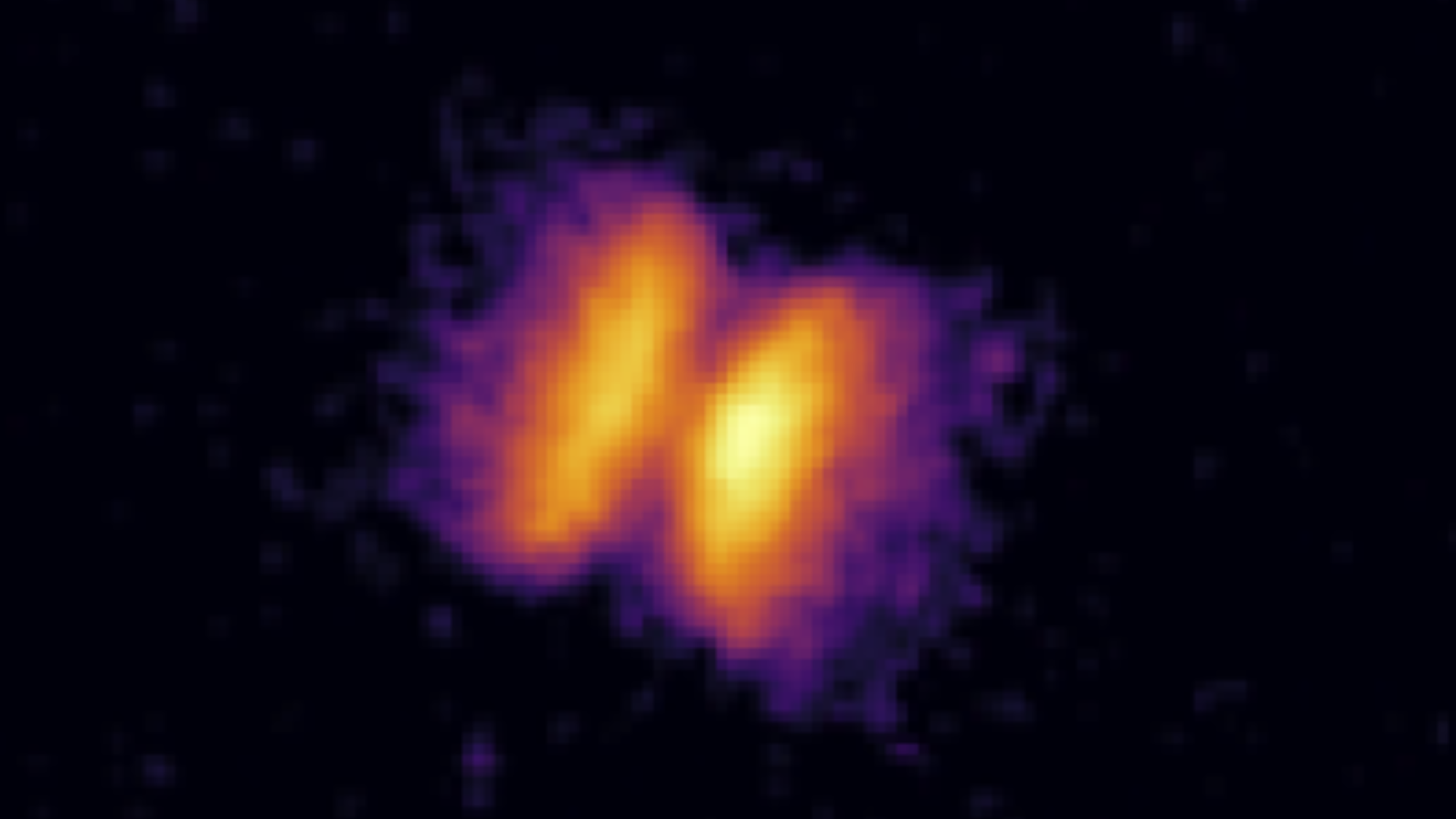
As the explosion progressed, it launched twin, bipolar plumes of debris—vast structures resembling butterfly wings that stretched for more than a trillion miles into the interstellar medium. Shortly after this initial outburst, a dense, dark cloud of dust formed around the binary pair. For two decades, this debris disc acted as a physical and observational barrier, preventing astronomers from determining the precise nature of the stars involved.
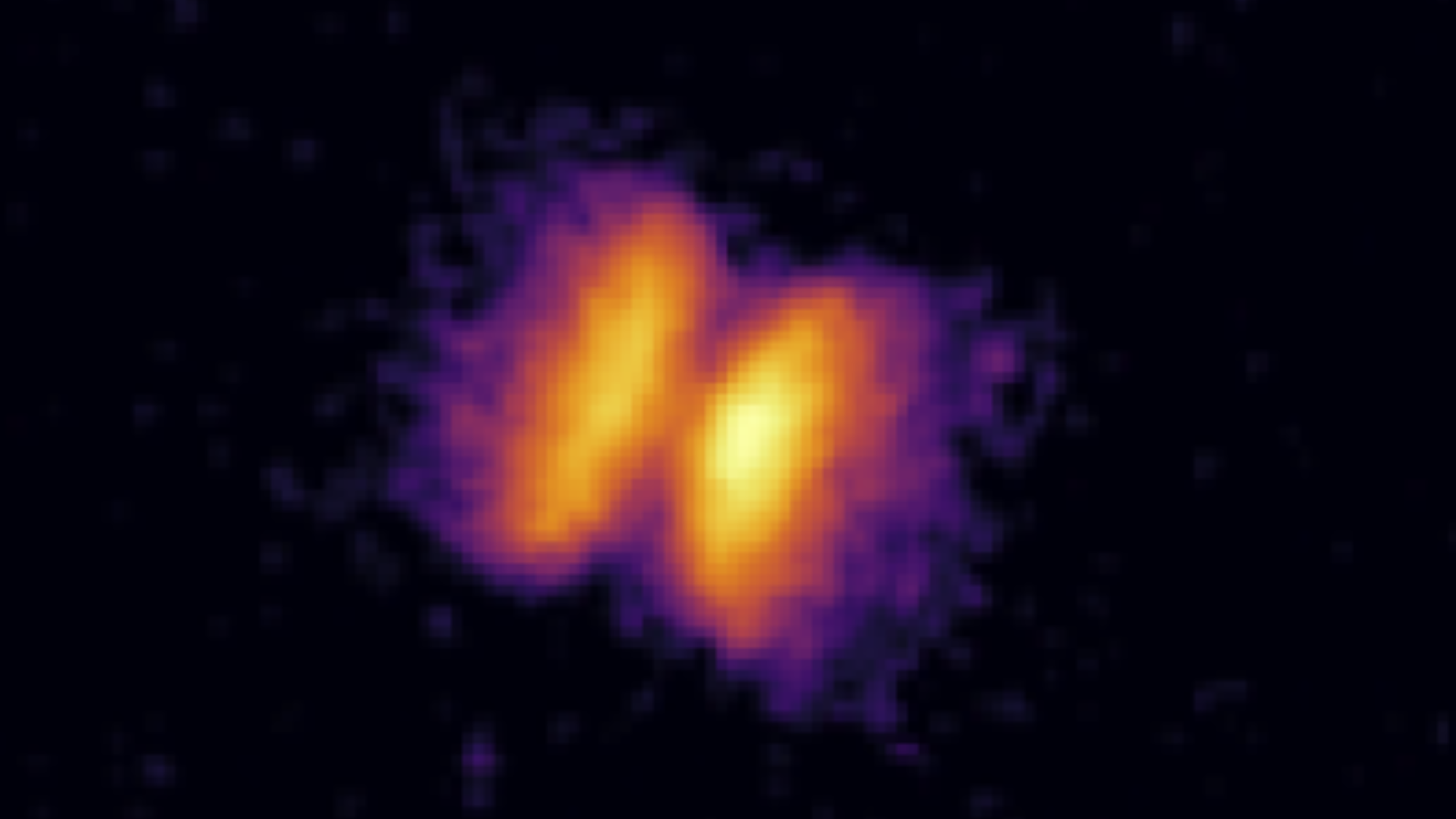
It was only as this debris cloud began to thin and disperse that the research team could finally employ multi-wavelength observations to analyze the binary system’s core. By combining the high-resolution imaging of Hubble with the survey capabilities of TESS and the deep-space spectroscopic power of the VLT, the team successfully stripped away the "fog" of the debris. They identified that the donor star is indeed a rare helium star, marking V445 Puppis as a singular laboratory for studying this extreme mode of stellar evolution.
The Mystery of the Cosmic Bullets
Perhaps the most startling discovery made by the team was the presence of high-velocity "bullets" of gas being ejected from the site of the explosion. These clumps of potentially oxygen-rich material are traveling at velocities reaching 20 million miles per hour—a speed so extreme that it challenges current models of how matter is accelerated during a nova event.
"The origin of these ‘bullets’ is a mystery," Mills noted during his presentation at the Royal Astronomical Society’s National Astronomy Meeting. "We suspect that these originated post-outburst, but ‘bullets’ of this kind have not been observed in any other nova."
The existence of these projectiles suggests that the explosion mechanism within a helium nova may involve complex fluid dynamics and magnetic interactions that are far more violent than those seen in hydrogen-fueled events. Whether these bullets are the result of shock waves interacting with the dense disc of dust or a direct byproduct of the thermonuclear runaway remains a subject of intense theoretical debate.
Implications for the Future: A Second Eruption?
One of the most consequential findings of the research is that V445 Puppis is showing signs of renewed activity. Analysis of recent data suggests that the white dwarf has successfully overcome its previous "stellar indigestion" and is once again actively siphoning matter from its helium-rich companion.
This process is the exact precursor to the initial 2000 eruption. The realization that the system is preparing for another outburst provides scientists with a rare "watch-tower" opportunity: the chance to monitor a system before, during, and after a rare helium-nova event.
This has profound implications for our understanding of Type Ia supernovas. Astronomers have long hypothesized that repeated nova eruptions—where a white dwarf periodically accumulates and expels material—could eventually push the white dwarf over the "Chandrasekhar limit," the mass threshold at which it can no longer support itself against gravity, leading to a total, catastrophic collapse and a Type Ia supernova.
A "Standard Candle" in the Dark
Type Ia supernovas are the bedrock of modern observational cosmology. Because they explode with a predictable, uniform peak luminosity, they function as "standard candles." By measuring how bright a Type Ia supernova appears from Earth, astronomers can calculate its distance with incredible precision.
These calculations have been instrumental in determining the expansion rate of the universe and confirming the existence of dark energy—the mysterious force driving the accelerated expansion of the cosmos. If V445 Puppis is indeed a precursor to a Type Ia supernova, studying it provides a "pre-mortem" look at the conditions that lead to these essential cosmic yardsticks.
"I look forward to seeing how this result may help us uncover what powers other similar hydrogen-poor astronomical explosions," says Mills. "Understanding the progenitors of Type Ia supernovas is essential if we are to refine our measurements of the universe’s age and expansion history."
Conclusion: A New Window into the Extreme
The study of V445 Puppis serves as a reminder of how much of our galaxy remains hidden in plain sight. For a quarter of a century, this system was viewed merely as a dusty, obscure anomaly. Today, it stands as a cornerstone for understanding the most violent processes in stellar evolution.
As the scientific community turns its collective focus toward the system, the hope is that the next eruption will be captured with modern, high-precision instrumentation that was not available in 2000. By decoding the physics of the "cosmic bullets" and monitoring the delicate dance of the white dwarf and its helium-star companion, researchers are not just learning about one peculiar binary system; they are refining the very tools we use to measure the history and destiny of the universe itself.
The research presented at the National Astronomy Meeting in Birmingham, UK, marks a new chapter in this ongoing saga—a testament to the power of persistence in astronomy and the enduring mystery of the stars that, even in death, refuse to go quietly.