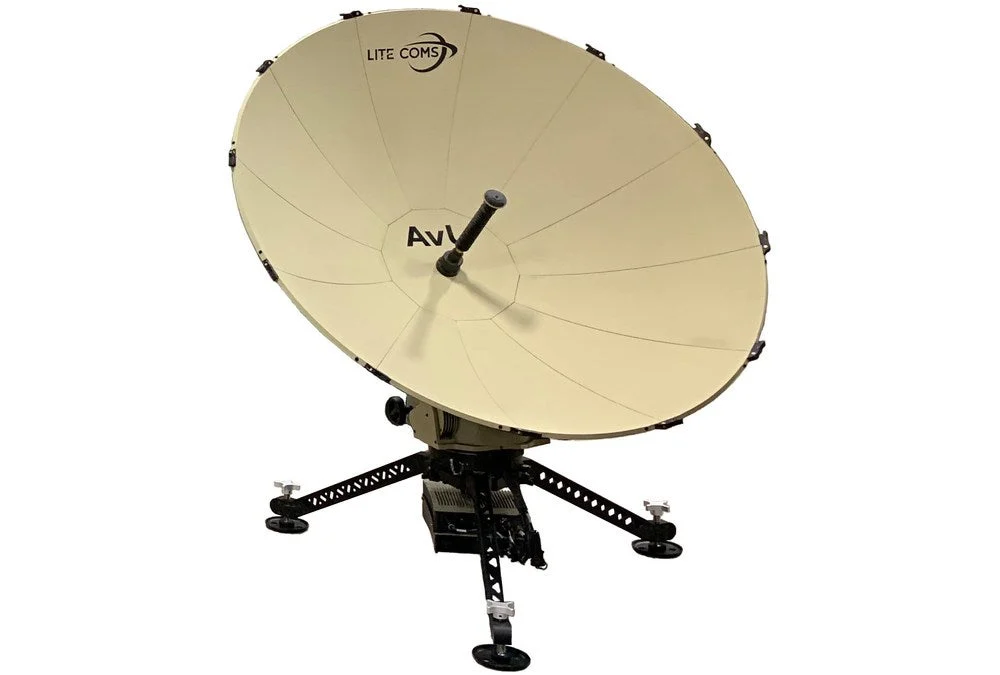
August 27, 2026 — In a significant development for tactical communications, U.S.-based satcom manufacturer Lite Coms has officially announced that its flagship Lite Sat 1.3A terminal has been validated for use with SES’s O3b mPOWER Sovereign Services and Hybrid Sovereign Gateway architectures. This integration, achieved through a strategic coupling with Comtech’s SLM-5650B modem, represents a major milestone in the effort to bring high-throughput, low-latency Medium-Earth Orbit (MEO) connectivity to the most challenging military environments.
The Convergence of Mobility and High-Capacity Throughput
The modern battlefield is increasingly data-dependent, requiring commanders to move vast amounts of intelligence, surveillance, and reconnaissance (ISR) data in real-time. Traditional satellite communications (SATCOM) infrastructure, while robust, often struggles to balance portability with the high-throughput requirements of modern warfare. The Lite Sat 1.3A terminal was engineered specifically to bridge this gap.
As a lightweight Very Small Aperture Terminal (VSAT), the 1.3A is designed for rapid deployment. Whether supporting special operations forward-deployed teams, mobile command-and-control (C2) vehicles, or personnel operating in austere, remote environments, the terminal provides essential multi-band flexibility. It operates across X-, Ku-, and Ka-band frequencies, ensuring that military users can leverage various spectral assets depending on the mission requirements and the availability of satellite resources.
By achieving validation for the SES O3b mPOWER ecosystem, the Lite Sat 1.3A moves beyond being a mere hardware component; it becomes a certified node within one of the world’s most advanced satellite constellations.
Chronology: Building the Sovereign Ecosystem
The path to this certification has been a deliberate process of technical alignment between Lite Coms, Comtech, and SES. The timeline of this integration highlights the systematic approach required to ensure military-grade reliability:
- September 2025: A critical precursor to the current announcement, Comtech received formal certification for its SLM-5650B modem to operate on the O3b mPOWER constellation. As a WGS-certified modem, the SLM-5650B was already a staple in defense communications; its validation for MEO orbits effectively bridged the gap between legacy wideband networks and next-generation high-throughput services.
- Early 2026: Lite Coms and SES began the rigorous testing phase to ensure the Lite Sat 1.3A mechanical and software architecture could seamlessly interface with the mPOWER gateway requirements. This included testing for signal acquisition, handover capabilities, and the latency performance required for MEO orbits.
- August 2026: Final validation is achieved. The Lite Sat 1.3A is cleared for integration into the SES Sovereign Services framework, allowing government and defense customers to procure a pre-tested, end-to-end communication solution.
Technical Synergy: The Role of the SLM-5650B
A terminal is only as capable as the modem that processes its signal. The inclusion of Comtech’s SLM-5650B is not merely a design choice; it is a strategic decision to ensure broad interoperability. The SLM-5650B is a high-performance modem known for its resilience in contested environments. Its ability to operate across various waveforms makes it the ideal partner for the Lite Sat 1.3A.
By pairing the two, Lite Coms provides a "plug-and-play" capability for military units. Instead of navigating the complex integration of disparate hardware, defense agencies can now deploy a validated configuration that is guaranteed to interface with the O3b mPOWER network. This reduces the logistical burden on the end-user and significantly shortens the time-to-mission-readiness.
Official Perspectives: Reducing Risk for Defense Partners
For the stakeholders involved, this announcement is about more than just technology—it is about providing confidence to the warfighter.
"The certification of our Lite Sat 1.3A in this terminal-modem configuration gives our government and military customers a validated, low-risk path to sovereign MEO connectivity through the SES O3b mPOWER ecosystem," said Lite Coms CEO Robert Jacobson.
Jacobson’s emphasis on "low-risk" is a direct nod to the primary concern of defense procurement officers: integration risk. When a new system is introduced into a theater of operations, the primary danger is not just hardware failure, but "interoperability failure"—the inability of new systems to talk to existing ones. By pre-validating this configuration, Lite Coms and SES are effectively underwriting the technical risk of the deployment.
This collaboration is also a testament to the "Sovereign Services" philosophy championed by SES. By allowing governments to maintain control over their gateway and data traffic while utilizing a commercial constellation, SES is providing a middle ground between traditional government-owned satellites and standard commercial broadband, satisfying the strict security requirements of the defense sector.
Broader Implications for Modern Military Operations
The validation of the Lite Sat 1.3A has profound implications for how the military approaches communications in the coming decade.
1. The Death of the "Static" Command Post
Historically, high-capacity communication required large, fixed infrastructure. The ability to bring MEO-tier throughput into a man-portable or vehicle-mounted form factor means that command posts can remain mobile. This mobility is essential in a "peer-to-peer" conflict scenario where static locations are highly vulnerable to precision-guided munitions.
2. Multi-Orbit Resilience
Defense agencies are increasingly moving toward multi-orbit strategies, utilizing Low-Earth Orbit (LEO) for low latency, MEO for high-throughput capacity, and Geosynchronous (GEO) for persistent coverage. The Lite Sat 1.3A’s flexibility across multiple frequency bands makes it a versatile tool for this multi-orbit architecture. As the military transitions to a "mesh" network of satellites, having terminals that can easily switch between providers and orbits is critical.
3. Democratizing High-Throughput Connectivity
Historically, only high-echelon headquarters had access to the bandwidth necessary to run complex cloud-based AI tools or high-definition situational awareness software in the field. By lowering the barrier to entry with a smaller, more affordable, and easier-to-operate terminal, Lite Coms is effectively pushing high-end data capabilities down to the tactical edge.
Strategic Challenges and Future Outlook
While the certification is a major win, the environment in which these terminals will operate remains hostile. The future of tactical communications will be defined by Electronic Warfare (EW) and cyber-contested environments.
The next frontier for the Lite Sat 1.3A and its peers will be hardening these systems against signal jamming and spoofing. SES and its manufacturing partners will likely focus future iterations on software-defined radio (SDR) updates that allow for rapid waveform switching and advanced encryption protocols to stay ahead of evolving adversarial capabilities.
Furthermore, as the number of O3b mPOWER satellites continues to grow, the density of the network will only increase. The Lite Sat 1.3A is well-positioned to take advantage of this expanding capacity. As the constellation reaches full operational capability, users can expect even higher data rates and more robust link availability, further cementing the role of MEO as the backbone of military satellite communications.
Conclusion
The partnership between Lite Coms, Comtech, and SES marks a turning point in the availability of sovereign, high-throughput communications. By validating the Lite Sat 1.3A terminal within the O3b mPOWER architecture, these companies have provided the defense community with a reliable, scalable, and mobile solution for modern tactical operations.
As the digital transformation of the battlefield continues, the ability to maintain a robust, secure, and high-speed data link from anywhere on the planet is no longer a luxury—it is a prerequisite for mission success. With this certification, Lite Coms has ensured that its customers are better equipped to meet the challenges of an increasingly complex and data-intensive global security landscape.