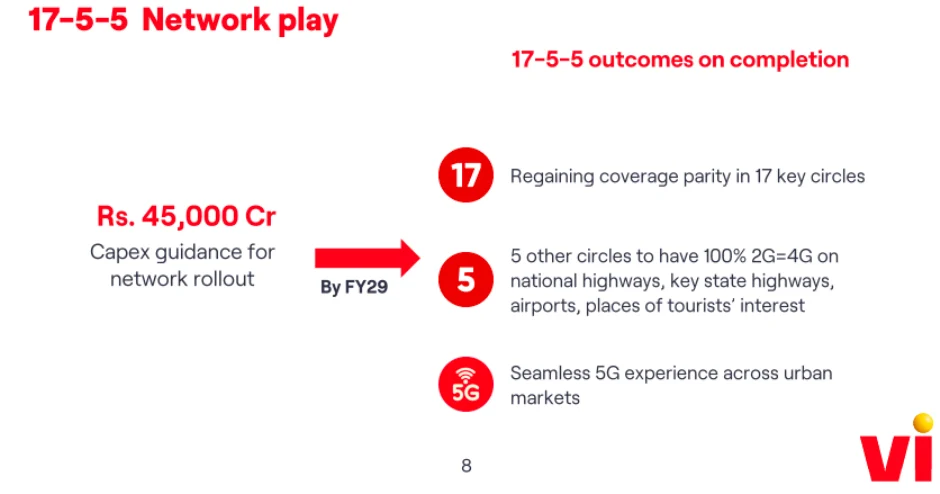
Mumbai, India – November 28, 2026 – Vodafone Idea (Vi), the Indian telecommunications joint venture, has unveiled a comprehensive and aggressive network investment strategy, committing a substantial ₹45,000 crore in capital expenditure through fiscal year 2029. This significant financial outlay is earmarked to dramatically enhance its 4G coverage nationwide, bolster its nascent 5G services, and critically, reignite subscriber growth across the vast Indian market. The company’s latest financial disclosures for the second quarter of FY27 reveal a positive uptick in revenue and a stabilization, followed by a modest increase, in its subscriber base, underscoring the urgency and strategic imperative of this network modernization drive.
The "17-5-5" Network Strategy: A Blueprint for Revival
At the heart of Vodafone Idea’s future lies its "17-5-5" network strategy, a meticulously crafted roadmap designed to restore competitive parity and elevate customer experience. This strategy, detailed in a recent investor presentation, outlines three core objectives:
- Restoring Competitive Network Coverage in 17 Key Telecom Circles: This primary objective signifies a focused effort to shore up Vi’s presence in its most crucial operational regions, where network quality and reach have historically been a differentiating factor. The aim is to bring Vi’s network performance in these circles up to par with, or surpass, that of its competitors.
- Achieving 4G Coverage Parity in Five Additional Circles: Beyond the 17 core circles, Vi aims to extend its 4G footprint to match its existing 2G coverage in five other strategic circles. This involves ensuring robust 4G connectivity along national and important state highways, at airports, and in popular tourist destinations, thereby catering to a wider spectrum of user needs and mobility patterns.
- Delivering a Seamless 5G Experience Across Urban Markets: As 5G technology matures and adoption grows, Vi is prioritizing the delivery of a high-quality, seamless 5G experience in urban centers. This focus acknowledges the increasing demand for faster speeds and advanced mobile capabilities in densely populated and economically vibrant areas.
Vodafone Idea intends to leverage these strategic network investments to achieve a trifecta of critical business outcomes: enhanced subscriber acquisition, improved customer retention, and robust revenue growth. The company has also articulated a broader three-part business strategy targeting sustained subscriber additions, double-digit revenue growth, and a threefold increase in cash EBITDA within the next three years. This network overhaul is not merely about infrastructure; it’s intrinsically linked to Vi’s overarching commercial ambitions.
Financial Traction and Operational Milestones
The recent financial results for the second quarter of FY27 (ending September 30, 2026) paint a picture of cautious optimism for Vodafone Idea. The company reported a revenue of ₹11,884 crore, marking a healthy 6.2 percent year-on-year increase from ₹11,195 crore in the same period of FY26. This revenue growth, coupled with an increase from ₹11,689 crore in the preceding quarter (Q1 FY27), signals a positive trajectory.
Crucially, Vi’s subscriber base has shown signs of stabilization and modest growth. As of September 2026, the company reported a total subscriber base of 194.4 million, a slight increase from 193.1 million in the previous quarter. This marks a significant turnaround from earlier periods characterized by subscriber attrition. While this figure remains slightly below the 196.7 million recorded in Q2 FY26, the shift to positive net subscriber additions—1.3 million in Q2 FY27—is a vital indicator of regained momentum.
The shift towards higher-value services is also evident. The 4G and 5G subscriber base has expanded to 131 million, up from 127.8 million a year prior, adding 3.2 million users. Total data subscribers have also seen an increase, reaching 136.4 million. A particularly encouraging trend is the substantial growth in postpaid subscribers, which surged to 33.9 million from 27.9 million in Q2 FY26, an impressive addition of 6 million users. This indicates a successful strategy of attracting and retaining customers who are willing to commit to premium services.
The penetration of 4G and 5G subscribers within Vi’s total customer base has risen to 67.4 percent, a notable improvement from 61.4 percent in the previous year. This aligns with the company’s strategic focus on converting its existing 2G customer base to more advanced 4G and 5G services, while simultaneously encouraging the adoption of higher-value data plans.
Network Expansion: Quantifiable Progress
The ambitious network investment plan is already being translated into tangible network enhancements. By September 30, 2026, Vodafone Idea’s 5G network had expanded its reach to an impressive 400 cities and towns across 17 telecom circles. The operator’s extensive network infrastructure comprises over 216,500 unique sites, approximately 8,030 MHz of spectrum holdings, and a vast optical fibre cable network exceeding 355,000 kilometers. This robust infrastructure underpins a mobile network that covers over 1.2 billion people and approximately 487,000 towns and villages.
In terms of 4G coverage, Vi has made significant strides. Its 4G population coverage increased to 87.8 percent in Q2 FY27, up from 84.4 percent in Q2 FY26, representing a 3.4 percentage point improvement. The number of towns and villages covered by its 4G network also saw a substantial expansion, growing from 398,779 to 431,445 during the same period, an addition of 32,666 locations. This expansion is critical, as the gap between its 2G population coverage (maintained at 91.3 percent, covering 487,173 towns and villages) and its 4G coverage highlights the significant opportunity for Vi to further enhance broadband connectivity across its existing footprint.
The operator’s broadband infrastructure has also seen a considerable increase. Broadband sites grew to 610,521 in Q2 FY27, an addition of 83,509 sites compared to Q2 FY26. Similarly, broadband towers increased to 213,616, adding 22,520 towers. Total unique towers also saw an increment, rising from 198,428 to 216,560. These expansions not only bolster network capacity but also pave the way for more efficient 4G coverage and accelerated 5G deployments.
ARPU Growth and Customer Churn Management
A key indicator of a telecom operator’s financial health and service quality is its Average Revenue Per User (ARPU). Vodafone Idea has demonstrated a commendable improvement in this metric. Customer ARPU, excluding machine-to-machine connections, climbed to ₹198 in Q2 FY27, a robust 10 percent year-on-year increase from ₹180 in Q2 FY26. This also represents a sequential increase from ₹195 in Q1 FY27. Blended ARPU, which includes M2M connections, reached ₹178, up from ₹167 a year earlier and ₹177 in the previous quarter.
This ARPU growth is being driven by Vi’s strategic focus on migrating customers to higher-value plans, increasing the proportion of 4G and 5G subscribers, and expanding its postpaid offerings. The average monthly data consumption per 4G and 5G subscriber has also seen a significant rise, increasing to 23 GB from 18.5 GB a year earlier, indicating a growing appetite for data services among its user base. Overall daily data traffic has surged by a substantial 27.1 percent to 93.6 petabytes.
While ARPU is on an upward trend, customer churn remains a critical area of focus. In Q2 FY27, blended customer churn stood at 4.0 percent, a slight improvement from 4.3 percent in Q2 FY26, but a marginal increase from 3.8 percent in Q1 FY27. Reducing churn remains a paramount objective for Vi, and the sustained network improvements are expected to play a pivotal role in this endeavor.
Leveraging Technology: AI and Digital Services
Beyond the physical infrastructure, Vodafone Idea is embracing advanced technologies to optimize its operations and enhance customer engagement. The company is significantly expanding its use of Artificial Intelligence (AI) across network operations, customer service, and enterprise connectivity.
AI-Powered Customer Experience Initiatives:
Vi has identified three key AI-led customer experience initiatives:
- Super Agents: This initiative combines generative AI with emotional intelligence to revolutionize contact center operations, improve outbound customer engagement, and enhance the user experience within the Vi App.
- Voice Biometric Authentication: The implementation of voice biometric authentication aims to simplify and secure customer verification processes, making interactions more seamless.
- Self-Healing Network: This proactive approach utilizes AI for early detection of network issues and automated fixes, thereby minimizing service disruptions and ensuring a more reliable network.
These AI-driven initiatives are part of a broader customer service digitization program targeting a 50 percent reduction in assisted customer interactions. Early results are promising, with a reported 42 percent reduction in assisted customer complaints and a significant 74 percent decrease in interaction-related complaints across various customer touchpoints.
Enterprise Services and Digital Ecosystem:
In the enterprise segment, Vi is focusing on high-growth areas such as private networks, AI-enabled managed Wi-Fi, hybrid SD-WAN, cloud platforms, Internet of Things (IoT), and next-generation security services. The company plans to enhance its IoT Smart Central platform with AI-based prognostics and develop specialized enterprise connectivity solutions for hyperscalers and large organizations.
Vi’s expansive digital ecosystem includes its flagship Vi App, along with services like Vi Movies & TV (which aggregates streaming platforms and over 300 television channels), Vi Shop, Vi Ads, and Vi Finance. This integrated digital offering aims to create a sticky ecosystem for its users, further driving engagement and revenue.
Implications and Future Outlook
Vodafone Idea’s ₹45,000 crore network investment strategy through FY29 represents a decisive move to reclaim market share and establish a stronger competitive footing. The "17-5-5" strategy, coupled with a clear focus on improving customer ARPU and expanding its 4G and 5G subscriber base, demonstrates a well-defined path towards recovery and growth.
The recent positive trends in revenue, subscriber additions, and ARPU are encouraging indicators that Vi’s turnaround efforts are gaining traction. However, the company faces the formidable task of not only maintaining this momentum but also accelerating its progress to achieve its ambitious targets. Recovering its overall subscriber base from the previous year’s levels, further expanding 4G coverage, and consistently reducing customer churn will be critical determinants of its success.
The effective execution of its planned network investments, the timely expansion of 5G availability, and its ability to attract and retain higher-value subscribers will ultimately dictate whether Vodafone Idea can achieve its stated goal of double-digit revenue growth. The company’s commitment to leveraging cutting-edge technologies like AI further underscores its strategic intent to build a future-ready network and deliver superior customer experiences in the dynamic Indian telecommunications landscape. The coming years will be crucial in determining the success of this ambitious revitalization plan.