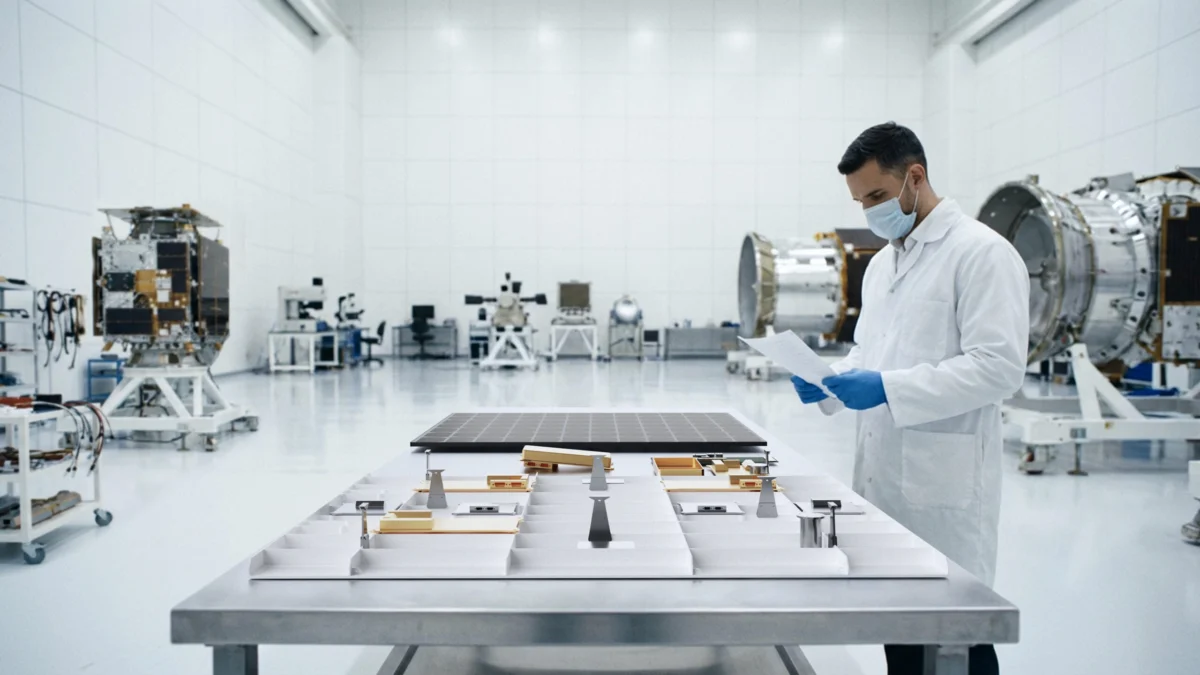
In an era where terrestrial data centers are grappling with exponential energy demands, extreme water usage, and physical space constraints, a revolutionary vision is emerging from the convergence of aerospace engineering and high-performance computing. On July 29, 2026, Sophia Space and the California Institute of Technology (Caltech) announced a landmark development in infrastructure: the issuance of U.S. Patent No. 12,679,564, titled Space-Based Data Centers.
This patent, which officially entered the public record on July 14, 2026, after being filed in October 2024, marks a foundational shift in how humanity may soon handle the world’s ballooning data processing requirements. By moving the physical hardware of the internet into orbit, the collaboration aims to solve the "energy lifecycle" crisis currently plaguing earthbound cloud providers.
The Genesis of an Orbital Infrastructure
The journey toward Patent No. 12,679,564 began not in a server room, but within the rigorous, high-stakes environment of NASA’s Jet Propulsion Laboratory (JPL). The patent credits seven primary inventors—a team representing a "who’s who" of aerospace and systems engineering: Dr. John R. Brophy (JPL), Dr. Leon Alkalai (Sophia Space), Prof. Sergio Pellegrino (Caltech), Dr. Jonathan Sauder (JPL), Timothy P. McElrath (JPL), Dr. Douglas J. Sheldon (JPL), and Don J. Hunter.
The core of the initiative lies with Dr. Leon Alkalai, a longtime JPL Fellow and an expert in space systems. Recognizing that the commercialization of space required a more specialized, venture-backed approach, Alkalai founded Sophia Space in June 2023. Operating as a portfolio company of Mandala Space Ventures—a Pasadena-based venture studio dedicated to the burgeoning orbital economy—Sophia Space was specifically designed to translate deep-space expertise into tangible commercial utility.
Chronology of the Development
- June 2023: Leon Alkalai founds Sophia Space under the umbrella of Mandala Space Ventures.
- October 2024: Formal application for Space-Based Data Centers patent filed with the U.S. Patent and Trademark Office.
- July 14, 2026: Patent No. 12,679,564 is officially issued.
- July 29, 2026: Sophia Space and Caltech publicly announce the patent, confirming a new sponsored research agreement to advance the technology.
The TILE Architecture: Solving the Thermal Conundrum
The most significant hurdle in space computing is not just power—which can be harvested through solar arrays—but the management of heat. On Earth, data centers rely on massive HVAC systems, liquid immersion, or external ambient air to keep processors from melting. In the vacuum of space, convection is impossible.
Dr. Alkalai explains that the "TILE" architecture—the centerpiece of the patent—redefines the thermodynamics of computing. "You can’t simply take a terrestrial data center and move it into space," Alkalai stated. "Building data centers in space requires a fresh look at the energy life-cycle problem. Cooling in space is not simple. The only way to cool the data center in space is by radiating waste heat into deep space."
The TILE architecture represents a modular, scalable, passively-cooled computing and storage unit. These tiles are designed to be assembled into large-scale computing surfaces in orbit. By orienting these surfaces to constantly receive solar energy while simultaneously radiating waste heat into the cold, infinite sink of deep space, the TILE system creates a perpetual thermal equilibrium. This eliminates the need for power-hungry mechanical cooling systems, potentially making orbital data centers far more energy-efficient than their terrestrial counterparts.
Supporting Research: The Caltech-Sophia Partnership
The issuance of the patent is merely the starting line. To move from a patent-protected concept to an operational constellation of data servers, Sophia Space has entered into a new sponsored research agreement with Caltech.
Under the direction of Prof. Sergio Pellegrino, a pioneer in deployable structures, this research will focus on the mechanical viability of large-scale orbital arrays. The collaboration aims to develop:
- Lightweight Deployables: Structures that can be folded into a launch vehicle’s fairing and unfurled in orbit to cover square meters or even hectares of space.
- Advanced Thermal Management: Research into high-emissivity materials that can accelerate the radiation of heat away from the TILE units.
- Modular Assembly: Developing automated or robotic techniques to scale the infrastructure incrementally as demand grows.
This research is critical because the economics of space depend on mass and surface area. Every kilogram launched into orbit carries a significant price tag; therefore, the structures must be incredibly light, yet durable enough to withstand the orbital environment, including micro-meteoroids and ionizing radiation.
Implications for the Global Data Economy
The implications of the Sophia Space-Caltech patent reach far beyond the aerospace industry. We are currently witnessing a global struggle between the rapid advancement of Artificial Intelligence (AI) and the carbon footprint of the data centers that power it.
1. Decoupling Growth from Carbon
Terrestrial data centers are becoming primary consumers of regional power grids, often forcing utilities to keep aging fossil-fuel plants operational. By relocating high-latency or high-demand computing tasks to space, companies could tap into constant, uninterrupted solar energy, effectively decoupling the growth of digital infrastructure from terrestrial climate goals.
2. The Rise of the Orbital Economy
The involvement of Mandala Space Ventures highlights a broader trend: the transition of space from a realm of government exploration to a sphere of private industrial utility. If Sophia Space succeeds, it will pave the way for an "orbital manufacturing and compute" sector. This would create a new class of assets in Low Earth Orbit (LEO) and Geostationary Orbit (GEO) that provide high-speed, secure, and potentially sovereign-immune data services.
3. Latency and Data Sovereignity
While latency remains a factor for orbital data centers—due to the distance signal must travel—the architecture is uniquely suited for data-intensive, non-latency-sensitive workloads, such as deep-learning model training, large-scale data archival, and scientific simulations. Furthermore, for nations or corporations looking to safeguard data outside of traditional terrestrial jurisdictions, an orbital data center provides a unique, highly secure physical environment.
Future Outlook: Challenges and Regulatory Hurdles
Despite the technical elegance of the TILE architecture, the path to commercialization is steep. The team must address several critical challenges:
- Launch Costs: While launch costs have plummeted due to reusable rocket technology, maintaining and upgrading space-based hardware remains a logistical challenge compared to replacing a server rack in a suburban warehouse.
- Orbital Debris: As more modular units are launched, the management of these arrays to avoid orbital debris will be paramount.
- Data Security: Transmitting data to and from orbit via high-bandwidth laser communication (optical comms) requires robust encryption and hardware hardening against solar flares and cosmic rays.
"This patent reflects a different way of thinking about computer infrastructure," Dr. Alkalai noted. By shifting the paradigm from "cooling the box" to "radiating into the void," the Sophia Space team has identified a pathway that leverages the fundamental laws of physics to solve a modern engineering crisis.
As the industry watches the progress of this partnership, it is clear that the cloud is no longer just a metaphor. Within the next decade, the "cloud" may very well be located thousands of miles above our heads, silently processing the world’s information while powered by the sun and cooled by the absolute zero of deep space. For Sophia Space, Caltech, and the team at Mandala Space Ventures, the race to build the first true extraterrestrial infrastructure has officially begun.