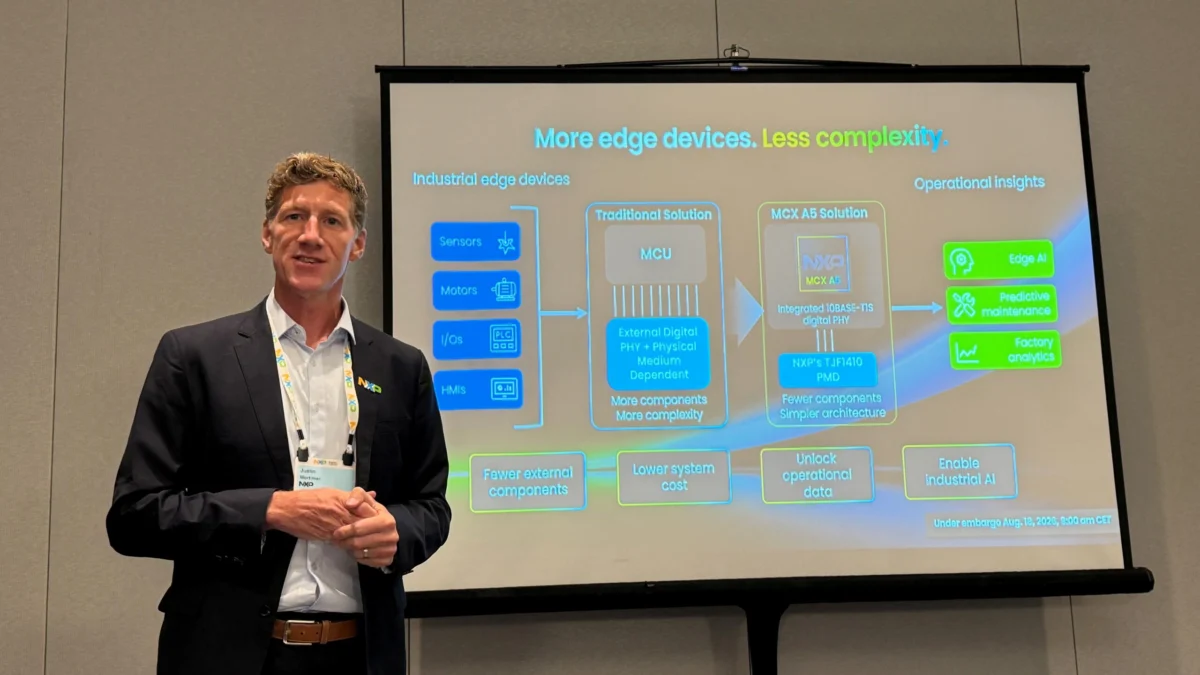
At the NXP Technology Days event held last week in Santa Clara, California, NXP Semiconductors unveiled a strategic advancement in industrial and edge-IoT connectivity: the MCX A5 microcontroller (MCU) family. By integrating 10BASE-T1S Ethernet and groundbreaking topology discovery capabilities, NXP aims to solve one of the most persistent challenges in factory automation: the "dark" endpoint. This release marks a shift in how engineers design for the industrial edge, transitioning from opaque, legacy fieldbus systems to transparent, IP-addressable, and quantum-ready architectures.
The Main Facts: Bridging the Divide
The MCX A5 family is designed to function as a bridge between the physical realities of industrial hardware and the digital requirements of modern operational intelligence. Traditionally, sensors, actuators, and motor controllers in a factory setting have been linked via serial fieldbus protocols like RS-485. While reliable and simple to install, these buses suffer from a lack of inherent network visibility; they are often "gray" zones where individual nodes remain unreachable as unique IP entities.
NXP’s solution integrates 10BASE-T1S Ethernet—a standard for single-pair Ethernet (SPE)—directly into the MCU. This allows manufacturers to extend Ethernet connectivity to the very edge of the system. The inclusion of topology discovery enables these devices to be automatically identified and mapped on a network, effectively turning an opaque multi-drop bus into a transparent, managed network.
Key technical specifications for the MCX A5 include:

- Processor Core: Arm Cortex-M33, clocked up to 240 MHz.
- Memory: Up to 2 MB of Flash and 640 KB of SRAM.
- Connectivity: 10BASE-T1S Ethernet, I3C, CAN FD, High-Speed USB, and FlexIO.
- Security: PSA Certified Level 3, featuring Post-Quantum Cryptography (PQC) hardware root of trust.
- Ecosystem: Supported by the MCUXpresso developer suite, including integrated Rust support for memory-safe programming.
A Chronology of the Shift Toward "Right-Sized" Intelligence
The unveiling of the MCX A5 follows a long-term trajectory for NXP. Earlier this year at Computex in Taiwan, NXP CEO Rafael Sotomayor articulated a vision of "right-sized intelligence"—the idea that physical AI must be scalable, requiring compute power that matches the needs of specific edge nodes rather than forcing high-power processors into every corner of a factory floor.
The chronology of this development reflects the broader industry trend:
- Phase 1 (Legacy Era): Adoption of RS-485 and traditional fieldbus, which provided basic connectivity but zero network intelligence or addressability.
- Phase 2 (The Connectivity Push): The industry began moving toward Ethernet, but the complexity and cost of 10/100/1000BASE-T hardware made it prohibitive for small, low-power sensors.
- Phase 3 (The SPE Transition): The emergence of IEEE 802.3cg-compliant 10BASE-T1S allowed for low-cost, low-power, single-pair Ethernet.
- Phase 4 (The NXP Innovation): By embedding topology discovery into the microcontroller itself, NXP has effectively "closed the loop," allowing the network to manage itself, map its own structure, and provide the diagnostic data necessary for modern Industry 4.0 applications.
Supporting Data and Technical Architecture
The technical architecture of the MCX A5 is built to minimize system complexity. By pairing the MCX A5 with NXP’s TJF1410 10BASE-T1S physical medium dependent (PMD) transceiver, developers can create a robust, cost-effective single-pair Ethernet solution.
The topology discovery feature is particularly notable. In a multi-drop environment, the software within the MCX A5 acts as a node-mapping utility. When queried, the system can automatically identify what is connected to the bus, where it is located, and its current status. As Justin Mortimer, NXP’s senior director for secure connected edge products, noted, this is not intended to be a constant background process that clogs bandwidth. Instead, it serves as a powerful configuration, diagnostic, and maintenance tool.

For maintenance teams, the implications are immediate. Rather than troubleshooting a "dead" segment of a factory line by manually checking every connection on an RS-485 chain, a technician can use an HMI to visualize the network, identify the specific node that has failed, and perform a hot-swap or firmware update—all without interrupting the broader network.
Official Perspectives: Security as a Foundation
Security was the central pillar of the NXP Technology Days presentation. With the rise of the Cyber Resilience Act (CRA) and similar regulations, NXP has positioned the MCX A5 to ensure compliance throughout a product’s 10-to-20-year lifespan.
"It’s not just about what is needed today," said Justin Mortimer during his keynote. "It’s about protecting the infrastructure for the next two decades."
To this end, the MCX A5 includes a hardware root of trust, secure boot, secure firmware updates, and secure attestation. Furthermore, the inclusion of PQC support ensures that the devices are resilient against future cryptographic threats, including those posed by potential quantum computing advancements. The support for the Rust programming language is another forward-looking choice, enabling developers to mitigate memory-safety vulnerabilities—a common vector for cyberattacks in industrial systems.

Implications for Industrial Verticals
The practical applications for this technology are vast, spanning logistics, building automation, and robotics.
Logistics and Warehousing
In high-throughput environments like automated distribution centers, systems are often expanded in phases. Traditional systems require significant rewiring when a new conveyor or sorting belt is added. With the MCX A5, each new segment can be added as an IP-addressable node. The network "discovers" the new hardware automatically, significantly reducing the downtime associated with facility expansion.
Building Automation
HVAC systems and lighting control represent the most immediate "brownfield" opportunity. These systems are currently heavily reliant on legacy buses. The MCX A5 offers a drop-in migration path, allowing facility managers to gain IP-based control and diagnostic capabilities without the need to tear out existing wiring infrastructure.
Robotics and Physical AI
The most ambitious application lies in advanced robotics. Modern robots are increasingly complex, with distributed intelligence across motors, grippers, and tactile sensors. By assigning an IP address and a secure identity to every joint and sensor, the central AI controller can gain a holistic, real-time view of the robot’s health and performance. This move toward "transparent" robotics is expected to be a major driver for the next generation of physical AI.

Conclusion: A New Standard for the Edge
The NXP MCX A5 family represents a significant milestone in the evolution of the industrial edge. By solving the dual problems of network opacity and long-term security, NXP has provided a path for legacy industries to modernize without the need for a "rip and replace" strategy.
As manufacturers face increasing pressure to extract data from every corner of the production line to fuel their AI analytics, the ability to see—and securely manage—every endpoint will become a prerequisite for competitiveness. With the MCX A5, NXP is not just selling a microcontroller; it is providing the architectural foundation for the next decade of industrial automation. Whether through the lens of easier maintenance, improved security, or the enabling of complex physical AI, the impact of these new MCUs will be felt in factories and warehouses long after the initial deployment phase.