In a significant move to reshape how software is built within the enterprise, Slack has officially unveiled "Slack Code"—a transformative feature set that introduces dedicated "code channels." By fostering a shared, multi-player environment, this initiative aims to dissolve the traditional silos between software developers and non-technical business stakeholders, allowing both groups to collaborate directly with AI coding agents in real-time.
As businesses race to integrate artificial intelligence into their workflows, Slack—now a cornerstone of the Salesforce ecosystem—is positioning itself as the central command center for this transition. The goal is no longer to treat AI as a personal assistant for the individual programmer, but as a collaborative teammate accessible to product managers, marketers, and designers alike.
The Core Concept: A Multi-Player AI Workspace
The fundamental premise of Slack Code is the transition from solitary AI interactions to communal, project-based development. Previously, developers would interact with coding agents—such as GitHub Copilot or Anthropic’s Claude—in isolated threads. While efficient for the individual, this created an "information black hole" for the rest of the team.
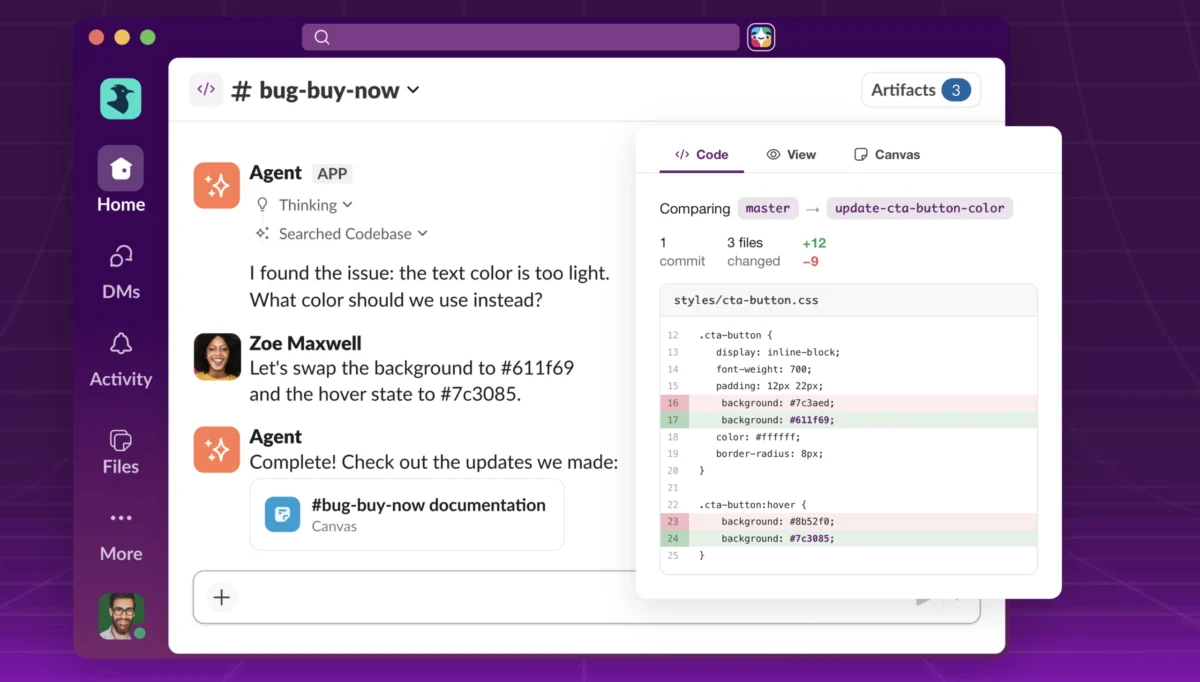
Slack’s new "code channels" function as ephemeral, purpose-built workspaces. When a team member tags a supported AI agent in a standard Slack channel or direct message with a specific request—such as fixing a bug, updating a web page, or scaffolding a new application feature—the system automatically spins up a dedicated code channel. This new space aggregates relevant documentation, invites key stakeholders, and provides a persistent, searchable history of the project’s evolution.
Within these channels, participants can use natural language to guide the AI, review code diffs, and inspect live HTML previews via Slack’s "canvas" feature. When the task is complete, the channel is archived, leaving behind a clean record of the collaboration.
Chronology of the Development
The path to Slack Code reflects a broader evolution in the "Agentic AI" landscape:
- Pre-2023: Slack functioned primarily as a communication hub where developers manually shared code snippets and logs from external IDEs (Integrated Development Environments).
- 2023–Early 2024: The proliferation of AI coding assistants (Devin, Copilot, Cursor) began, but these tools remained largely disconnected from the collaborative fabric of the workplace.
- Mid-2024: Slack began integrating individual AI agents, allowing users to converse with bots within the platform, though these interactions remained largely siloed.
- November 2024: The formal introduction of "Claude Tag" marked the beginning of a shift toward agents as "teammates" rather than tools.
- Current Date: The launch of Slack Code channels realizes the vision of "multi-player AI," where agents act as facilitators within the shared, governed environment of a workspace.
Supporting Data and Technical Architecture
At its launch, Slack Code supports a robust suite of industry-leading coding agents: Claude Code, Devin, GitHub Copilot, and Vercel. Slack has indicated that this list will expand as the ecosystem matures.
The architecture relies on three primary pillars:
- Session Artifacts: These are the visual outputs of the agent. They include code diffs (highlighting granular changes), canvas documents (for collaborative drafting), and live previews (allowing non-technical users to see the functional outcome of the code).
- Governed Guardrails: To prevent "shadow engineering," Slack admins can set strict permissions. This ensures that while non-technical staff can participate in the ideation and review process, they cannot push code to production without explicit engineering sign-off.
- Security Integration: The feature inherits the enterprise-grade security and permission models already established in a company’s Slack instance, ensuring that agents only have access to data for which the workspace has already granted authorization.
Official Responses and Strategic Vision
Sateja Parulekar, Vice President of Product Marketing at Slack, emphasized that this is part of a deliberate strategy to turn Slack into the "home for agents."
"We built code channels to be this multi-player AI experience," Parulekar stated. "It’s not just engineers and product managers; it’s marketers and product designers who are now able to interact with a coding agent in a safe, governed environment. We are closing the gap between where work gets done and where code gets written."
Wayne Kurtzman, a research vice president at IDC, views this as a vital step for the modern enterprise. "Slack Code closes the gap between where work gets done and where code gets written," Kurtzman noted. "This furthers the Salesforce goal of making work more seamless and multi-player within the Slack environment, regardless of the other applications the business is using."
Implications for the Future of Work
The introduction of Slack Code raises significant questions about the future of software development, corporate roles, and the broader application of agentic AI.
1. The Blurring of Roles
For years, the "technical" vs. "non-technical" divide has been a defining characteristic of software teams. Slack Code effectively invites stakeholders into the development loop. A marketing manager can now request a landing page change, view a live preview, and approve the CSS changes without ever leaving their communication hub. While this increases efficiency, it also necessitates a new set of soft skills for non-technical employees, who must learn to communicate effectively with large language models (LLMs).
2. The Governance Challenge
Will McKeon-White, a senior analyst at Forrester, highlights that "permissions" will be the primary friction point for IT departments. "Some inherit user permissions based on task, some have persistent permissions… each has flaws," he warned. As organizations adopt these tools, IT administrators will face the daunting task of creating "safe" channels where AI can operate autonomously without creating security vulnerabilities or unauthorized code deployments.
3. Emergent Behaviors and Multi-Agent Collaboration
The long-term implication is the move toward "dynamic, multi-agent collaboration." Today, Slack Code handles one-to-one or one-to-many interactions between humans and a single agent. However, the future likely involves multiple agents—one for UI, one for backend logic, and one for security auditing—working in concert. As noted by Anthropic’s research, this could lead to "emergent behavior," where agents solve complex, cross-functional problems in ways that human supervisors may not have anticipated.
4. Beyond Coding
Slack’s vision extends well beyond software development. Parulekar confirmed that the infrastructure behind Slack Code—the ability to track changes, review documents, and preview outputs—will eventually be applied to legal, marketing, and HR workflows. Imagine a "Legal Channel" where an AI agent reviews a contract, highlights redlines, and allows stakeholders to collaborate on the final draft in real-time, all within a governed Slack space.
Conclusion: A New Operating System for Collaboration
Slack Code is not merely a feature release; it is a signal that the workplace is evolving into a space where the distinction between "talking about work" and "doing work" is vanishing. By moving the coding process directly into the channel, Slack is attempting to become the primary operating system for the AI-augmented enterprise.
While the feature is currently available at no extra cost to Slack subscribers, its true value will be measured by how well organizations navigate the shift in culture and governance. For first-movers, the advantage is clear: a faster, more collaborative, and more inclusive development lifecycle. For others, the challenge will be adapting to a world where the AI agent is not just a tool, but a permanent, multi-player member of the team.