For years, the Mobile World Congress (MWC) has served as a theatrical stage for the future of robotics. Attendees have grown accustomed to the spectacle: mechanical dogs patrolling exhibition halls and robotic baristas meticulously pouring lattes. While these displays were once dismissed as mere "trade show novelties," the narrative has shifted. As Artificial Intelligence migrates from the confines of cloud servers and smartphone screens into physical, embodied hardware, these machines are evolving from curiosities into critical infrastructure.
From Honor’s "Lightning" humanoid—which made headlines by shattering the world record for a half-marathon—to autonomous security units at the FIFA World Cup, the "robotic era" is no longer a distant forecast. It is an industrial imperative. However, as AI takes physical form, it poses an existential question for the telecommunications industry: Is the current network architecture robust enough to sustain a world populated by billions of autonomous, data-hungry agents?
The Paradigm Shift: From Downlink to Uplink
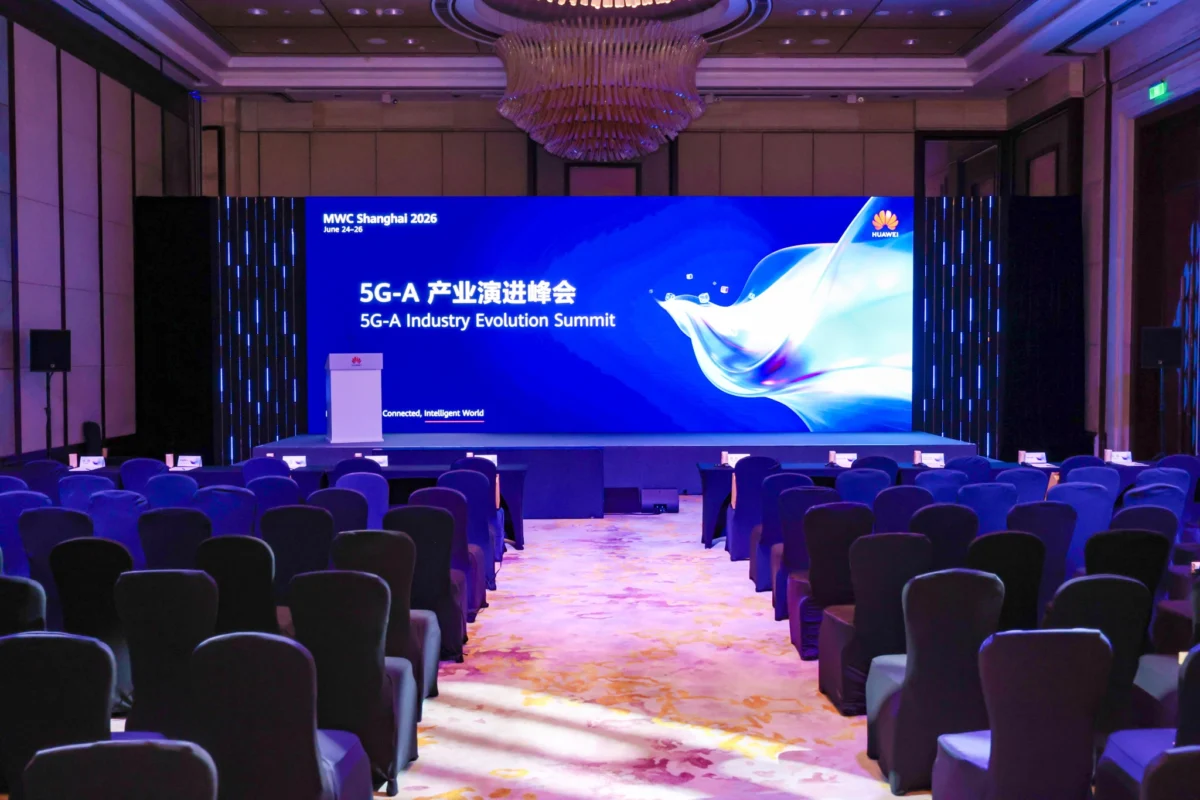
The consensus emerging from the 5G-A Industry Evolution Summit at MWC Shanghai 2026 is clear: 5G-Advanced (5G-A) is not merely a marginal upgrade in speed or capacity. It is the foundational layer upon which the physical AI ecosystem must be constructed.
For decades, mobile network design has been tethered to a "downlink-heavy" philosophy. The architecture was optimized for human consumption: streaming high-definition video, browsing the web, and downloading files. However, embodied AI fundamentally inverts this requirement.
Humanoid robots, autonomous industrial vehicles, and multi-modal AI terminals operate on a cycle of constant interaction with their environment. They must ingest massive streams of sensory data—LiDAR, 4K video, thermal imaging, and haptic feedback—and transmit it to the edge or cloud for instantaneous processing. This requires an unprecedented level of uplink capacity. If the network is a highway, the AI revolution is changing the traffic flow from a trickle of inbound information to a flood of outbound data.
Chronology of an Evolution: The Path to Intelligent Connectivity
The transition to an AI-native network has been a steady progression, accelerated by the maturation of generative AI models:
- 2023–2024 (The Pilot Phase): Early experimentation with robot dogs and basic automated delivery bots. Networks functioned adequately on standard 5G, as deployments were isolated and limited in scale.
- 2025 (The Compute Bottleneck): As robots became more complex, developers attempted to place high-end GPUs directly on the hardware. The result was a failure in commercial viability; power consumption proved too high, and battery life was decimated.
- 2026 (The 5G-A Pivot): MWC Shanghai 2026 marked the turning point. Industry leaders officially pivoted toward a "cloud-edge synergy" model, where the "robotic brain" is offloaded to the network, and the terminal focuses on sensing and acting.
- 2027–2035 (The Scaling Era): With 15 billion AI terminals projected to be active by 2035, the focus has shifted to massive-scale, deterministic network performance.
Supporting Data: Why "Best-Effort" Networks Must Die
The technical requirements for this new era are stringent. According to insights from the 5G-A Summit, a 20Mbps uplink has become the new baseline technical requirement to sustain real-time AI modeling and situational awareness.
"Scaling autonomous intelligence puts a massive strain on our current infrastructure," explains Yang Lifan, Deputy General Manager of China Unicom Beijing. "We can handle two cameras on a robot, but what happens when you have eight? We can support five robots at a site, but what about a hundred operating simultaneously? We need to highly optimize our 5G-A networks for these conditions."
The efficiency gap is staggering. Experts from TD Tech, which characterizes itself as a "robotic brain business," note that running an AI model locally on a device consumes nearly 20 times more energy than offloading that same task to the cloud via a high-performance network. To preserve the battery life and mobility of these devices, the pressure must shift from the device’s hardware to the operator’s network.
Furthermore, latency requirements have moved beyond the "consumer-grade" threshold. When a robot interacts with a human, it requires a response latency of approximately 650ms to ensure safety and precision. This necessitates a move away from "best-effort" network delivery toward "deterministic" performance, where latency, jitter, and packet loss are strictly managed and guaranteed.
Official Responses and Strategic Initiatives
In response to these challenges, Huawei and other industry leaders have launched specialized solutions, such as "GigaUplink." By utilizing multi-antenna technology upgrades and sophisticated scheduling algorithms, these solutions aim to deliver a five-fold increase in uplink capacity, directly addressing the bottlenecks identified by operators.
Eric Yang, President of Huawei Carrier Business, emphasized that the three pillars of the mobile AI era are "big bandwidth, uplink expansion, and user experience guarantee." These are not luxury features, but the mandatory plumbing of the future economy.
A significant point of contention remains the spectrum. The industry is currently rallying for the Upper 6GHz (U6G) band (6.425–7.125 GHz). As David Li, President of Huawei’s TDD Product Line, noted, "U6G is the second-best spectrum for widespread 5G-A deployment after C-band. With improvements to our technology, we will soon be able to make U6G coverage as good as C-band." This resource is vital to bridge the gap until 6G becomes commercially available.
Implications: The Token-Based Business Model
Perhaps the most profound implication of this technological shift is the potential for a new economic model. For years, the mobile industry has been trapped in a "volume trap," where revenue is tied to gigabytes consumed. As 5G coverage reached near-ubiquity in advanced markets, average revenue per user (ARPU) stagnated.
The rise of physical AI offers a way out. Because AI operates on "tokens"—the units of processing power and data exchanged between a device and a model—operators have the opportunity to shift from billing for data "weight" (gigabytes) to billing for "intelligence" (tokens).
By acting as an orchestrator of compute power rather than just a pipe for data, telcos can implement Network-as-a-Service (NaaS) frameworks. This would allow operators to offer tiered, deterministic service guarantees based on application profiles. Whether it is a precision-manufacturing robot requiring sub-10ms latency or a drone swarm requiring high-bandwidth uplink, operators can monetize the value of the connection rather than the volume of the data.
Conclusion: Orchestrating the Future
The transformation of the mobile network into an AI-native ecosystem is not a choice; it is a necessity driven by the demands of the physical world. As we look toward 2035, the mobile industry stands at a crossroads. By embracing 5G-A, advocating for essential spectrum like U6G, and evolving toward token-based business models, telcos can transition from being a simple utility provider to the indispensable backbone of the autonomous age.
The "happy robot" of the future requires a sophisticated, symmetrical, and deterministic network. If the industry successfully navigates these architectural and commercial shifts, it will not only resolve its long-standing monetization struggles but will also cement its role as the primary facilitator of the next great technological revolution. The machines are ready—the question is, is the network?