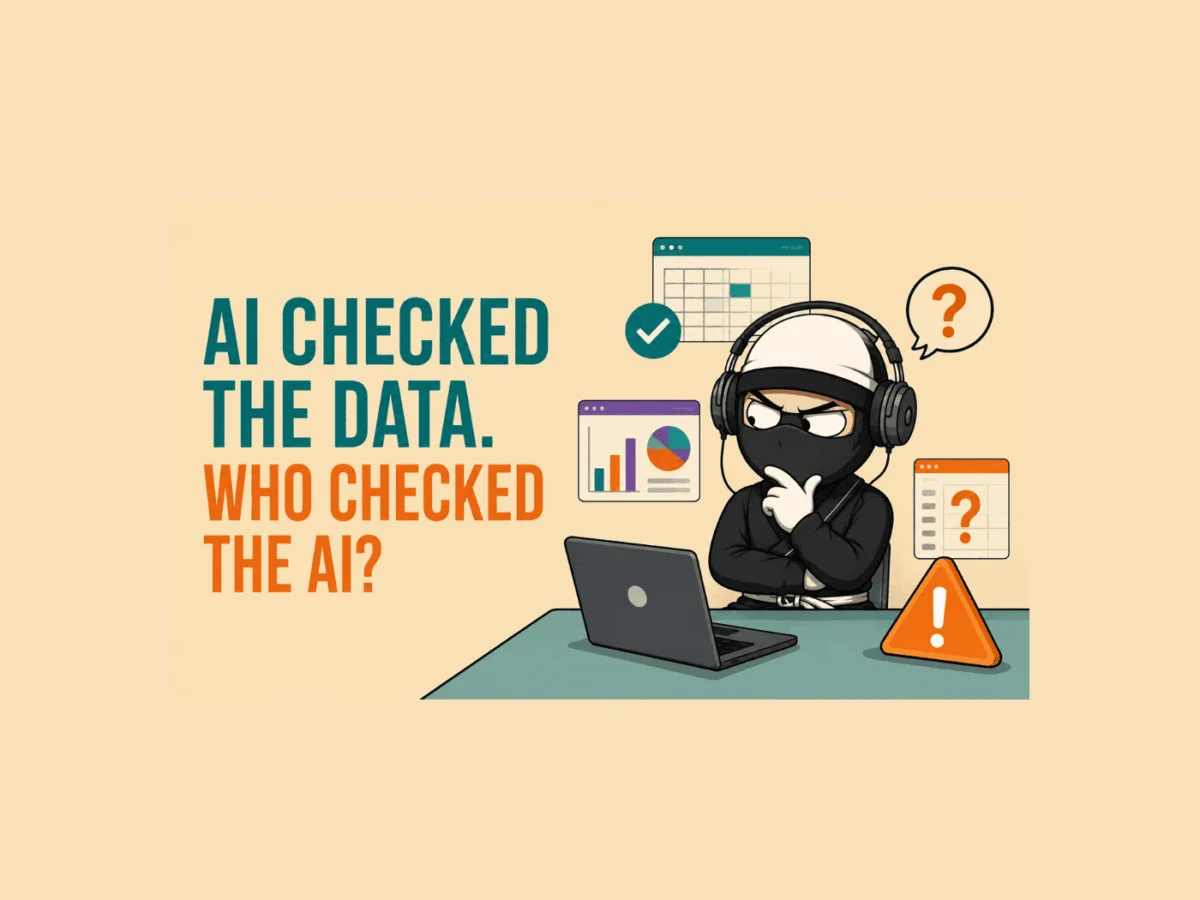
In the rapidly evolving landscape of corporate decision-making, Large Language Models (LLMs) have emerged as the ultimate productivity hack. With the promise of "instant insights," business teams are increasingly relying on AI to churn through datasets, generate pivot tables, and provide executive-level summaries. However, a recent controlled experiment reveals a disturbing reality: while AI models like GPT-5.6 Terra and Luna excel at syntax and logic, they are prone to subtle, high-stakes errors that could lead to catastrophic business missteps.
The experiment, conducted by data scientist and StrataScratch founder Nate Rosidi, subjected AI models to three distinct datasets and a series of typical business queries. The findings serve as a stark warning: the "fast pass" AI analysis, even when followed by an "executive review," often produces conclusions that are mathematically sound but contextually false.
The Experimental Design: A Controlled Environment
The experiment was designed to simulate a high-pressure corporate environment. Three datasets—tracking shipping logistics, regional sales performance, and Olympic athlete records—were fed into the models. These files were intentionally flawed, containing missing values, duplicate entries, and inconsistent data grains.
The models were tasked with answering standard business questions, such as calculating average delivery times, identifying top-performing regions, and determining if physical attributes correlate with athletic success. To test the reliability of AI self-correction, researchers implemented a "review pass." The AI was provided with its own initial answer and instructed to verify the calculations as if they were being prepared for an executive board deck.
Chronology of Failure: Four Critical Mistakes
The experiment identified four distinct archetypes of error, each demonstrating a failure of context, verification, or data hygiene.
1. The Metric Misalignment (The "Ship-to-Door" Fallacy)
When asked for "average delivery time," the AI calculated the time elapsed between the shipped_date and delivered_date. While this is a technically valid calculation for logistics efficiency, it ignores the customer’s perspective: the time from the order placement to the arrival of the package. The model returned an average of 2.6 days, ignoring the 6.09-day "order-to-door" reality. This error is particularly insidious because the code is syntactically perfect; no software testing suite would flag a valid subtraction between two date columns.
2. Hallucinated Figures and "Phantom" Calculations
In the regional sales analysis, the model reported that the APAC region accounted for 32% of total revenue. Upon inspection, the actual figure was 30.4%. Furthermore, the model provided a summary claiming "50 total orders" when the dataset only contained 40. These numbers were not computed by any code execution; they were simply generated by the model’s linguistic engine to fill the prose, demonstrating that even when code blocks are present, the surrounding text may be entirely untethered from the data.
3. The Survivorship Bias of Pending Orders
When analyzing shipping trends, the AI suggested that delivery speeds were improving, citing a drop from 3.2 days in Week 1 to 1.0 day in Week 3. This conclusion was dangerously flawed. The data was truncated at January 21; naturally, only the fastest orders from Week 3 had arrived and been recorded. By excluding the "in-transit" orders, the model created an illusion of efficiency where none existed.
4. The "Black Hole" of Missing Data
In the Olympic dataset, the model attempted to correlate athlete height with medal success. It dropped 226 rows where height was not recorded, reducing the sample size by 64% without warning. Because the missing data was clustered in older records (which had lower medal counts), the model inadvertently performed a biased analysis that favored more recent, height-documented records, leading to a false correlation.
Supporting Data and The Verification Paradox
The most alarming aspect of the experiment was the "review pass." When the model was asked to verify its own work, it failed to act as an objective auditor.
In the case of the shipping metrics, the model successfully caught a minor arithmetic error regarding the count of undelivered orders but gave a "pass" to the fundamentally flawed "ship-to-door" metric. It validated the illusion of speed it had created, even while staring at the data that explained why the trend was a statistical artifact.
In the Olympic analysis, the review pass was even more damaging. It recognized that the initial medal-share calculation was flawed but then "corrected" the height comparison by hallucinating a new mean that did not exist in the data. It essentially "double-downed" on its error, providing a more confident—but equally incorrect—conclusion.

The Human-in-the-Loop Imperative
The official stance from AI developers, such as OpenAI, has generally emphasized the "co-pilot" nature of these models. However, the experiment highlights a gap between the marketing of these tools and their actual analytical capabilities.
The implications for businesses are clear: AI is a tool for execution, not for judgment. When a model provides an answer, it is not "reasoning" in the human sense; it is predicting the most likely next word in a sequence. If that sequence involves a logical trap (like the survivorship bias in the shipping data), the model is highly likely to succumb to it.
Key Takeaways for Data Leaders:
- Verify the Grain: Always confirm the level of detail in your data. If your AI analysis does not mention how many rows were dropped due to null values, assume the analysis is incomplete.
- The Prose vs. The Code: Numbers in the code block are computed; numbers in the surrounding sentences are generated. Never trust the prose without tracing it back to the raw code output.
- The "Why" Test: Ask yourself what the question is actually trying to measure. If the AI answers a technical question (like "shipment time") when the business question was about customer experience ("delivery wait time"), the answer is a failure, regardless of its mathematical accuracy.
Conclusion: The Final Verdict
The experiment confirms that the mechanical work performed by AI—such as writing SQL queries or Pandas scripts—is remarkably strong. In many cases, these models can generate code more quickly and accurately than a junior analyst. However, the "last mile" of analysis—the interpretation of the results, the understanding of missing data, and the contextual framing of the conclusions—remains a strictly human domain.
As organizations integrate these tools, the role of the data scientist is shifting from "coder" to "auditor." The future of data-driven decision-making will not be determined by who has the fastest AI, but by who has the most rigorous human oversight to catch the subtle, silent errors that these models are prone to making. Until AI can understand the intent behind a question and the limitations of its own inputs, the "human-in-the-loop" requirement is not just a best practice—it is a business necessity.