The United States broadband market is experiencing a significant technological inflection point as Wi-Fi 7 adoption rapidly gains momentum. This burgeoning trend, fueled by consumer demand for faster, more reliable wireless connectivity, is creating a vital technology refresh cycle for both internet service providers (ISPs) and manufacturers of home networking equipment. While still in its early stages, Wi-Fi 7’s rapid growth signals a shift beyond early adopters, promising to unlock the full potential of multi-gigabit internet services and pave the way for future AI-driven applications.
The Ascendancy of Wi-Fi 7: A New Benchmark in Wireless Performance
Data from Ookla Speedtest paints a compelling picture of Wi-Fi 7’s burgeoning presence. In the first quarter of 2026, Wi-Fi 7 accounted for 7.2 percent of all Wi-Fi router generations reported by U.S. providers, a dramatic leap from a mere 1.8 percent in the same period of the previous year. This remarkable 300 percent year-over-year growth trajectory underscores a pivotal shift in the consumer electronics landscape, with households increasingly upgrading routers, smartphones, laptops, and other connected devices to embrace the next generation of wireless technology.
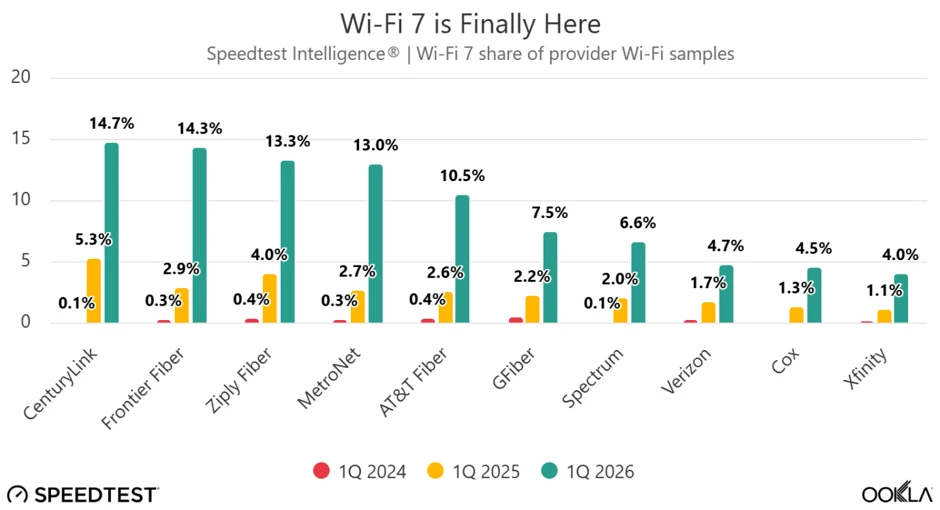
The initial wave of Wi-Fi 7 products began to surface in early 2024. However, adoption remained subdued, hovering below 1 percent at the close of Q1 2024 and staying in the low single digits throughout the following year. The latest figures, however, indicate a much more substantial upgrade cycle is now underway. According to Kerry Baker of Ookla, this acceleration is intrinsically linked to broadband providers integrating Wi-Fi 7-enabled gateways with their increasingly robust fiber and cable networks, creating a synergistic environment for enhanced performance.
Fiber Providers Lead the Charge in Wi-Fi 7 Penetration
When examining Wi-Fi 7 adoption as a percentage of their existing customer base, fiber broadband providers are emerging as the frontrunners in the U.S. market. These companies are actively deploying Wi-Fi 7 technology to complement their high-speed fiber optic infrastructure, offering subscribers a seamless and powerful wireless experience.
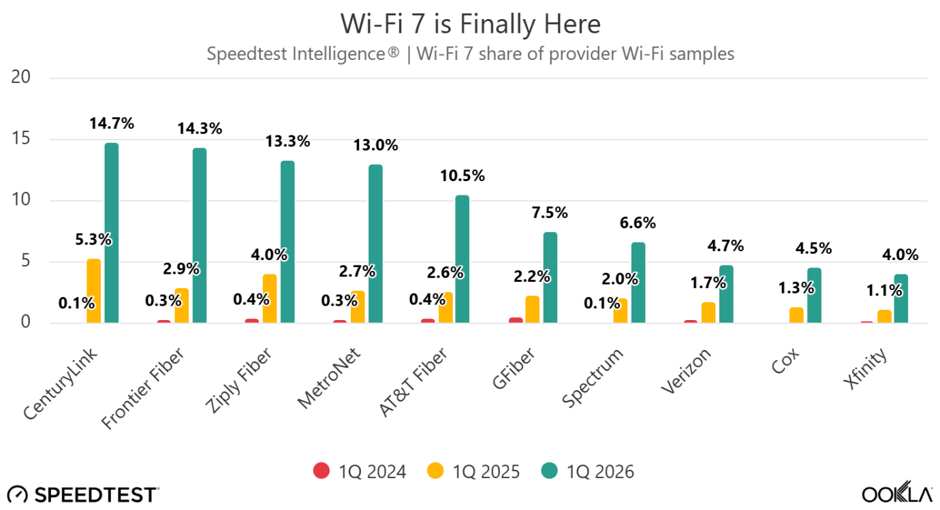
Leading this charge is CenturyLink, which boasts the highest Wi-Fi 7 penetration rate at an impressive 14.7 percent of its customer base. Hot on its heels are Frontier, with 14.3 percent, and Ziply Fiber, closely followed by MetroNet, with penetration rates of 13.3 percent and 13.0 percent, respectively. These figures significantly outpace the national average of 7.2 percent, highlighting the strategic advantage fiber providers hold in delivering the full benefits of Wi-Fi 7.
Conversely, cable broadband providers are showing lower penetration rates. Spectrum, a major player, recorded 6.6 percent Wi-Fi 7 penetration, while Cox and Xfinity trailed with 4.5 percent and 4.0 percent, respectively. This data reveals a clear divide within the U.S. broadband market: while fiber operators are leading in the percentage of customers adopting Wi-Fi 7, large cable companies possess the potential to dominate in terms of absolute user numbers due to their extensive subscriber bases.
Spectrum Dominates by Volume, Highlighting Scale in Wi-Fi 7 Deployment
Despite lower penetration rates, cable operators are demonstrating significant market presence through sheer scale. Spectrum, for instance, emerged as the largest Wi-Fi 7 provider in the U.S. by Speedtest sample volume in Q1 2026, accounting for a substantial 24.9 percent of all reported Wi-Fi 7 Speedtest samples. This figure more than doubles that of its closest competitor, Xfinity, which garnered 12.4 percent, and significantly surpasses Frontier’s 11.9 percent.
Spectrum’s dominance in Speedtest volume not only solidifies its position as the world’s largest Wi-Fi 7 provider by this metric but also places five U.S. providers among the top 10 globally. This underscores the potent impact of large installed customer bases, allowing cable companies to offset lower penetration percentages with a sheer volume of users actively testing and utilizing Wi-Fi 7 technology.
The potential for even greater market share for Spectrum could arise from Charter’s proposed merger with Cox. However, Cox’s current Wi-Fi 7 penetration rate of 4.5 percent, which is below Spectrum’s 6.6 percent, suggests that this combination might initially dilute Spectrum’s overall penetration rate. Meanwhile, international giants like China Telecom and China Unicom also command significant Wi-Fi 7 networks due to their vast subscriber numbers. However, China’s regulatory decision to allocate the 6 GHz band for mobile telecommunications rather than public Wi-Fi deployment presents a unique challenge to the widespread adoption of 6 GHz spectrum in their Wi-Fi 7 deployments.
Google Fiber Pioneers Multi-Gigabit Homes with Wi-Fi 7 Integration
The integration of Wi-Fi 7 is increasingly becoming the wireless backbone for multi-gigabit fiber broadband services, enabling consumers to fully leverage the capabilities of their ultra-fast internet connections. Google Fiber has been at the forefront of this movement, introducing a custom-engineered Wi-Fi 7 router in February 2026. This router is integral to their Home 3 Gig and Edge 8 Gig broadband offerings, boasting a 10 Gigabit Ethernet port and supporting Multi-Link Operation (MLO) for enhanced wireless performance.
Google Fiber’s Home 3 Gig provides symmetrical download and upload speeds of 3 Gbps, while the Edge 8 Gig delivers an astounding 8 Gbps symmetrical speeds. This strategic deployment highlights a significant opportunity for broadband operators: making multi-gigabit fiber connections far more attractive and valuable to consumers when paired with home Wi-Fi infrastructure capable of exploiting the available bandwidth. While other major U.S. broadband providers like AT&T Fiber, Verizon, and T-Mobile Home Internet are active players, direct comparisons of their Wi-Fi 7 penetration with Ookla’s provider figures require equivalent Speedtest measurements.
6 GHz Spectrum Usage Surges, Empowering Wi-Fi 7’s Potential
The rapid adoption of Wi-Fi 7 is intrinsically linked to the burgeoning utilization of the 6 GHz spectrum band. This expansive band, offering 1,200 MHz of contiguous spectrum between 5.925 GHz and 7.125 GHz, is crucial for Wi-Fi 7’s enhanced capabilities. Ookla’s data reveals a substantial 62 percent surge in U.S. 6 GHz spectrum usage between Q1 2025 and Q1 2026, reaching 13.8 percent of all U.S. Speedtest samples.
This significant increase is a direct consequence of the growing installed base of compatible Wi-Fi routers, alongside smartphones, laptops, and tablets equipped to harness this additional spectrum. Access to the 6 GHz band provides significantly more capacity for demanding applications, simultaneously alleviating congestion on traditional Wi-Fi bands. This makes it a cornerstone of the Wi-Fi 7 value proposition, enabling faster speeds, lower latency, and improved reliability.
Broadband Speeds Soar as Wi-Fi 7 Emerges
The advent of Wi-Fi 7 coincides with a period of substantial speed enhancements across U.S. fixed broadband networks. In Q1 2026, average download speeds for fixed broadband providers reached an impressive 316.34 Mbps, representing a 76 percent increase compared to Q1 2022. Upload speeds also saw remarkable growth, climbing to 68.31 Mbps, approximately tripling their Q1 2022 levels.
This surge in performance is largely attributable to cable network upgrades, particularly the implementation of mid-split and high-split architectures, which have been instrumental in bolstering upstream performance. Fiber networks, by their very nature, continue to offer superior symmetrical download and upload capacities.
Xfinity exemplifies the impact of these broadband network enhancements. Customers utilizing Wi-Fi 6E experienced a dramatic increase in upload speeds, jumping from 41.74 Mbps in Q1 2025 to 99.43 Mbps in Q1 2026. Similarly, Wi-Fi 7 upload performance surged from 41.45 Mbps to 108.76 Mbps during the same timeframe. These figures underscore a critical point: simply deploying a Wi-Fi 7 router does not guarantee performance improvements. The ultimate customer experience is a complex interplay of the broadband connection itself, the gateway, compatible client devices, home network conditions, and the available network capacity.
A New Horizon for Router and Broadband Equipment Manufacturers
The ongoing transition to Wi-Fi 7 is creating a significant opportunity for a widespread equipment refresh across the broadband customer-premises equipment (CPE) market. Ookla’s extensive dataset, encompassing over 150 router vendor entities, provides valuable insights into this evolving landscape.
While Chinese vendors, predominantly TP-Link, represent a notable 16 percent of the overall sample volume across all Wi-Fi bands and generations, their presence in the Wi-Fi 6E and Wi-Fi 7 router segments within the dataset is negligible. This suggests a shift in manufacturing and distribution strategies for these newer technologies. Many routers leased by U.S. internet service providers are sourced from established suppliers like Sagemcom and CommScope. Historically, Chinese-manufactured routers have held a stronger position in the retail market.
The broader broadband CPE ecosystem includes other key players such as Vantiva, Sercomm, Arcadyan, Hitron, and Askey, collectively forming a diverse supplier base poised to capitalize on the ongoing gateway replacement programs initiated by operators.
Vantiva’s recent financial performance serves as another indicator of this robust broadband equipment upgrade cycle. The company’s Broadband business generated €1.336 billion in revenue in 2025, a significant 9.1 percent increase from €1.224 billion in 2024. Vantiva attributes this growth to innovations including Wi-Fi 7 and DOCSIS 4.0, alongside the introduction of new device generations. Their product portfolio prominently features GPON Wi-Fi 7 equipment, a Wi-Fi 7 fiber gateway, and Wi-Fi 7 extenders, positioning them as a key supplier in this dynamic market.
Wi-Fi 7: The Foundation for the AI-Ready Home
The significance of Wi-Fi 7 extends far beyond simply delivering faster internet speeds. As artificial intelligence (AI), cloud computing, augmented reality (AR), high-resolution video, and other immersive applications become increasingly prevalent, they place escalating demands on home networks.
Ookla identifies latency as a particularly critical factor for AR and multimodal AI applications, which perform optimally at latency levels below 20 milliseconds. Fiber broadband, with its inherent characteristics, offers an approximate 10-millisecond advantage over cable in terms of latency, according to Ookla’s findings.
Furthermore, improvements in upstream performance are becoming increasingly vital. AI-generated content, cloud-based applications, real-time collaboration, video uploads, and interactive experiences all rely heavily on robust upload capacity, not just download speed. Wi-Fi 7 technologies, such as wider channels, Multi-Link Operation (MLO), and access to the 6 GHz band, are instrumental in optimizing traffic flow across the home network. However, it remains paramount to recognize that Wi-Fi performance will always be intrinsically linked to the underlying broadband connection, whether it be fiber or cable.
A Multi-Generational Market: Wi-Fi 4 Persists Amidst Rapid Advancement
Despite the rapid ascent of Wi-Fi 7, the U.S. market continues to operate as a multi-generational environment. Wi-Fi 4’s share of Speedtest samples, while declining, still accounted for 10 percent in Q1 2026, down from 13 percent in Q1 2025. This indicates that millions of older Wi-Fi devices and routers remain in active use. This lingering presence of older technology presents a substantial and prolonged upgrade runway for both broadband providers and equipment suppliers.
It is important to note that not every consumer requires immediate access to Wi-Fi 7. Depending on their broadband speed, connected devices, and specific usage requirements, upgrading from older technologies to Wi-Fi 6 or Wi-Fi 6E can still deliver significant performance improvements. Consequently, the transition to newer Wi-Fi standards is likely to unfold gradually rather than through a singular, mass replacement event.
FCC Router Regulations: A Potential Reshaping of the Equipment Supply Chain
Regulatory developments are also poised to influence the competitive landscape of the broadband router market. On March 23, 2026, the FCC added routers manufactured in foreign countries to its Covered List, a move stemming from national security determinations concerning foreign-produced consumer routers.
Ookla’s analysis suggests that this policy may have a limited immediate impact on Wi-Fi 7 deployment, given that Chinese vendors represented a minimal fraction of the Wi-Fi 6E and Wi-Fi 7 hardware identified in their dataset. However, this regulatory shift could potentially create new avenues of opportunity for compliant broadband equipment suppliers as U.S. internet providers accelerate their gateway replacement programs to ensure adherence to these new regulations.
The Dawn of Wi-Fi 8, But Wi-Fi 7 Takes Center Stage
The networking industry is already actively preparing for the next technological evolution, with prototypes of Wi-Fi 8 emerging and commercial products anticipated within the next two years. Discussions around Wi-Fi 9 standards have also commenced. This forward-looking industry trend creates an intriguing market dynamic: while the future is being shaped, the present sees Wi-Fi 7 only now beginning to achieve meaningful scale in the U.S. broadband market.
With Wi-Fi 7 adoption standing at just 7.2 percent in Q1 2026, despite its impressive 300 percent expansion from the previous year, the vast majority of broadband customers have yet to transition to the latest generation of wireless technology. For U.S. broadband operators, this represents a substantial and ongoing commercial opportunity.
The next phase of competition in the broadband sector will increasingly transcend mere advertising of faster speeds. Operators will need to strategically integrate a comprehensive suite of technologies to deliver a superior whole-home experience. This includes combining multi-gigabit fiber or upgraded cable networks with Wi-Fi 7 gateways, leveraging the 6 GHz spectrum, ensuring robust upload performance, and fostering compatibility with a wide array of consumer devices. While Wi-Fi 8 and Wi-Fi 9 may be on the horizon, Wi-Fi 7 is undoubtedly entering its most crucial commercial growth phase in the U.S. broadband market, promising a future of enhanced connectivity and performance for millions of consumers.