In the high-stakes arena of data center artificial intelligence, the hardware is only half the battle. While semiconductor giants compete to produce the most powerful AI accelerators, the real war is being fought in the software layer—a domain currently dominated by Nvidia’s entrenched ecosystem.
Qualcomm, a formidable player in mobile computing now aggressively targeting the data center, has executed a strategic pivot to address this imbalance. By acquiring Modular, the AI software company co-founded by compiler pioneer Chris Lattner, Qualcomm is attempting to solve a fundamental contradiction: how to sell more proprietary hardware while simultaneously enabling a software environment that makes the choice of silicon effectively invisible to the developer.
The Two Mountains: Hardware Innovation vs. Software Friction
For alternative accelerator vendors—companies looking to challenge the status quo—the path to market is defined by what Rashid Attar, Qualcomm’s senior VP and head of data center engineering, calls the "two mountains."
The first mountain is the hardware itself. Vendors must deliver silicon that offers a compelling value proposition in terms of power, efficiency, and throughput. However, delivering top-tier hardware is insufficient. The second mountain, which has proven insurmountable for many, is the software stack. If a customer has to reassign high-value engineering teams to port existing workloads from an established environment to new hardware, the adoption cost often outweighs the hardware’s performance benefits.

"When we talk to these customers, they say, ‘Excellent, I love what you have. I’m going to give you exactly zero engineers from my side,’" Attar told EE Times. By acquiring Modular, Qualcomm is effectively attempting to build a bridge over that second mountain, allowing customers to integrate Qualcomm’s hardware into environments built around Nvidia, AMD, or other chips without the painful tax of rewriting their codebases.
Chronology: From Compiler Innovation to Strategic Acquisition
The path to this acquisition began with the founding of Modular, which sought to address the fragmentation of AI infrastructure. Chris Lattner, renowned for his work on the LLVM compiler project and the creation of the Swift programming language, designed Modular to be a universal software layer.
- Foundation: Modular was established to create a unified stack capable of abstracting away the underlying hardware complexity, supporting everything from Apple silicon to Google TPUs and AWS Trainium.
- The Mojo Milestone: The company accelerated its momentum with the release of Mojo 1.0, a programming language designed to bridge the gap between high-level Python usability and low-level system performance.
- The Qualcomm Integration: As Qualcomm sought to solidify its data center AI footprint, it identified Modular’s stack as the key to overcoming the "Nvidia moat." The acquisition, completed in mid-2026, signals a shift in Qualcomm’s philosophy—moving from a purely hardware-centric approach to a platform-enabling strategy.
- The Future Alliance: Looking ahead, Qualcomm has committed to launching an industry alliance later this year to ensure the ecosystem remains open, aiming to assuage fears regarding vendor lock-in.
Understanding the "Softer Moat" of Nvidia
To understand why this move is necessary, one must look at the nature of Nvidia’s competitive advantage. As Matt Kimball, VP and principal analyst for the data center at Moor Insights & Strategy, explains, the "CUDA moat" is no longer just about the CUDA programming model. It has evolved into a comprehensive value stack that includes networking (NVLink), systems engineering, proprietary libraries, and rack-scale integration.
"Nvidia has been so smart," Kimball observed. "It leveraged CUDA effectively to drive a moat across the entire value stack." This creates a "softer moat"—a scenario where customers aren’t technically forced to use Nvidia, but doing so remains the path of least resistance for performance and reliability. Replacing CUDA is a necessary step, but it is insufficient; one must replace the entire integrated experience.

Modular is taking a broader, more aggressive approach than simple translation. "When we run on an Nvidia chip, we replace all of CUDA," Lattner said. "We replace all the math libraries, we replace all the algorithms, all the modeling—we replace that entire stack."
Supporting Data: Efficiency and Portability
The central question remains: can portability coexist with performance? Skeptics often argue that abstraction layers inherently sacrifice the "near-metal" optimizations required for state-of-the-art AI inference. However, Lattner argues that the Modular stack is designed to preserve hardware-specific advantages while automating the "boilerplate" work.
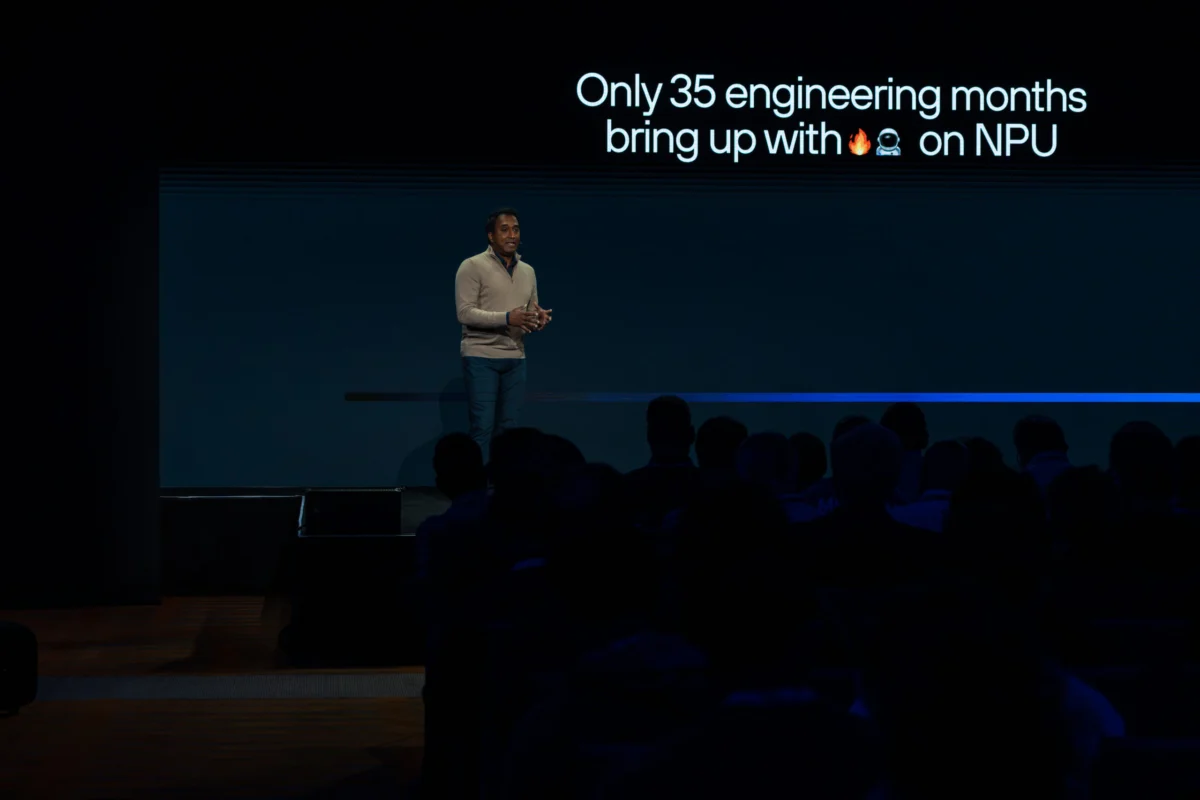
Modular’s work with AMD’s MI355X accelerator serves as a critical case study. In a 14-day sprint, two engineers successfully brought up the MAX framework on the new hardware. The findings were striking:
- 99.9% Architecture Agnostic: The vast majority of the software stack remained unchanged, allowing engineers to focus exclusively on architecture-specific optimizations like new BF16 conversion instructions and memory management.
- Performance Benchmarks: Modular claimed that its MAX framework outperformed AMD’s own optimized vLLM fork by as much as 2.2x in tested workloads.
These results suggest that abstraction does not equate to mediocrity. Instead, it allows for a more surgical application of engineering resources, focusing on the small percentage of code that actually differentiates one chip from another.

Official Responses and the Neutrality Challenge
The acquisition presents a significant optics problem: how can a software stack remain truly neutral when it is owned by a hardware manufacturer that is also a competitor?
Lattner acknowledges the gravity of this concern. "That’s a hard question. There’s not really a perfect answer to that," he admitted. To combat the perception of bias, Qualcomm is employing a multi-pronged strategy:
- Apache 2.0 Licensing: By releasing the Mojo compiler and toolchain under an open-source license, they have provided an "irrevocable grant of IP to the world," making it difficult for the platform to be "closed" in the future.
- Organizational Firewalls: Rashid Attar confirmed that Qualcomm will maintain strict firewalls. Modular engineers working on optimizing competing hardware (such as AMD or Intel) will be shielded from proprietary Qualcomm roadmap data, and vice versa.
- The Industry Alliance: By involving other hardware vendors in a formal alliance, Qualcomm hopes to transition Modular into a community-governed resource rather than a corporate tool.
Implications for the AI Ecosystem
The implications of this acquisition extend far beyond Qualcomm’s balance sheet. If successful, this move could trigger a democratization of AI silicon.
1. A Lifeline for Emerging Silicon Startups
Smaller accelerator startups often possess innovative architecture but lack the massive engineering resources required to build a competitive software ecosystem. A common software foundation—provided by the Modular stack—lowers the barrier to entry significantly. If these startups can plug into a pre-existing, high-performance ecosystem, they can focus on their hardware innovation rather than reinventing the wheel on software.

2. Shifting the Competitive Paradigm
If Modular succeeds in making diverse hardware interoperable, the basis of competition will change. Instead of customers being locked into a vendor because of the "software ecosystem they cannot leave," the conversation will shift toward objective metrics: performance, power efficiency, total cost of ownership, and availability.
3. The Future of Heterogeneous Computing
The vision for the future, as articulated by Lattner, is one of total heterogeneity. Workloads should be able to migrate fluidly from the edge to the cloud, utilizing the most appropriate accelerator for the task at hand. If Modular can achieve this, the industry will move away from the current era of "siloed" AI towards a more flexible, efficient, and competitive infrastructure.
Conclusion
Qualcomm’s acquisition of Modular is a high-stakes gamble that hinges on the belief that the AI market is ready for a software-defined future. By attempting to solve the industry’s "neutrality problem" while simultaneously removing the "second mountain" of software porting, Qualcomm is positioning itself not just as a chipmaker, but as a critical infrastructure provider.
If they succeed, the era of the "CUDA moat" may eventually yield to a more open, competitive, and heterogeneous landscape. If they fail to maintain that neutrality, however, they risk fragmenting the very ecosystem they are trying to unite. For now, the eyes of the semiconductor industry are fixed on the "walk the walk" promise made by Lattner—a promise that, if fulfilled, could fundamentally redefine the rules of the AI hardware game.