SHANGHAI — September 3, 2026 — As the global manufacturing sector grapples with the transition toward fully autonomous, software-defined production lines, the infrastructure supporting these environments is undergoing a radical shift. This week, at the 5G-ACIA Industrial 5G Day in Shanghai, Astella Technologies Limited emerged as a pivotal player, unveiling an expanded strategy to provide the silicon-level and software-layer foundations for the next generation of Industrial Internet of Things (IIoT) and private 5G networks.
The event, which brought together the world’s leading telecommunications engineers and industrial automation experts, underscored a singular theme: the move from 5G connectivity trials to deeply integrated, mission-critical production infrastructure.
Main Facts: The Intersection of Silicon and Industry
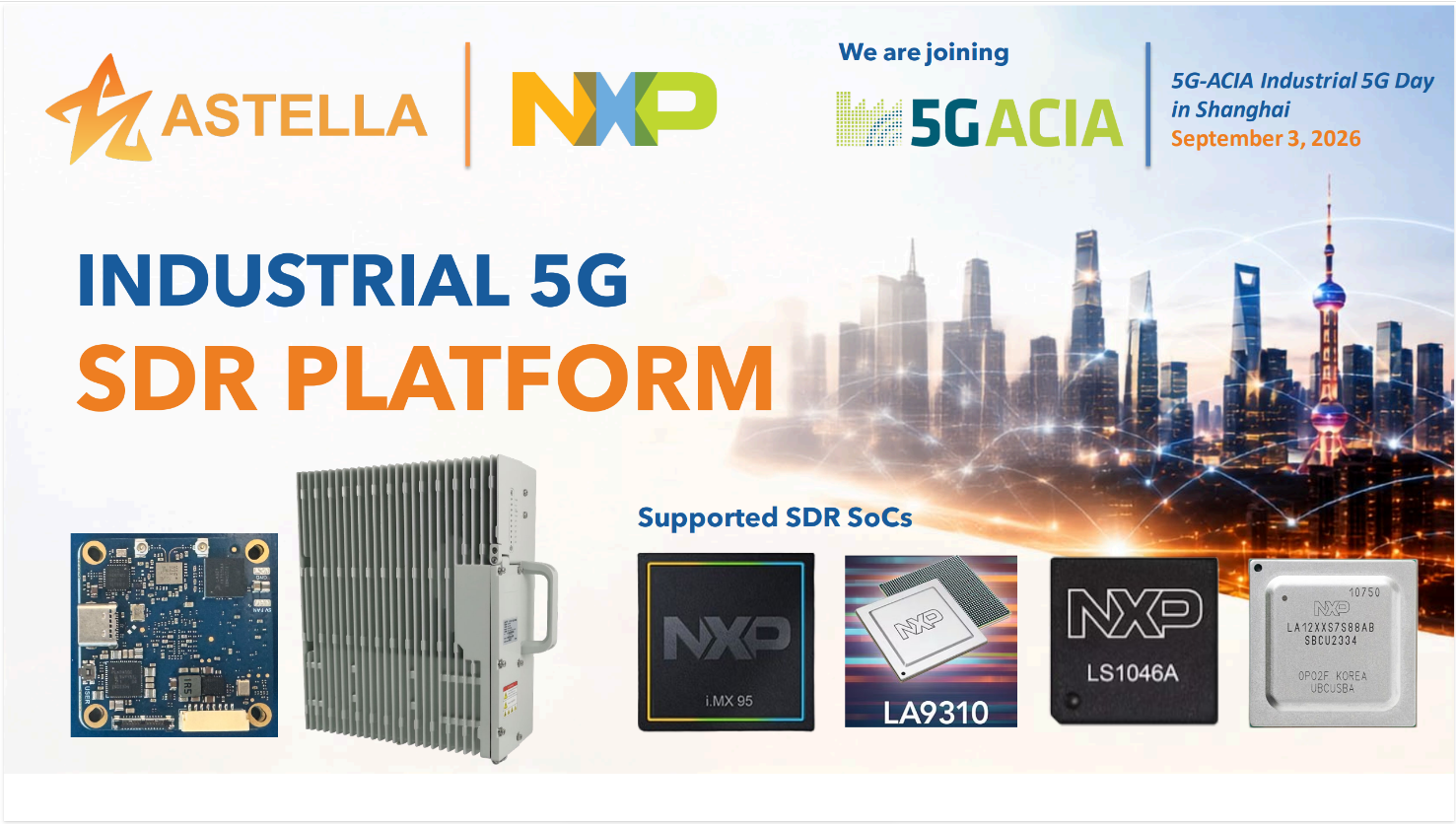
Astella is positioning itself as a "bridge" between the complex world of 5G New Radio (NR) standards and the practical, rugged requirements of the industrial sector. The company’s flagship offering—an end-to-end 5G Software Defined Radio (SDR) hardware and software IP platform—is designed to circumvent the traditional "build-from-scratch" bottleneck that has long slowed down industrial equipment manufacturers.
Built upon flexible NXP silicon platforms, the Astella solution integrates RF and baseband hardware architecture with a comprehensive software stack, including 5G NR L1/L2/L3 layers, 5G Core, Operations, Administration, and Maintenance (OAM) systems, and a robust API layer. By offering this as an IP platform, Astella allows partners to bypass the multi-year development cycles typically required to bring 5G-enabled industrial gear to market.

Chronology of the Shift Toward Private 5G
The industrial sector’s relationship with wireless technology has evolved rapidly over the last decade.
- 2020–2022 (The Trial Phase): Early adopters experimented with public 5G networks, finding that while bandwidth was sufficient, the latency and lack of network control were inadequate for precision robotics.
- 2023–2025 (The Private Network Era): Enterprises began investing in private 5G (P5G) deployments, seeking sovereignty over their data and localized performance. However, integration with existing industrial Ethernet and legacy production systems proved difficult.
- 2026 (The Integration Milestone): As of September 2026, the focus has shifted to "deep integration." It is no longer enough for a machine to be "connected"; it must be part of a deterministic, ultra-low-latency fabric. Astella’s participation at the 5G-ACIA event marks this pivotal transition, signaling that the industry is ready for standardized, customizable, and high-performance IP blocks that can be dropped directly into automated guided vehicles (AGVs), industrial gateways, and edge compute nodes.
Supporting Data: Why Industrial 5G is the New "Industry Standard"
The shift toward private, localized 5G networks is driven by specific technical requirements that traditional Wi-Fi or wired Ethernet often cannot satisfy in a modern factory setting.
The Technical Mandates of Modern Industry:
- Deterministic Latency: For robots operating in high-speed assembly, a millisecond of jitter can result in a collision or a defective product. Astella’s platform targets sub-millisecond, ultra-low-latency communications (URLLC).
- Network Slicing: Unlike public networks, industrial private networks require dedicated "slices" of bandwidth to ensure that a massive software update on a server does not interfere with the real-time commands sent to a robotic arm.
- Integrated Sensing and Communication (ISAC): A emerging capability where 5G waveforms are used not just for data, but to "sense" the environment—detecting the presence of personnel or objects without the need for additional camera sensors.
- Positioning Accuracy: In large-scale logistics centers, GPS is unavailable indoors. 5G signals are being utilized to provide centimeter-level positioning accuracy for automated guided vehicles (AGVs).
Astella’s business model is designed to address these four pillars by providing the "DNA" of the base station and the terminal. By licensing their IP to semiconductor companies and system integrators, they are effectively enabling a broader ecosystem of "5G-ready" industrial equipment.
Official Perspectives: The View from the Top
"Industrial 5G is moving from connectivity trials toward deeply integrated production infrastructure," said Dr. Hanwei, Director of Astella, during the Shanghai event. "Factories increasingly need networks that are low-latency, reliable, independently manageable, and adaptable to their own specific equipment and production processes. Astella’s role is to provide the hardware and software technology foundation that enables industrial partners to build these products and networks faster."

Dr. Hanwei emphasized that the complexity of 5G is the biggest barrier to entry for many industrial firms. By providing an "out-of-the-box" software and hardware IP suite, Astella aims to democratize access to advanced 5G capabilities, ensuring that smaller specialized equipment manufacturers can compete with global conglomerates in the IIoT space.
Implications for the Global Industrial Ecosystem
The implications of Astella’s strategy are profound for several key sectors:
Smart Manufacturing and Robotics
As manufacturing processes become increasingly modular, the ability to "unplug" a production line and reconfigure it within hours—rather than weeks—depends entirely on wireless connectivity. Astella’s hardware, capable of supporting flexible spectrum and rapid deployment, is a critical enabler for the "Smart Factory" of 2030.
Defense and Public Safety
The requirements for industrial private networks often overlap with defense and emergency response. Secure, localized networks that function independently of public infrastructure are essential for mission-critical operations. The IP-based approach allows for specialized, hardened versions of 5G hardware to be developed without relying on general-purpose consumer 5G chipsets that may have security vulnerabilities or supply chain risks.

Energy and Utilities
For the energy sector, the "Smart Grid" requires widespread, reliable connectivity for sensors monitoring pipelines, substations, and remote power generation assets. The high-reliability, low-latency nature of the Astella platform makes it ideal for these wide-area industrial deployments.
The Path Forward: Partnerships and Customization
Astella is not merely a vendor; they are framing themselves as a development partner. Their business model, which includes IP licensing, technology transfer, and joint development, is a direct response to the "customization problem." No two factories are identical; therefore, the hardware controlling their internal networks cannot be identical.
By offering a platform that allows for rapid customization of base stations, core networks, and industrial terminals, Astella is effectively shortening the time-to-market for specialized 5G products. The company is actively inviting industrial enterprises, semiconductor firms, and system integrators to engage in pilot partnerships to test the limits of their IP.
Conclusion: A New Era of Connectivity
As the 5G-ACIA Industrial 5G Day concludes, the industry is left with a clear vision of the future. The transition from general-purpose 5G to specialized, high-performance industrial 5G is no longer a distant roadmap—it is a present-day reality.

Companies like Astella, by focusing on the "heavy lifting" of RF and baseband architecture, are allowing the rest of the industry to focus on what matters most: innovation in robotics, process automation, and intelligent manufacturing. As we look toward the remainder of 2026 and beyond, the success of these industrial 5G deployments will likely be measured by how quickly and reliably manufacturers can bridge the gap between their digital plans and their physical output. With their end-to-end SDR platform, Astella has positioned itself as the underlying architecture for that very bridge.
About Astella Technologies Limited
Astella Technologies Limited is a leading provider of end-to-end 5G SDR hardware and software IP, specifically engineered for the demands of industrial and private-network applications. With a portfolio that spans RF and baseband architecture, 5G NR software, and core network management, Astella serves a diverse range of industries including smart manufacturing, AGV/robotics, energy, and defense. Based in Shanghai, the company provides a practical path from conceptualization to full-scale deployment for global industrial partners.
For more information, please visit https://www.astellatech.com/ or contact Dr. Hanwei at [email protected].