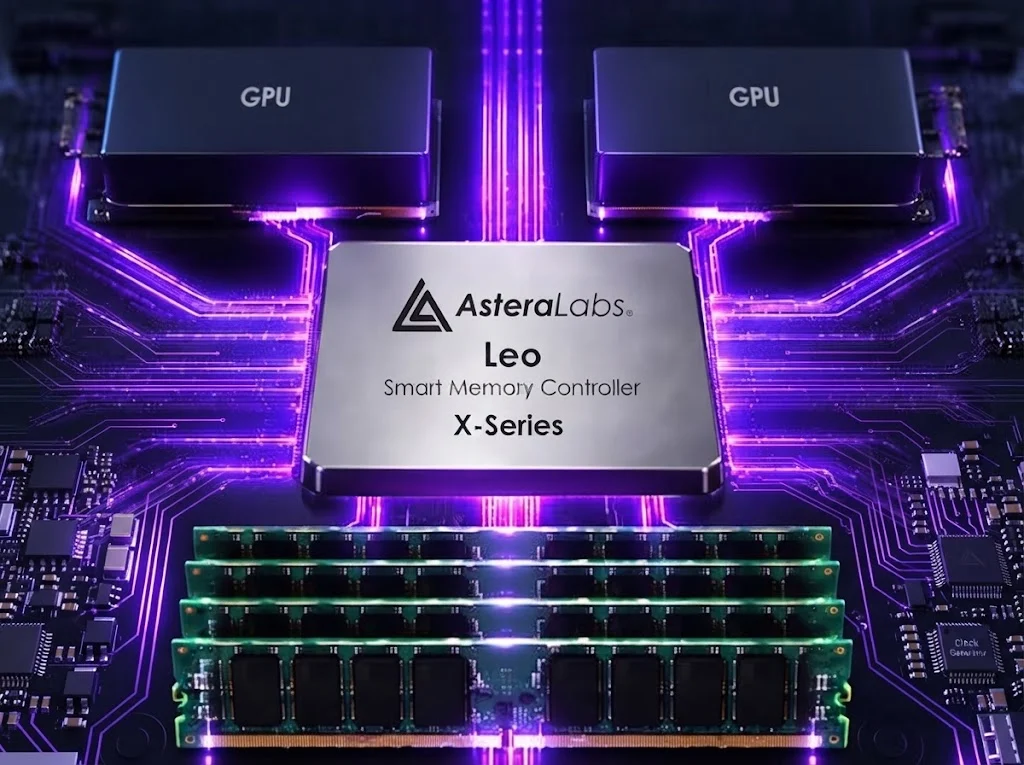
The rapid evolution of Large Language Models (LLMs) into sophisticated, multi-turn agentic systems has pushed the underlying infrastructure of modern data centers to its absolute limit. As the demand for generative AI grows, so too does the "memory wall"—the fundamental bottleneck where the speed of compute outstrips the ability of memory systems to deliver data. To bridge this divide, Astera Labs has unveiled a major expansion to its Leo Smart Memory Controller family, aiming to redefine how memory is accessed, pooled, and utilized in the age of AI.
The Core Challenge: Memory as the Data Center’s Greatest Bottleneck
The AI boom has fundamentally changed the requirements of server architecture. During the initial surge of AI deployment, the primary focus was on GPU clustering and sheer raw compute power. However, as models have grown more complex, the industry has hit a wall. Memory—specifically the high-bandwidth capacity required to keep GPUs fed with data—has become the central infrastructure hurdle.
Thad Omura, senior VP of Astera Labs’ compute connectivity group, describes the current state of the industry as a reckoning. “All the bottlenecks around memory are back and driving new architectures,” Omura explained during a recent briefing with EE Times. “We are seeing the return of memory constraints as the primary limiting factor for AI scaling. As GPUs get faster, they need data faster; when the memory can’t keep up, the silicon becomes an expensive paperweight.”
To solve this, Astera Labs is shifting the paradigm from static, CPU-bound memory to a more fluid, fabric-attached approach. By moving memory closer to compute and creating more intelligent pathways for data, the company aims to eliminate the inefficiencies that plague current hyperscale deployments.

The New Leo Portfolio: X-Series, E-Series, and P-Series
Astera Labs’ latest announcement centers on three distinct pillars within its Leo controller family, each engineered to address specific pain points in the modern AI pipeline.
The Leo X-Series: Fabric-Attached Memory for Inference
The flagship of the announcement, the Leo X-Series, is a fabric-attached memory controller designed specifically for the heavy lifting of AI inference. In high-stakes inference environments, the Key-Value (KV) cache—the portion of memory storing the state of a conversation—can quickly overwhelm a GPU’s native High-Bandwidth Memory (HBM).
The Leo X-Series circumvents the traditional path through the CPU, instead working in concert with Astera’s Scorpio fabric switches to create a dedicated, high-speed memory tier directly on the PCIe fabric. This architectural change allows for significantly larger memory capacity to be available for inference tasks without choking the CPU.
Leo 2 E-Series and P-Series: Maximizing Efficiency
The Leo 2 E-Series and P-Series represent the evolution of Astera’s CXL-based strategy for CPU-attached memory expansion. These controllers are designed to address the "stranded memory" problem—a scenario where memory is physically present in a server but cannot be effectively utilized due to architectural limitations.

The new controllers support both modern DDR5 and legacy DDR4 memory, offering up to 4 TB of DDR5 capacity per controller and up to 768 GB of repurposed DDR4. Beyond simple capacity, these units introduce advanced telemetry, memory testing, and predictive failure analysis. These features are critical for hyperscalers who are looking to extend the life of their infrastructure by redeploying aging DIMMs rather than discarding them, a move that aligns with both economic and sustainability goals.
Benchmarking Performance in Real-World AI Workloads
The efficacy of Astera Labs’ approach is not merely theoretical. In recent benchmark testing, the company utilized a setup featuring four Nvidia H200 GPUs running the Qwen2.5-32B model—a standard for testing multi-turn agentic workloads.
When comparing the Leo-equipped system against conventional CPU-DRAM-based KV cache offloading, the results were striking. Astera Labs reported a 62% reduction in time-to-first-token (TTFT) and a 22% increase in total tokens per second. These metrics are the "gold standard" for LLM performance; reducing TTFT improves the perceived latency of AI agents, while increasing tokens-per-second enhances the throughput of the entire cluster. By offloading the KV cache, the system ensures the GPU spends less time waiting for data and more time performing calculations.
The Economic Pressure: Navigating the Supply Crunch
Beyond the technical hurdles of latency and bandwidth, data center operators are facing severe economic headwinds. Ahmad Danesh, associate VP of product management at Astera Labs, highlighted that the surge in AI demand has created a significant supply crunch for DDR5 memory.

“There’s a big supply crunch and a wafer supply crunch because of AI,” Danesh noted. “Memory manufacturers are prioritizing high-bandwidth memory (HBM) production, which leaves less capacity for standard DDR5.”
This supply scarcity makes the "dynamic pooling" features of the Leo 2 family particularly attractive. By allowing memory capacity to be allocated across servers on-demand, Astera enables operators to do more with the hardware they already own. “That stranded DRAM is the industry’s next scale-up resource,” Omura said. “By turning idle capacity into usable memory, we are helping operators bypass some of the volatility in the memory market.”
Scorpio Fabric Switches: The Nervous System of AI Clusters
If the memory controllers are the storage, the Scorpio fabric switches are the nervous system. During the briefing, the company emphasized that the interconnect is no longer "passive plumbing." It is an active, intelligent component of the system.
The Scorpio X-Series 320-Lane Smart Fabric Switch is built to handle the gargantuan communication requirements of large-scale AI clusters. To optimize performance per watt—a metric that has become vital as AI data centers reach gigawatt-scale power consumption—Astera has integrated hardware acceleration engines directly into the switch silicon.

These in-network compute engines allow for calculations to be performed within the switch fabric itself. By offloading specific collective operations from the GPU to the switch, the system reduces the load on the accelerator. “We can calculate inside our silicon,” Danesh stated. “You’re spending less time sending the data and more time on the compute, which ultimately increases the GPU utilization.”
This strategy is complemented by the company’s "Cosmos" software, which provides the management layer required to orchestrate these complex, high-speed fabrics. As Danesh pointed out, as deployments grow from single racks to entire data centers, the intelligence provided by the software becomes the differentiator in quality of service and overall resilience.
Implications for the Broader CXL Ecosystem
Astera Labs is not alone in identifying CXL (Compute Express Link) as the key to unlocking next-generation AI infrastructure. The industry is currently witnessing a race to optimize data movement, with several key players entering the fray.
The Korean startup Xcena, for instance, has introduced a CXL Type 3 device that integrates 2 TB of DDR5 with custom RISC-V cores, aiming to push compute into memory in a manner similar to Astera’s vision. Meanwhile, major players like Synopsys and Marvell are aggressively updating their own portfolios to make CXL integration easier for cloud providers.

However, Astera Labs’ comprehensive approach—linking memory controllers, fabric switches, and management software—positions them as a "full-stack" connectivity partner. The company’s trajectory over the last five years, from the initial launch of its CXL Memory Accelerator Platform to the sophisticated, AI-optimized ecosystem it offers today, underscores a fundamental shift in the data center industry.
Conclusion: The Era of Active Interconnects
As we look toward the future of AI, it is clear that the "memory wall" is not a static barrier, but a shifting landscape that requires constant innovation. The days of treating memory and interconnects as static components are over.
As Astera Labs’ leadership emphasized, the modern data center is moving toward a model where every nanosecond and every milliwatt counts. By transforming interconnects into active, intelligent, and flexible system components, companies like Astera are not just moving data—they are actively shaping the GPU utilization, resilience, and economic sustainability of the AI era. For hyperscalers struggling to balance the insatiable demand for AI performance with the harsh realities of power budgets and supply constraints, the ability to "pool, manage, and accelerate" memory will likely be the defining competitive advantage of the next decade.