At the BoxWorks 2026 conference, Box, the enterprise content management giant, signaled a pivotal shift in its product strategy. By moving beyond simple AI-assisted search toward fully automated, agentic business processes, the company aims to redefine how organizations interact with their unstructured data. The dual announcement of "Box Architect" and a high-performance Context Retrieval engine marks a significant milestone in the evolution of enterprise AI, promising to bridge the gap between static document storage and active, autonomous operations.
The Evolution of Automation: Introducing Box Architect
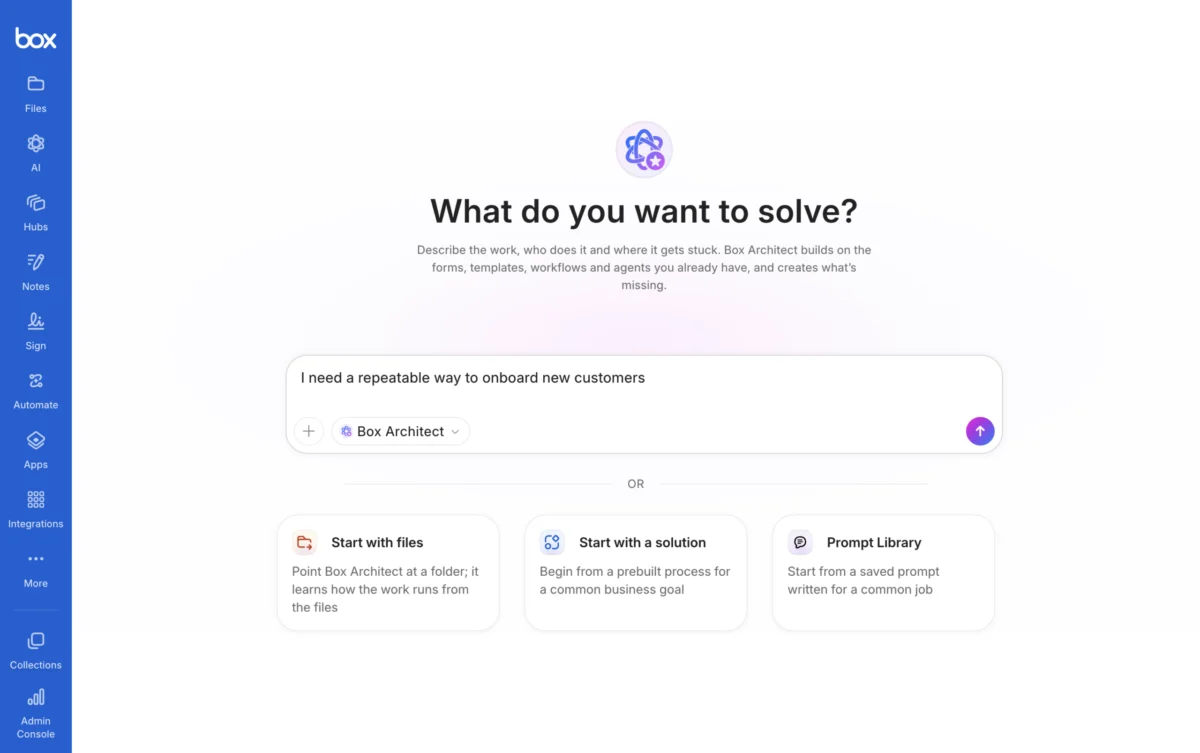
Box Architect represents the next generation of the company’s platform, designed to function as an "agentic operator." Unlike legacy automation tools that require complex coding or rigid rule-based logic, Architect is powered by natural language processing.
How It Works
Users can simply describe a business process in plain language—for example, "Create a client onboarding workflow that collects documents, verifies them against internal policy, routes them for signature, and updates our CRM." Architect then takes this instruction, breaks it down into logical stages, and builds the workflow while automatically inheriting the existing enterprise security, permissions, and retention policies already established within the Box environment.
This capability moves Box from being a "file cabinet" to a "process engine." By embedding intelligence directly into the file lifecycle, Box is attempting to remove the friction that typically prevents organizations from digitizing complex, multi-departmental processes.
Chronology of the Announcement
- Early 2026: Development of the "Agentic Workflow" framework accelerates, focusing on integrating LLMs with existing enterprise document security models.
- Thursday, BoxWorks 2026: CEO Aaron Levie officially unveils Box Architect, demonstrating its ability to orchestrate tasks across disparate Box tools like Box Forms, Box Extract, and Box Sign.
- Q4 2026: Scheduled beta release of Box Architect for Enterprise Advanced customers.
- Early 2027: General availability for the Context Retrieval engine, powered by Nvidia’s Nemotron models.
Deep Dive: The Engine Under the Hood
While Architect handles the logic of automation, the new Context Retrieval engine handles the intelligence required to fuel that logic. Powered by Nvidia’s Nemotron open-weight models, this engine is designed to solve the "context problem" that plagues many large language model (LLM) deployments: the inability to quickly and accurately surface specific, relevant information from massive, messy enterprise repositories.
Technical Performance Metrics
Box CTO Ben Kus highlighted several key performance improvements resulting from the integration of the Nemotron-based retrieval system:
- Search Accuracy: Internal testing demonstrated a 20% improvement in search precision compared to previous iterations.
- Latency Reduction: The engine delivers a fourfold increase in question-answering speed, significantly reducing the "waiting time" for AI agents.
- Token Efficiency: Perhaps most significantly for enterprise budgeting, the engine has achieved up to a 90% reduction in tokens sent to downstream models. By refining the context before it is processed by an LLM, companies can save substantial costs associated with AI usage fees.
The system utilizes "multimodal indexing," allowing it to scan across various file formats, including images, audio, video, and text. Furthermore, it employs a hybrid approach—combining keyword-based searching with semantic, intent-based search—to ensure that even if a user lacks the exact terminology used in a document, the AI can still surface the correct information.
The Strategic Value: Expert Analysis
Jason Andersen, vice president and principal analyst at Moor Insights & Strategy, views these developments as a necessary maturation of the enterprise AI market. According to Andersen, the move toward agentic workflows is the logical conclusion of the AI hype cycle.
"Architect makes it easier to build agents and workflows based on the collective knowledge of a team or business," Andersen noted. "This moves the focus away from individual productivity—which is fine—toward organizational efficiency, which is where the real ROI lies."
However, Andersen also offered a word of caution regarding the "black box" nature of AI. "As with any AI system that involves business data, customers must be rigorous in their evaluation," he warned. "I would strongly recommend human oversight during the design phase of any agent development project. Organizations must employ observability tools to ensure that these autonomous agents are operating within the specific risk and cost management boundaries set by the business."
Implications for the Enterprise
The introduction of these tools has broad implications for how companies structure their IT departments and manage data governance.
1. The "Human-in-the-Loop" Requirement
Box has built safeguards into the Architect tool, allowing users to insert mandatory human review and approval steps. This is critical for high-stakes environments like legal, finance, or human resources, where an automated agent making a mistake could have significant regulatory or financial consequences. By allowing users to test workflows in a sandbox environment before deployment, Box is prioritizing a "trust but verify" model.
2. Cost Management and AI Units
The use of "AI Units" remains a central pillar of Box’s pricing strategy for the Enterprise Advanced tier. As companies scale their use of autonomous agents, the ability of the new Context Retrieval engine to reduce token usage by 90% is not just a technical optimization—it is a financial imperative. By making the AI more efficient, Box is effectively lowering the cost-per-workflow, making it more viable for large-scale enterprise adoption.
3. Governance and Security
One of the most persistent hurdles for AI adoption has been the fear that AI might expose sensitive data to unauthorized users. Box’s integration of its existing permission structure directly into the Retrieval engine is a key differentiator. The AI only "sees" what the user is authorized to see. This ensures that the deployment of advanced agents does not inadvertently create new security vulnerabilities.
Looking Ahead: The Future of Agentic Workflows
The promise of Box Architect is that it democratizes the creation of complex workflows. In the past, automating a process that touched Box Forms, an extraction tool, and a digital signature provider would require professional services, custom APIs, and months of integration work. With Architect, a business analyst with no coding background could, theoretically, describe the workflow and have it operational in hours.
However, as the industry pivots toward these autonomous systems, the focus will increasingly shift toward governance. As Andersen noted, "To get the most benefit from context management, a good set of design principles and governance are needed. Customers must account for the cultural and procedural shift required to manage these systems effectively."
As we look toward 2027, the success of Box’s strategy will depend on how easily enterprise customers can transition from "chatting with documents" to "managing autonomous agents." By leaning into open models like Nvidia’s Nemotron, Box is betting that the combination of performance, security, and ease-of-use will be the catalyst that finally turns enterprise AI from an experimental project into a foundational component of modern business operations.
For now, the industry awaits the Q4 beta launch. If the performance gains observed in internal testing hold up in real-world, high-volume enterprise environments, Box may have successfully carved out a dominant position in the next phase of the digital transformation era.