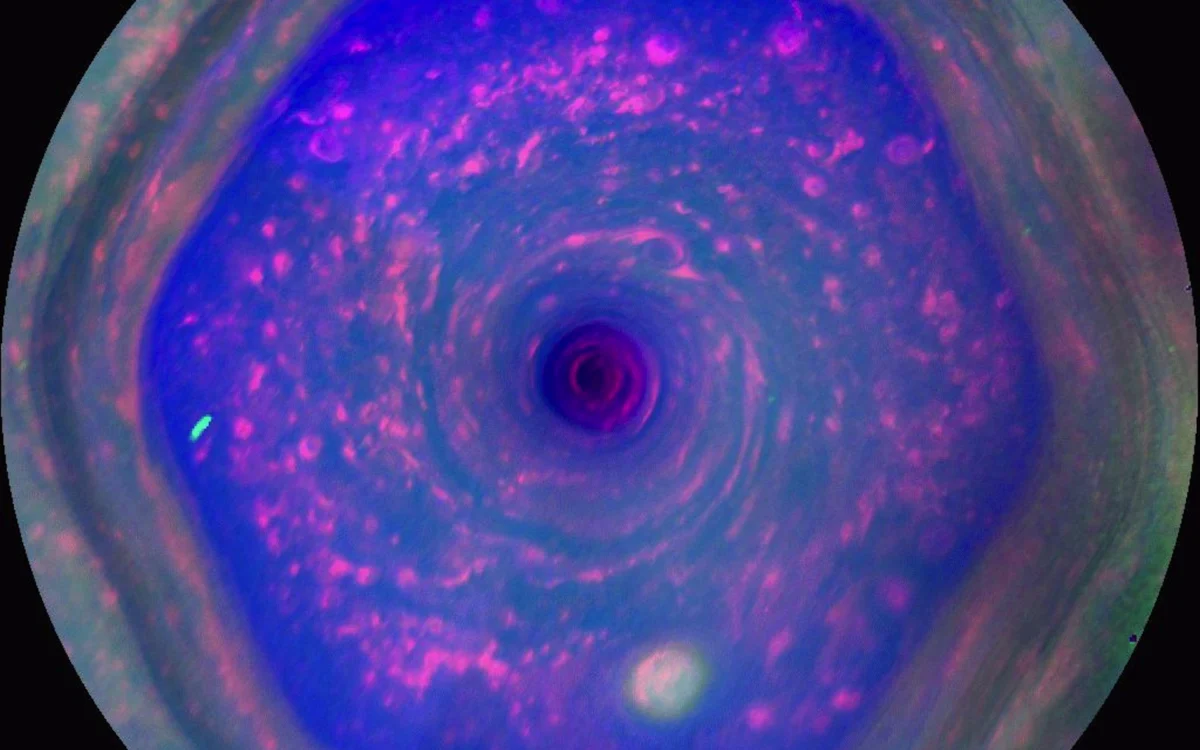
In a discovery that has fundamentally reshaped our understanding of gas giant meteorology, astronomers have identified a massive, ten-sided cloud formation swirling around Saturn’s south pole. This "decagon," a geometric marvel of atmospheric dynamics, mirrors the long-studied hexagonal storm at the planet’s north pole, challenging decades-old assumptions that the northern feature was a singular, unique anomaly in the solar system.
The finding, published on September 2 in the journal Science Advances, represents a triumph of modern long-term planetary observation. By leveraging the high-resolution capabilities of the Hubble Space Telescope, researchers have pulled back the curtain on a southern hemisphere that had remained obscured from Earth’s vantage point for over a decade.
The Core Discovery: A Geometry of Gas
The newly discovered decagon is a colossus of planetary scale. Stretching approximately 104,250 miles (167,820 kilometers) in diameter, each of its ten distinct sides measures roughly 10,425 miles (16,782 km). This structure is significantly larger than the well-known northern hexagon, which spans roughly 20,000 miles (32,000 kilometers).
While the northern hexagon has been a fixture of astronomical literature since it was first identified in data from NASA’s Voyager missions in the 1980s, its southern counterpart remained hidden. For years, planetary scientists questioned why the north pole hosted such a stable, geometric jet stream while the south appeared relatively featureless. The discovery of the decagon suggests that Saturn’s atmosphere possesses a latent, symmetry-forming mechanism that can manifest across different latitudes and conditions.
A Chronology of Observation
The path to identifying this ten-sided vortex was dictated by the mechanics of celestial alignment. Saturn’s axial tilt, which sits at roughly 27 degrees, causes the planet’s poles to experience long periods of visibility and shadow from the perspective of Earth-based telescopes.
1980–1981: The Voyager Era
The initial discovery of the north pole’s hexagon occurred during the Voyager 1 and 2 flybys. At the time, the phenomenon was viewed as a biological curiosity—an inexplicable, rigid geometric structure in a fluid, chaotic gas giant atmosphere. For decades, researchers treated the hexagon as a local oddity, potentially tied to specific conditions unique to the north pole.
2012–2023: The Southern Gap
Following the Cassini mission’s intensive study of the planet, Earth-based observation of the southern hemisphere became impossible. Due to the planet’s tilt, the south pole was effectively hidden behind the curve of the planet and its rings from the perspective of Earth’s orbital path. During this eleven-year hiatus, scientists were unable to monitor the southern atmosphere, leaving the potential for southern-hemisphere geometric formations purely speculative.
2023: The Hubble Breakthrough
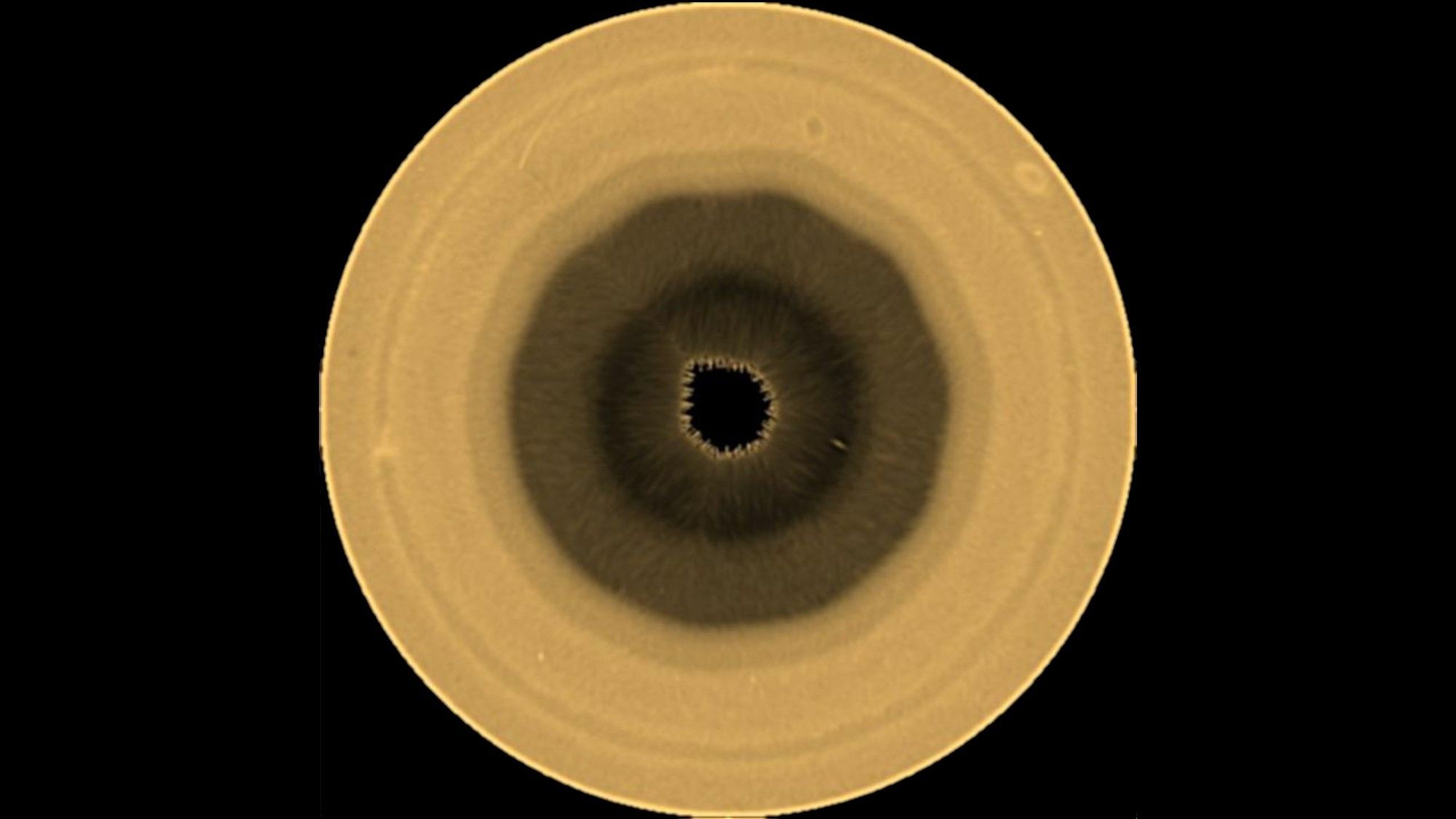
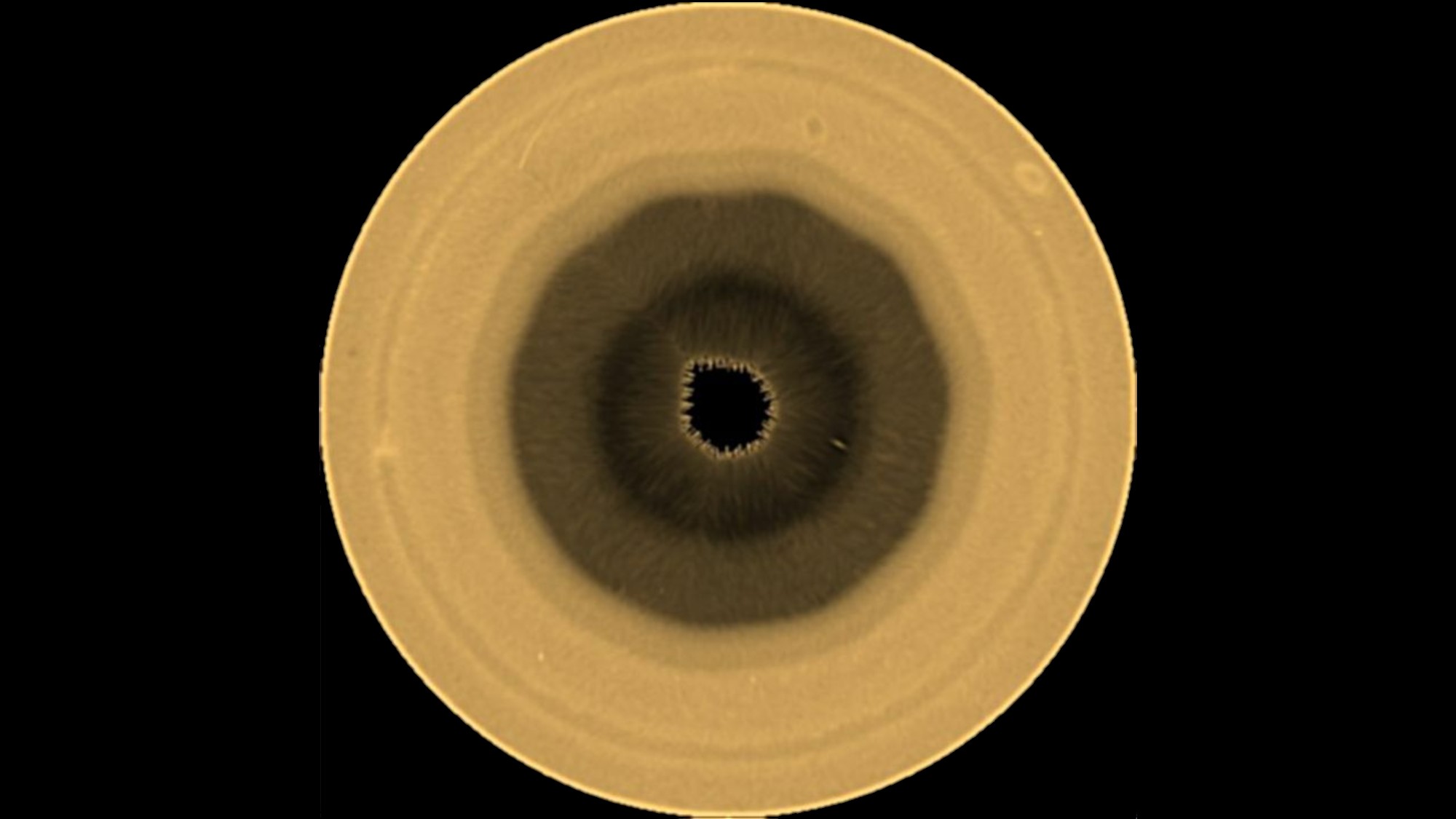
In 2023, as Saturn’s orientation shifted, the Hubble Space Telescope finally gained a clear line of sight to the southern pole. When the images were processed, the decagon was revealed. "It certainly came as a surprise," noted study lead author Agustin Sanchez-Lavega, a planetary scientist at the University of the Basque Country. "We had looked at older data and subsequent images hoping to find a southern counterpart to the hexagon, but there was no sign of it." The visibility of the structure now allows for a real-time study of how these massive patterns form and evolve.
Atmospheric Dynamics and Supporting Data
The mechanisms behind these "polygon storms" are rooted in fluid dynamics. Saturn’s atmosphere is defined by powerful, eastward-flowing jet streams. Previous theories on the northern hexagon suggested that the shape arises from a "meandering" jet stream, where small perturbations—essentially atmospheric "bumps" or interactions with other currents—cause the jet to snake into a stable, closed-loop polygonal shape.
Computer Simulations and Shallow Water Models
To test this hypothesis for the southern decagon, the research team utilized sophisticated computer simulations modeled on shallow-water fluid dynamics. The results suggest that the decagon is not a random collection of clouds, but a trapped wave. In these models, a circular jet stream, when subjected to specific atmospheric pressure gradients, naturally collapses into a polygon.
However, there are critical differences between the two poles:
- Stability: The northern hexagon is remarkably consistent, with its sides and points maintaining a steady, dark appearance for decades.
- Variable Evolution: The southern decagon displays varying degrees of darkness across its ten sides. This variance indicates that the structure may still be in a state of flux, potentially evolving or struggling to maintain its equilibrium.
- Rotation: The decagon moves at a glacial pace, taking approximately 800 days to complete a single rotation around the southern pole.
Official Perspective and Scientific Implications
Dr. Sanchez-Lavega and his team are framing this discovery as a major advancement in general meteorology. By observing a second geometric structure, scientists can now move beyond "case studies" of one and begin to develop a unified theory of planetary atmospheric symmetry.
"This is a very unusual atmospheric phenomenon that is helping us to advance our understanding of meteorology in general," Sanchez-Lavega stated. The team is particularly interested in the 2032 solar cycle peak. As solar radiation increases, it will strike the southern latitude at 60 degrees south with greater intensity. Researchers are currently debating whether this added energy will act as a stabilizer, anchoring the decagon into a permanent feature, or if it will introduce enough turbulence to cause the structure to break apart.
Furthermore, the team plans to investigate the three-dimensional architecture of the decagon. Understanding the vertical profile of these clouds—including the interplay of hazes, wind shear, and temperature fluctuations at different altitudes—is essential for building more robust predictive models.
The Broader Impact: Why It Matters
The existence of the decagon forces a re-evaluation of how gas giants process energy. Saturn is not just a planet of rings and moons; it is a laboratory for extreme fluid dynamics. The fact that such vast, complex shapes can emerge from the chaotic swirling of hydrogen and helium suggests that the atmosphere of a gas giant possesses a "memory" and a structural rigidity that we are only beginning to comprehend.
This discovery also highlights the necessity of long-term monitoring. If the Hubble Space Telescope had not been directed toward Saturn at this specific time, the decagon might have remained an invisible secret of the south pole. It underscores the vital role that space-based observatories play in providing the continuity required to capture transient, long-cycle planetary events.
As the scientific community continues to analyze the data from Science Advances, the focus will shift toward the 2032 milestone. Will the decagon survive the shift in solar radiation, or will it vanish as quickly as it was discovered? For now, the ten-sided sentinel continues its slow, 800-day journey around the south pole, serving as a reminder that even in the vacuum of space, the laws of physics can conjure the most elegant, unexpected geometries.
The study, while providing answers, has ultimately opened a new door of inquiry, proving that Saturn’s secrets are far from exhausted. As astronomers turn their instruments toward the ringed giant once more, the search for further atmospheric patterns—and the potential for even higher-order polygons—remains an active and thrilling frontier in planetary science.