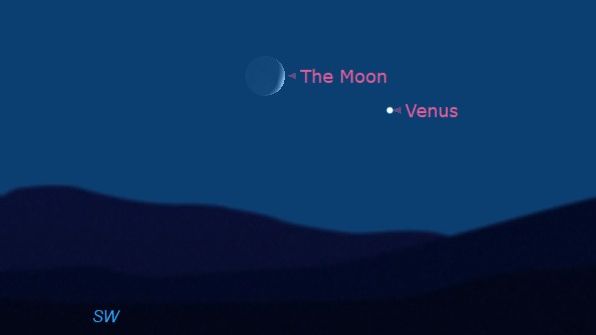
The celestial stage is set for a dramatic, albeit brief, exit. For months, the "Evening Star"—the planet Venus—has served as the most luminous beacon in our twilight firmament. Since its emergence in late March, it has captivated stargazers, outshining all other celestial bodies with its brilliant, steady glow. However, as September progresses, this glamorous performer is preparing to take its final bow, sinking lower toward the horizon each evening before it vanishes from our dusk skies to begin a new journey as the "Morning Star."
Main Facts: Understanding the Venusian Departure
Venus is currently navigating the final leg of its evening apparition, a period that has been characterized by an increasingly challenging viewing geometry for observers in the Northern Hemisphere. To understand why the planet is departing, one must look at its orbital mechanics. Venus, the second planet from the sun, moves in a tighter, faster orbit than Earth. As it swings around the sun, its position relative to our line of sight changes, causing the planet to transition between the evening sky (when it follows the sun after sunset) and the morning sky (when it precedes the sun before sunrise).
By late October, Venus will reach a point known as "inferior conjunction," where it passes between the Earth and the sun. During this phase, the side of the planet illuminated by the sun is turned away from our vantage point, rendering it essentially invisible to the naked eye for a short window. This is not a permanent departure, but rather a standard transition in a dance that has been observed by humanity for millennia.
A Chronology of the 2024-2025 Cycle
The rhythm of Venus is remarkably consistent. The planet completes roughly 13 orbits around the sun for every 8 Earth years, a pattern that causes it to trace five distinct loops across our sky over that same duration.
- Spring 2024: Venus emerged from the sun’s glare to grace our evening skies, rapidly becoming the most conspicuous object in the west after sunset.
- June 2024: Stargazers were treated to a rare alignment, as Venus, Jupiter, and Mercury gathered in a celestial trio, providing a visual spectacle for those with a clear view of the western horizon.
- August 15, 2024: Venus reached "greatest elongation," the moment of its maximum angular distance from the sun. Despite this being technically the "best" time for viewing, the low altitude of the ecliptic made the display feel more muted for mid-northern observers than in previous years.
- September 2024: We are currently in the final phase of this apparition. With each passing day, the planet lingers for a shorter time after sunset. By the end of the month, it will be hovering dangerously close to the horizon, visible only as a fleeting spark in the deep twilight.
- October 24, 2024: The date of inferior conjunction. Venus will pass approximately 6 degrees south of the sun.
- November 2024: The "Morning Star" returns. Emerging from the solar glare on the eastern horizon, Venus will once again become a dominant feature, this time as a harbinger of dawn.
Supporting Data: The Geometry of the Twilight
The frustration expressed by some amateur astronomers regarding this year’s apparition is rooted in the "low-key" nature of the planet’s path. At mid-northern latitudes (approximately 40 degrees north), the angle of the ecliptic—the path the sun, moon, and planets follow across the sky—is quite shallow during the autumn months.
As Venus slides lower in the southwest, its altitude at sunset is minimal. By the final days of September, the planet will stand only about 5.5 degrees above the horizon at the moment of sunset. To put this in perspective, if you hold your clenched fist at arm’s length, that distance represents roughly 10 degrees of the sky. Thus, Venus will be sitting at a height of barely half a fist-width above the horizon. This requires observers to have an exceptionally clear, unobstructed western view, free of trees, buildings, or hills.
Furthermore, the telescopic appearance of the planet is currently at its most dramatic. Because Venus is moving closer to Earth, its apparent size in a telescope is increasing, even as its illuminated portion shrinks. Currently, it presents as a narrowing crescent. Much like the moon, as Venus approaches its transition point, its phase thins from a gibbous shape to a delicate, sliver-like arc of brilliant light.
Implications for Future Observations
The transition of Venus from an evening to a morning object is a significant event for amateur and professional astronomers alike. As the planet nears the sun in our sky, its visibility is not just compromised by the horizon, but also by the intense solar glare.
For those hoping to catch a final glimpse, the period between now and the end of September is critical. Atmospheric turbulence is often more pronounced near the horizon, meaning that the "twinkling" effect of the planet will be magnified. Binoculars or a telescope with a steady mount are recommended, but observers must exercise extreme caution: never attempt to view Venus (or any object) near the sun without proper, professional-grade solar filters if the sun is still above the horizon. Even a brief glance at the sun through an unfiltered lens can cause permanent, irreversible eye damage.
However, the "implication" for the coming months is one of renewal. By late November and throughout December, the planet will climb higher into the morning sky. By the time the winter holiday season arrives, Venus will be a brilliant "Christmas Star," rising more than two hours before the sun and commanding the eastern pre-dawn sky.
Expert Perspectives on the Venusian Phenomenon
Astronomy experts, such as Joe Rao of the Hayden Planetarium, emphasize that while this specific cycle might feel underwhelming due to the planet’s low altitude, the underlying mechanics remain a testament to the clockwork precision of our solar system.
"The cycle of Venus is one of the most predictable and beautiful displays in the night sky," Rao notes. "While this year’s evening show has been hampered by the tilt of the ecliptic, the return of the Morning Star in the winter will be a stark contrast. It will be high, bright, and impossible to miss for anyone heading to work or school before sunrise."
Historians of science also point out that this cycle was not lost on ancient civilizations. The Maya and the Aztecs tracked the synodic period of Venus—the 584-day cycle it takes to return to the same position relative to the sun—with incredible accuracy. They developed complex calendars based on these movements, viewing the planet not just as a light in the sky, but as a deity whose movements signaled times for agriculture, war, and religious ritual.
Preparing for the Morning Return
As we bid farewell to our evening companion, the focus for the astronomical community shifts to the upcoming morning apparition. Observations during this time are often more rewarding for the casual observer because the contrast between the dark morning sky and the brilliant planet is more pronounced.
As the planet reaches inferior conjunction in late October, it will essentially be "re-born." In the weeks following, it will move from being a sun-drenched, nearly invisible object to a prominent morning beacon. The transition is a reminder of the dynamic nature of our solar system. We are not merely looking at a static map of stars, but at a living, moving system where our perspective from Earth is constantly shifting.
Whether you are a seasoned astronomer with a high-end telescope or a curious skywatcher with nothing but the naked eye, the next few weeks offer a final chance to bid farewell to the Evening Star. Find a spot with a clear, unobstructed western horizon, wait for the sun to dip fully below the line of the earth, and look for the brilliant, unblinking light of Venus. It is a fleeting, ephemeral moment—a curtain closing on one act before the next, more radiant act begins in the eastern sky just a few short weeks from now.