On Tuesday, September 8, skywatchers across North America have a rare opportunity to witness a spectacular celestial phenomenon. In a cosmic display of precision, the moon will perform an occultation of Jupiter—a dramatic event where the lunar body glides directly in front of the solar system’s largest planet, effectively erasing it from the sky for nearly an hour.
This event, while technically challenging due to its occurrence during daylight hours, offers a profound reminder of the mechanical precision of our solar system. For amateur astronomers and casual observers alike, the day begins with a stunning, easily visible predawn pairing, setting the stage for the more elusive "disappearing act" that follows in the afternoon.
The Morning Prelude: A Delicate Celestial Smile
The day’s astronomical festivities begin well before the sun crests the horizon. Skywatchers are encouraged to set their alarms for 5:00 a.m. local time to catch the initial encounter.
As the sky begins to lighten, look low toward the east-northeast horizon. It is highly recommended to scout your viewing location in advance; because the event takes place quite low in the sky, even minor obstructions like buildings, tree lines, or hills can completely obscure the view.
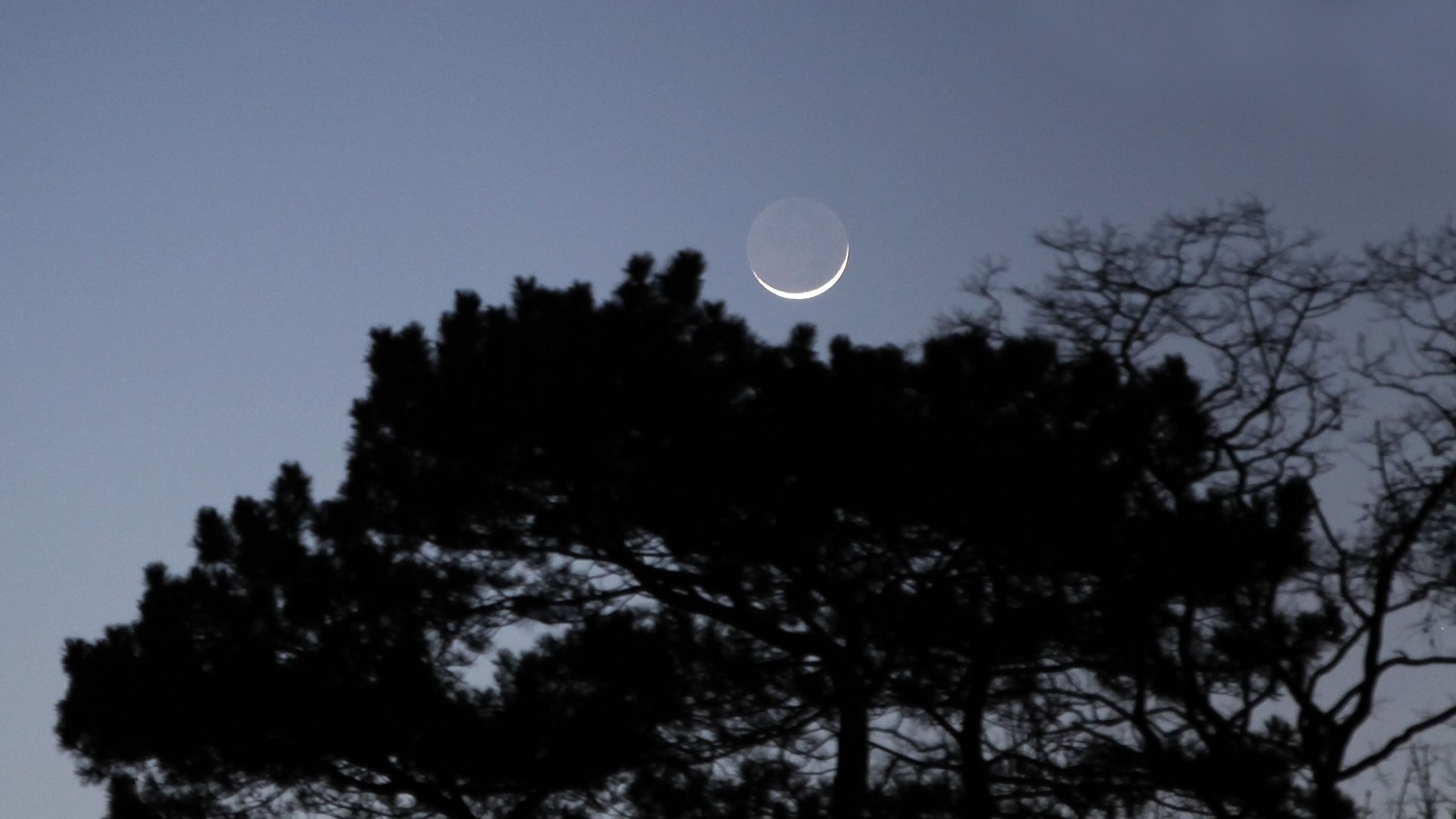
The primary feature of this early morning tableau is a slender, waning crescent moon. At less than 10% illumination, it appears as a delicate "celestial smile" suspended in the twilight. Positioned approximately 5 degrees below the moon—roughly the width of your clenched fist held at arm’s length—will be the brilliant, steady glow of Jupiter.
Jupiter, having emerged from a period of solar conjunction between early July and mid-August, is once again visible, offering a prime target for telescope users. Early morning observers with optics can enjoy a crisp view of the gas giant’s complex cloud belts and its retinue of Galilean moons, which are now back in full view after the planet’s absence from the night sky.
The Physics of an Occultation
An occultation is a specific type of transit where a larger foreground object passes in front of a smaller, more distant background object. In this case, the moon’s orbital path brings it directly in front of Jupiter relative to an observer on Earth.
Because the moon is significantly closer to Earth than Jupiter, it appears much larger in our sky. When the moon’s disk intersects with the path of the planet, the result is an occultation. This is not merely an aesthetic alignment; it is a high-precision event that allows astronomers to calculate the exact positions of these bodies with incredible accuracy.
The Afternoon Main Event: A Disappearing Act
While the morning provides a scenic pairing, the true spectacle occurs later in the day. For much of North America, the moon will pass directly over Jupiter in the early afternoon.
Visibility Constraints
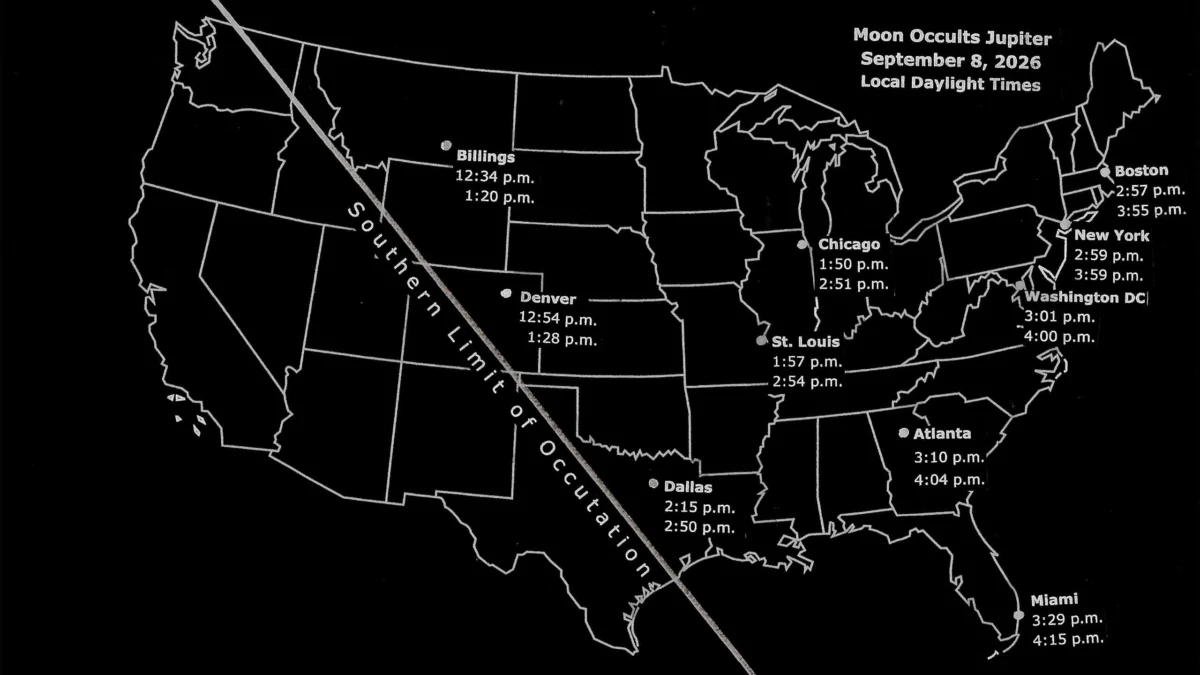
Geography plays a significant role in this event. The occultation will not be visible to everyone. A significant portion of the western United States—specifically areas west and south of a line running roughly from Bellingham, Washington, to Rockport, Texas—will fall outside the visibility zone. For observers in these regions, the moon and Jupiter will remain in close proximity, but the planet will avoid being eclipsed by the lunar disk.
Timing the Disappearance and Reappearance
For those within the path of visibility, the event takes place during the afternoon hours, when both bodies are relatively low in the sky and well to the right of the sun. Observers must exercise extreme caution: never look directly at the sun with the naked eye or through any optical instrument, as permanent eye damage can occur instantly.
Jupiter will vanish behind the moon’s sunlit, or "bright," limb. Because the moon’s edge is not a sharp, instantaneous barrier but rather a physical body moving across the line of sight, the immersion of Jupiter will not be an immediate "flick-off." Instead, the planet will take approximately one minute or more to slowly fade from view as the moon edges across its face.
The duration of the occultation lasts approximately 50 minutes, though this can vary by about ten minutes depending on the observer’s specific latitude and longitude. Jupiter will then gradually emerge from the moon’s dark, shadowed edge, providing a dramatic reappearance against the blue backdrop of the afternoon sky.
Estimated Times for Major Time Zones:
- Eastern Time Zone: 2:55 p.m. to 3:30 p.m.
- Central Time Zone: 1:45 p.m. to 2:20 p.m.
- Mountain Time Zone: 12:30 p.m. to 1:00 p.m.
How to Successfully Observe in Daylight
Observing an occultation in broad daylight is an advanced challenge for any amateur astronomer. The primary obstacle is the overwhelming brightness of the sky, which washes out the contrast between the moon and the gas giant.
1. The "Track-and-Trace" Method
The most reliable way to catch the afternoon event is to find the pair before sunrise. By tracking their positions early in the morning and keeping them centered in your telescope or binoculars, you can maintain your "lock" on the target as the sun rises and the sky turns blue.
2. Sky Transparency
The success of your observation will depend heavily on atmospheric transparency. A deep, clear blue sky is ideal. If the atmosphere is hazy or laden with high-altitude moisture, the scattering of sunlight will make it nearly impossible to distinguish Jupiter from the background light.
3. Equipment Considerations
Jupiter will appear approximately one-sixtieth the diameter of the moon through a telescope. It will have a much lower surface brightness than the lunar surface. When the planet emerges from the dark limb of the moon, it will appear as a faint, glowing jewel emerging from the "void." A telescope with a high-contrast eyepiece or a sturdy tripod with a tracking mount is highly recommended to keep the objects centered throughout the hour-long event.
Scientific and Historical Implications
Occultations are more than just spectacles; they have served as historical tools for mapping the heavens. Before the advent of modern radar and satellite tracking, timing the exact moment of an occultation was one of the most effective ways for early astronomers to determine the precise size and shape of the moon.
Furthermore, these events provide a unique opportunity to study the atmosphere of the occulting body or the light-scattering properties of the background planet. While modern science has more advanced methods, the "citizen science" aspect of reporting the exact timing of an occultation remains a valuable contribution to the amateur astronomical community, helping to refine orbital models.
If You Miss It: Future Opportunities
If your location is outside the occultation zone, or if cloud cover spoils your attempt, do not be discouraged. The moon and Jupiter maintain a dynamic relationship in our sky.
In less than a month, on Tuesday, October 6, the pair will have another interaction. Unlike the September event, the October alignment will occur roughly eight hours earlier, before sunrise, when the sky is still dark or in early twilight. This timing makes the October 6 event significantly easier to view, requiring no specialized equipment for a spectacular naked-eye experience.
Space.com will continue to provide updates and guidance as that date approaches, ensuring that enthusiasts remain informed on how to best enjoy the next meeting of the moon and the king of the planets.
About the Author: Joe Rao is a veteran meteorologist and the skywatching columnist for Space.com. An eight-time Emmy-nominated broadcaster, he served the Putnam Valley region of New York for over two decades. As an instructor at the Hayden Planetarium in New York City, he shares his passion for the cosmos through regular lectures and contributions to publications including Sky & Telescope and The Old Farmer’s Almanac.