In the rapidly shifting sands of the global semiconductor industry, few figures possess the historical perspective and enduring influence of Sir Robin Saxby. A veteran of the industry since the 1980s, Saxby’s career is synonymous with the rise of modern mobile computing. As the founding CEO and chairman of Arm, he presided over a period of explosive growth that transformed the company from a U.K.-based startup into the architectural heartbeat of the mobile world.
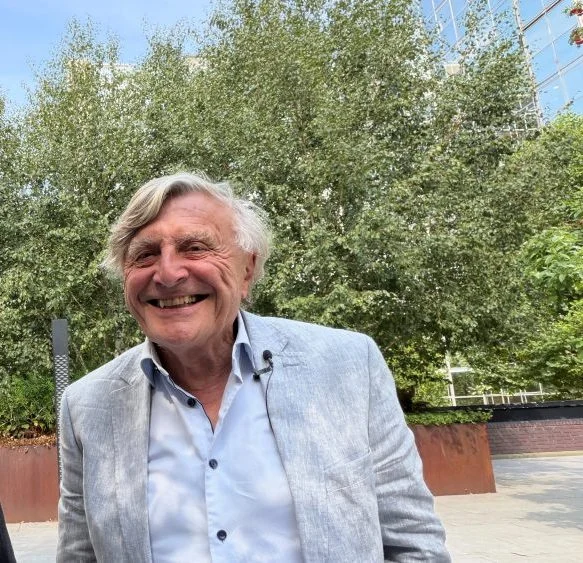
During the recent TechWorks S2S (Semiconductors to Systems) Summit 2026 in West London, I had the privilege of sitting down with Sir Robin for an exclusive, wide-ranging interview. Our conversation spanned the evolution of his own career, the complexities of the current geopolitical landscape, and the profound shift in how engineering teams must function in the age of Artificial Intelligence.
A Career Defined by Connectivity
Saxby’s entry into the industry began long before the smartphone era. His early tenure at European Silicon Structures (ES2) provided a foundational understanding of the volatility and promise of semiconductor design. However, it was his transition to Arm in 1991 that cemented his reputation as a visionary leader.
Working alongside a founding team that included the late Jamie Urquhart—a man whose contributions to the industry remain immeasurable—Saxby steered Arm toward a business model that would eventually become the industry benchmark. By prioritizing intellectual property licensing over manufacturing, Saxby allowed Arm to proliferate across the global market, embedding its architecture in virtually every mobile phone produced over the last two decades.
Reflecting on those formative years, one observes a characteristic that defined Saxby’s leadership style: an indefatigable energy. Whether it was navigating boardrooms in the U.S., engaging with partners in Japan, or scouting emerging markets, Saxby’s presence was constant. His knighthood in 2002 was not merely an accolade for his corporate success; it was a recognition of his role in establishing the U.K. as a global hub for semiconductor innovation.

Chronology: From Silicon Structures to Global Dominance
To understand the current state of the semiconductor industry, one must look at the path Saxby walked:
- 1980s – The ES2 Era: Saxby cut his teeth at European Silicon Structures, navigating the early days of custom silicon and learning the importance of rapid prototyping and customer-centric design.
- 1991 – The Arm Foundation: Saxby joined Arm as its first CEO. At the time, the company was an experimental venture; under his leadership, it adopted a licensing model that would redefine the industry’s economic structure.
- 1990s – Mobile Expansion: Through relentless international travel and strategic partnerships, Arm became the dominant power in the burgeoning mobile phone market, establishing a standard that persists to this day.
- 2002 – Recognition: Saxby was knighted, solidifying his status as a pillar of the British technology sector.
- 2007 – The Transition: Having built a global titan, Saxby retired as chairman, transitioning into a role of elder statesman, mentor, and advocate for U.K.-based technology.
- 2026 – The S2S Summit: At the TechWorks summit, Saxby continues to engage with the next generation of engineers, proving that for industry leaders, "retirement" is simply a shift in focus toward long-term institutional impact.
The Geopolitical Fragmentation of the Chip Ecosystem
One of the most sobering segments of our interview was the discussion regarding the global chip ecosystem. During his time at Motorola, ES2, and Arm, the semiconductor world was characterized by a tightly integrated, borderless pursuit of innovation. Today, that environment has been irrevocably altered.
"Unfortunately for any CEO today, making decisions long-term, like investments and so on, is a lot more difficult than when I was a CEO," Saxby noted. The current landscape is defined by trade friction, the U.S. CHIPS Act, and the lingering aftershocks of Brexit.
The era of "globalization as usual" has given way to a period of localized legislation and geopolitical sensitivity. CEOs must now navigate a labyrinth of export controls and domestic manufacturing mandates that did not exist during the 1990s. This shift creates a "cost of complexity" that ripples through the entire supply chain, forcing leaders to prioritize resilience over efficiency—a reversal of the principles that guided Saxby’s own success.
System Complexity and the "Team-First" Mandate
Beyond geopolitics, the engineering discipline itself has undergone a seismic shift. Saxby noted that modern silicon design has moved far beyond the flat layout sheets of his early career. We are now in the age of 3D packaging, multi-variable engineering, and massive software integration.

"As technology gets more expensive and complex, success for engineering managers and their teams relies on building balanced, specialized teams," Saxby explained. The myth of the "lone genius" engineer, he argued, is a relic of the past. Today’s systems are simply too large for any one person to master the entire stack. Success is now a function of collaborative friction—the ability to harmonize diverse expertise into a coherent product.
The Promise and Perils of AI
During our discussion, I asked Saxby about the integration of AI tools into the engineering workflow. As an active user of modern AI, he offered a nuanced perspective: AI is an unparalleled accelerator, but it is not a replacement for judgment.
"AI lacks emotional intelligence," Saxby cautioned. "It can easily deliver flatly incorrect specifications if engineers become subservient to the tool rather than treating it strictly as a partner."
He posited a fascinating high-level vision: just as mathematics became the language of physics in the 20th century, AI could become the language of biology in the 21st. However, for the engineering cohort of today, the immediate danger is the loss of critical thinking. If an engineer cannot spot an error produced by an AI, they have ceased to be an engineer and have become merely a curator of machine-generated output.
Implications for Future Engineering Leadership
What advice does the man who built an empire have for the engineers of tomorrow? The transition from academia to industry is the most critical hurdle.

Academic success is built on individual competition—the pursuit of the top grade and the validation of individual intelligence. Industry success, conversely, is built on culture, collaboration, and the ability to work within a team where motivation is organic. Saxby’s advice is simple: learn to prioritize the "fit" of the team over the brilliance of the individual.
His work today, whether through the Royal Academy of Engineering Enterprise Hub or his initiatives at the University of Liverpool, is entirely dedicated to fostering this mindset. He remains a staunch believer that innovation is not just about the silicon—it is about the environment in which that silicon is conceived.
A Life Beyond the Boardroom
Finally, our conversation touched on the importance of maintaining personal passions. For Saxby, life is not solely defined by the semiconductor cycle. Whether it is the technical challenge of vintage radio restoration, the structure of music, or the community spirit of football, Saxby argues that these external passions are essential for sustained, long-term success.
"Many semiconductor industry executives don’t seem to ‘retire’ anymore," I noted, and Saxby’s career is the perfect case study. He has evolved from an executive to a mentor, from a CEO to an advocate. His commitment to the U.K. technology ecosystem continues to provide a blueprint for how industry titans can remain relevant long after their formal tenures have concluded.
As we look toward the next decade of semiconductor advancement—dominated by AI, 3D heterogeneous integration, and a highly volatile geopolitical climate—the lessons offered by Sir Robin Saxby remain as relevant as they were in 1991. Leadership, he reminds us, is about more than just the technology; it is about the courage to be in the right place, the wisdom to build the right team, and the perspective to see beyond the next fiscal quarter.

For those interested in hearing the full depth of his insights, the video and audio of our conversation from the TechWorks S2S Summit 2026 are available for viewing and listening at the top of this article. Sir Robin’s reflections offer a vital roadmap for those currently navigating the complexities of the modern tech landscape.