The James Webb Space Telescope (JWST) has spent its tenure in orbit fundamentally rewriting the textbooks on the early universe. Yet, among the most baffling discoveries to date are the "Little Red Dots"—compact, intensely luminous objects that seem to vanish from the cosmic record before the universe reaches its two-billion-year milestone. New research from Johns Hopkins University (JHU) suggests these enigmatic entities may be more than mere galaxies; they could be the long-sought "smoking gun" for primordial black holes (PBHs), relics forged in the immediate aftermath of the Big Bang.
The Mystery of the Little Red Dots
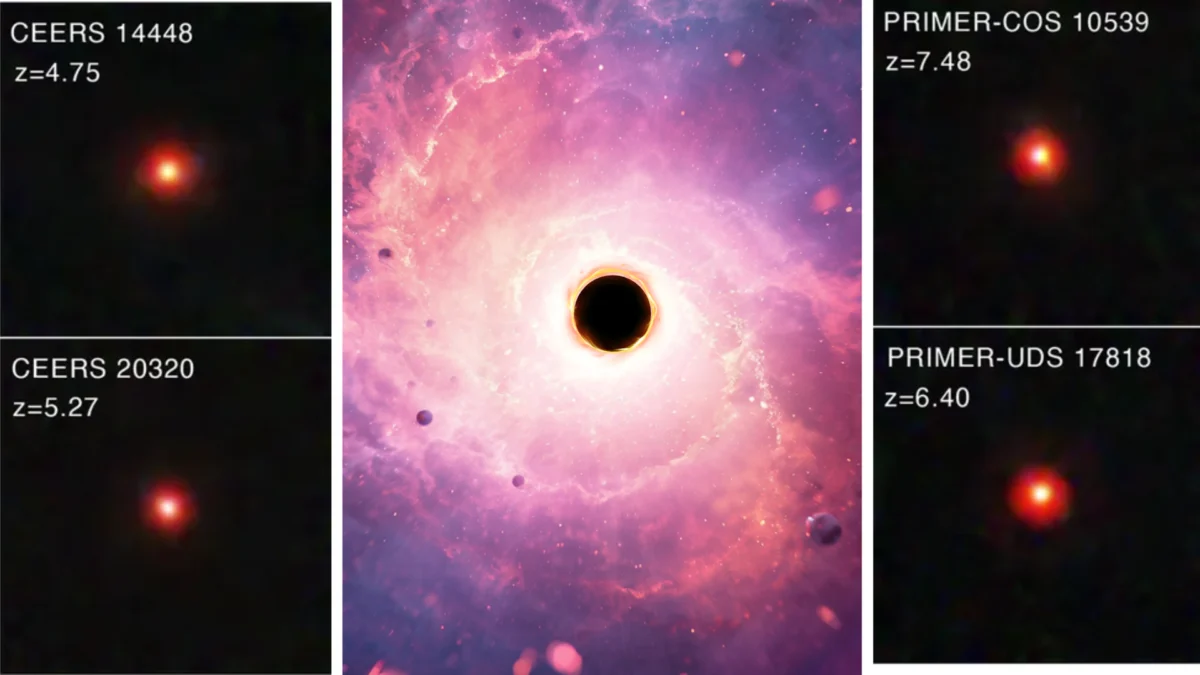
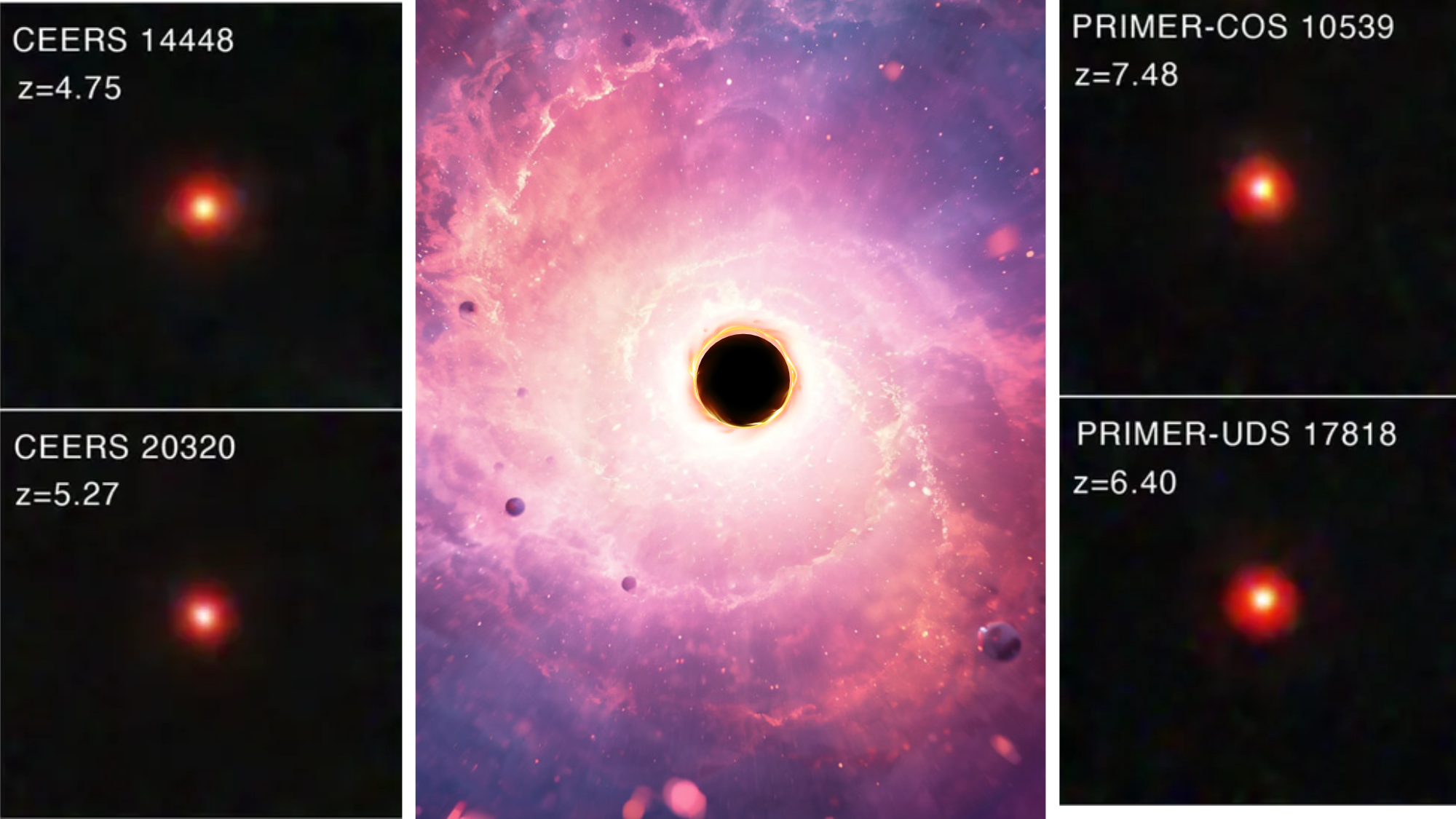
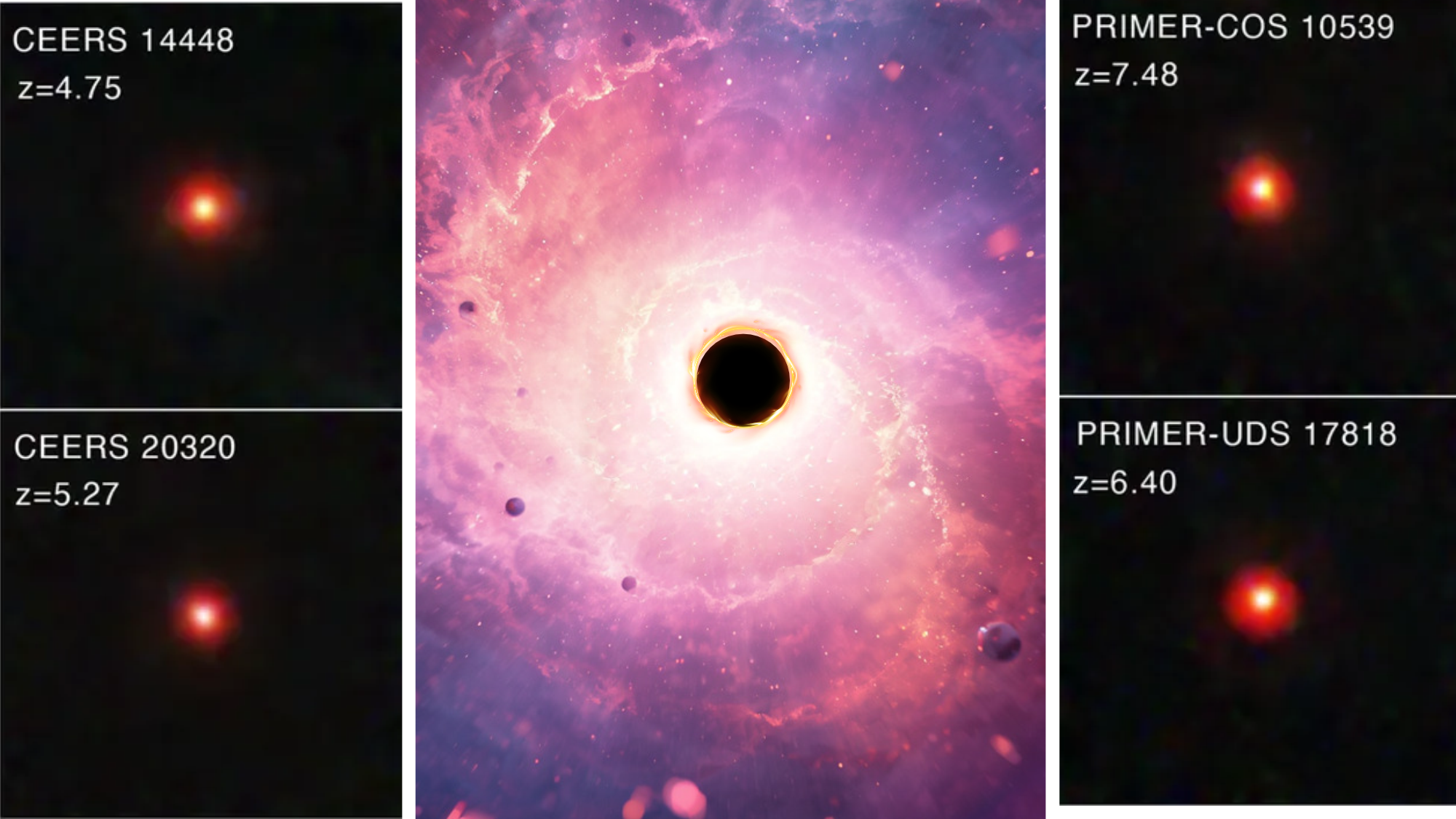
Since its deployment, the JWST has peered deeper into space and further back in time than any instrument in human history. The images returned have consistently challenged the standard cosmological model. The "Little Red Dots" are so named for their appearance in infrared data—small, reddened, and exceptionally bright. Their sudden appearance and subsequent disappearance have left astrophysicists scrambling for an explanation.
Traditional astrophysical black holes are the remnants of massive stars that have exhausted their nuclear fuel, collapsed under their own gravity, and exploded in supernovae. However, the Little Red Dots do not fit the typical profile of early galaxies or standard quasars. They appear in the universe when it was less than 700 million years old, a time when, according to conventional theory, there should not have been enough time for such massive, mature structures to form.
Chronology: From the Big Bang to the Webb Era
To understand the significance of this discovery, one must look at the timeline of the cosmos.
The Primordial Era (Seconds after the Big Bang): If the hypothesis holds, primordial black holes were not born from dying stars. Instead, they were forged during the universe’s rapid inflationary period. As the universe expanded exponentially in the first fractions of a second, tiny fluctuations in the density of matter could have caused regions to collapse into black holes long before the first atoms formed.
The Dark Ages: For millions of years, the universe was a dark, cooling expanse of hydrogen and helium. There were no stars, no galaxies, and no light-emitting bodies.
The Dawn of Stars: Eventually, gravity pulled gas together to ignite the first stars. Until recently, it was assumed that supermassive black holes grew slowly over billions of years by accreting matter and merging with other black holes.
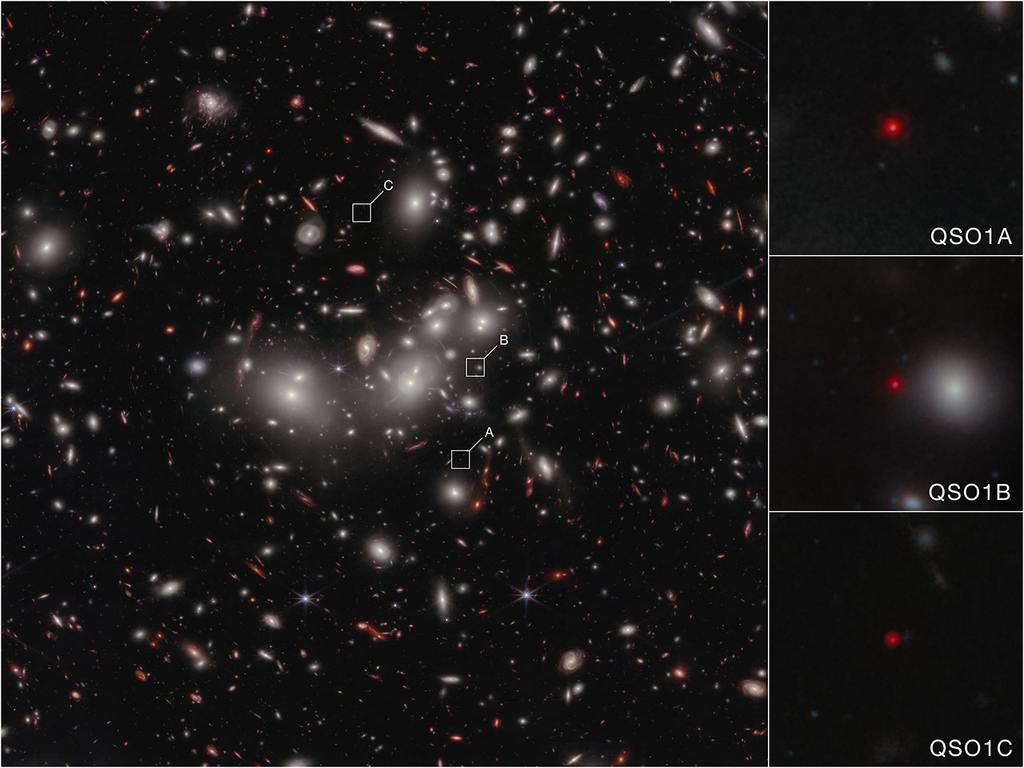
The Webb Revelation (Present Day): The JWST began identifying objects like Abell 2744-QSO1 (QSO1). By analyzing the light signatures of these objects, researchers found they were composed almost entirely of hydrogen and helium. Their chemical purity suggests they predate the enrichment of the universe with heavier elements—a hallmark of the "first light" era.
The Case of Abell 2744-QSO1
The JHU research team, including physicists Valerio De Luca and Loris Del Grosso, focused their analytical lens on QSO1. Located approximately 13.1 billion light-years from Earth, this specific Little Red Dot serves as a perfect laboratory for testing the PBH theory.
"A black hole is an object born from the gravitational death of a star. Primordial black holes are a very different story," says Valerio De Luca. "They come from the physics of the early universe that predates the first stars, when the universe was expanding exponentially in time and space. So the mechanisms for creating primordial black holes are different."
By modeling the evolution of a primordial black hole, the team sought to determine if a seed of dense, early-universe matter could account for the observed luminosity and mass of QSO1. Their models suggest that if a primordial black hole existed, it would have acted as a gravitational anchor, rapidly consuming surrounding gas and energy. This "feeding frenzy" would generate the intense, reddish glow observed by the JWST’s Near Infrared Camera (NIRCam).
Supporting Data and Theoretical Constraints
The transition from theory to empirical observation is fraught with difficulty. Scientists have speculated about the existence of PBHs since the 1970s, famously championed by Stephen Hawking. Despite their theoretical elegance, hard evidence has remained elusive.
The primary challenge lies in distinguishing a primordial black hole from an "astrophysical" black hole formed by stellar collapse. To address this, the JHU team had to reconcile their model with existing cosmological constraints.
"There are constraints on primordial black holes from cosmological observations," Loris Del Grosso explains. "There can only be so many primordial black holes in the universe, for example, and there cannot be too many of them in a given cluster."
The researchers tested three distinct formation scenarios for QSO1. Their findings indicated that the most plausible explanation is the existence of a smaller, primordial black hole that accreted gas at a sustained rate, growing to the size currently observed. This finding doesn’t just confirm that the dots could be PBHs; it provides a framework for identifying which specific dots are likely to be primordial versus those that are simply early, high-redshift galaxies.
Implications for Modern Physics
If the team is correct, the discovery would necessitate a radical update to the Standard Model of Cosmology. The implications are profound:
- The Nature of Dark Matter: Some theorists have long argued that primordial black holes could account for a significant portion of dark matter. If the JWST confirms that these objects are ubiquitous in the early universe, it could solve one of the greatest mysteries in physics.
- Early Structure Formation: The existence of massive black holes so soon after the Big Bang has been a "crisis" for astronomy. If these black holes were present as primordial seeds, they would have jump-started the formation of galaxies, explaining why we see such large structures in the very early universe.
- The Big Bang Mechanism: Confirming the existence of PBHs would provide a direct window into the conditions of the Big Bang itself. It would tell us about the density fluctuations that occurred during the first milliseconds of existence—information that is otherwise locked away behind the cosmic microwave background.
The Path Forward: A Census of the Dots
The work conducted by De Luca, Del Grosso, and their colleagues is merely the beginning. The JWST has identified over 100 Little Red Dots. The next phase of research involves a comprehensive census of these objects.
By applying their model to the remaining catalog of dots, the team hopes to establish a statistical pattern. Are these objects consistently showing the signatures of primordial origin, or is QSO1 a unique outlier?
"We’ve now cracked it open a little farther by showing some scenarios are more likely than others," says Del Grosso. "The door was open on this theory—that Little Red Dots could be primordial black holes."
For the scientific community, the stakes could not be higher. As the JWST continues its mission, the data it returns acts as a time machine, offering a glimpse into the chaotic, high-energy environment of our universe’s birth. If even a fraction of the Little Red Dots are confirmed as primordial black holes, the discovery will be heralded as a groundbreaking achievement, comparable to the confirmation of gravitational waves or the cosmic microwave background.
"We don’t have a clear understanding of what happens in the early universe right after the Big Bang," De Luca concludes. "If primordial black holes do exist, then something had to happen to make them in the first place, which would be a groundbreaking discovery in physics."
As researchers continue to scrutinize the data, one thing is certain: the universe is far older, far more complex, and far more mysterious than we ever dared to imagine. The answers, it seems, were hidden in plain sight, disguised as tiny, reddened specks of light in the deepest reaches of space. The team’s findings, published in Physical Review Letters, have set the stage for a new era of cosmic exploration, where the smallest objects in the sky may finally reveal the secrets of the beginning of everything.