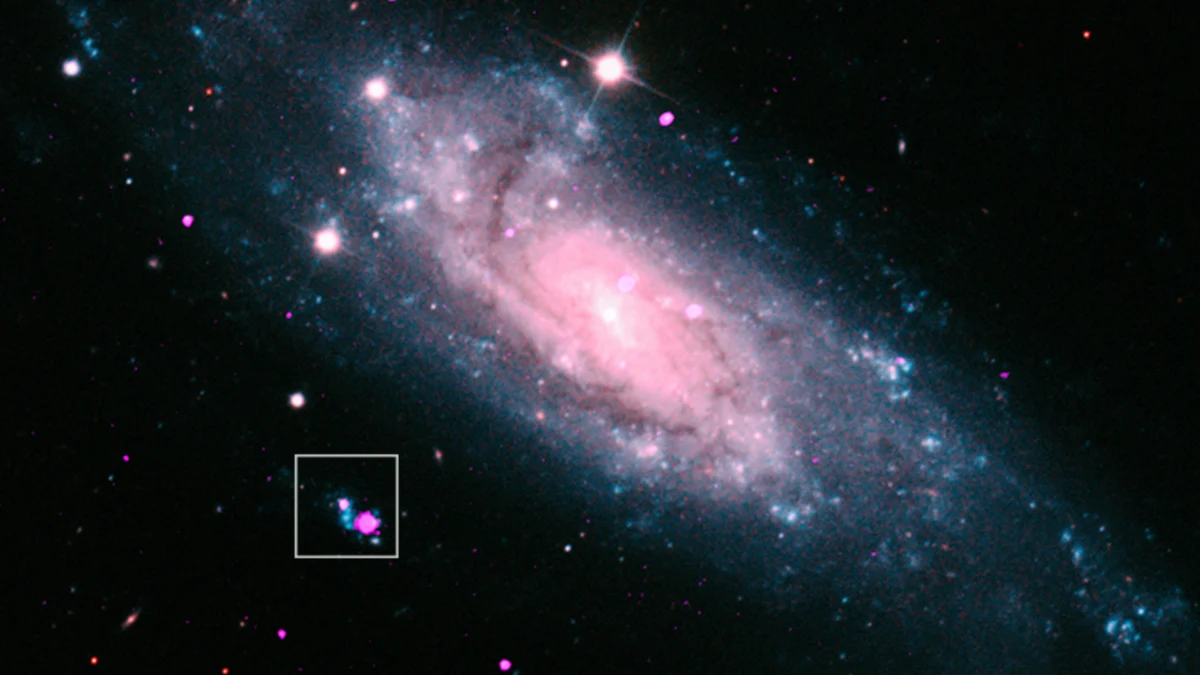
For over a decade, astronomers have been haunted by a celestial anomaly in the spiral galaxy NGC 4559, located 25 million light-years away. It was a "cosmic imposter"—a star that repeatedly appeared to undergo the cataclysmic death throes of a supernova, only to recover and repeat the performance time and time again.
Now, thanks to the high-energy "vision" of NASA’s Chandra X-ray Observatory, the secret behind this recurring spectacle has been unmasked. The culprit is not a star dying, but a star being cannibalized. AT 2016blu, a massive and inherently unstable Luminous Blue Variable (LBV), is locked in a parasitic dance with a compact, high-gravity companion—a "cosmic vampire" in the form of either a neutron star or a stellar-mass black hole.
The Great Deception: A History of False Alarms
The saga of AT 2016blu began in earnest on January 11, 2012. When telescopes first caught the light of what appeared to be a supernova on the outskirts of NGC 4559, the scientific community reacted with the standard protocols for a stellar death. In the lifecycle of a massive star, the end is usually dramatic: once the core runs out of nuclear fuel, the internal pressure can no longer support the star’s own immense gravity, leading to a catastrophic collapse and a subsequent explosion that can outshine an entire galaxy.
However, AT 2016blu refused to cooperate with the laws of stellar evolution. After the initial "explosion" faded, the star remained intact. More bafflingly, it began a rhythmic cycle of violence, brightening and dimming with a precision that suggested a mechanical, rather than a stochastic, cause. For 15 years, astronomers watched in confusion as the star underwent 27 distinct outbursts, each roughly 113 days apart.
"For 15 years, astronomers have been watching this star get really bright and then dim again on a regular basis," said Mojgan Aghakhanloo of the University of Virginia in Charlottesville, the lead researcher on the study. The scientific community had observed "supernova imposters" before, but never one that kept "crying wolf" with such alarming consistency.
Chronology of Discovery: Capturing the Culprit
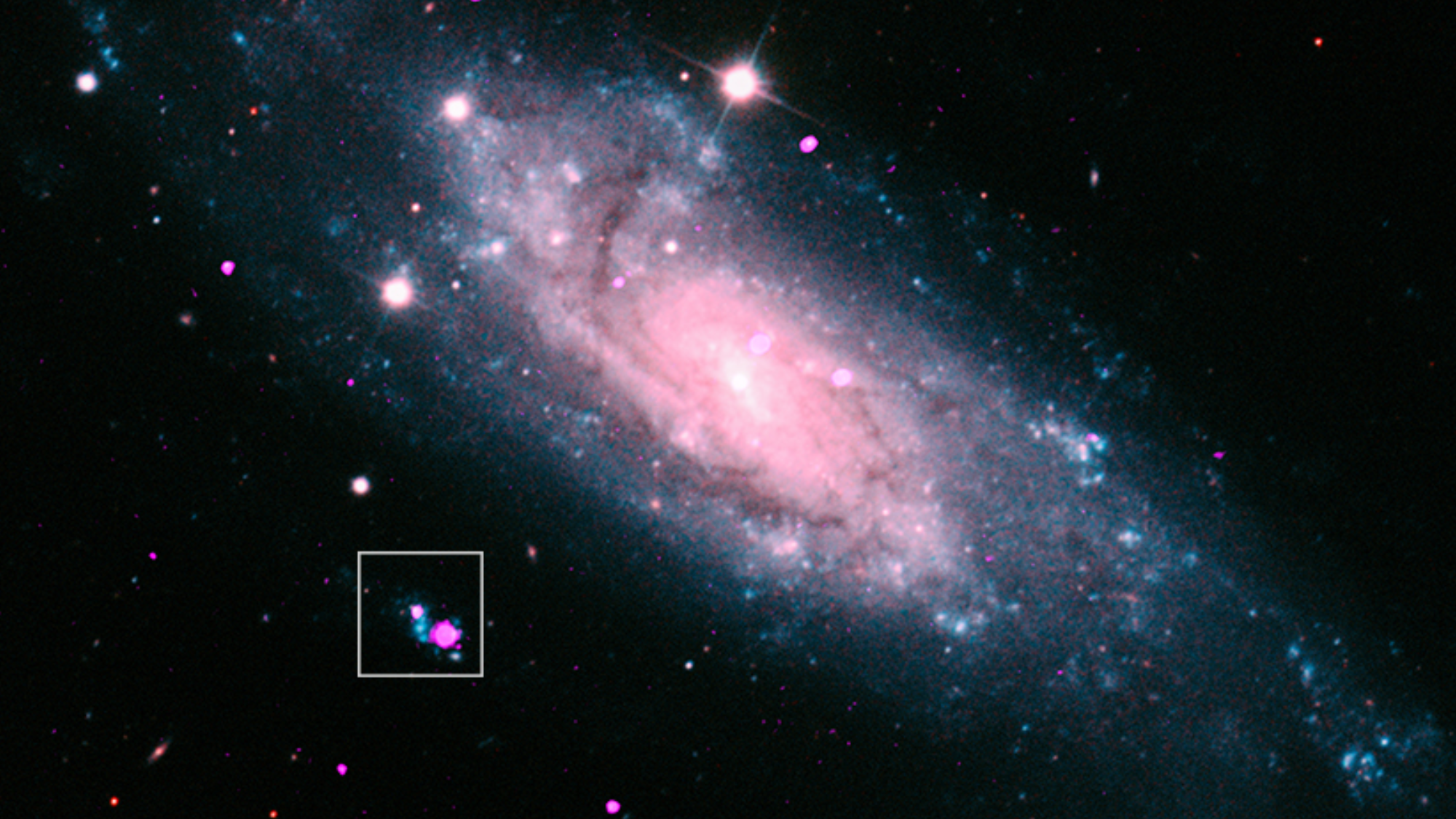
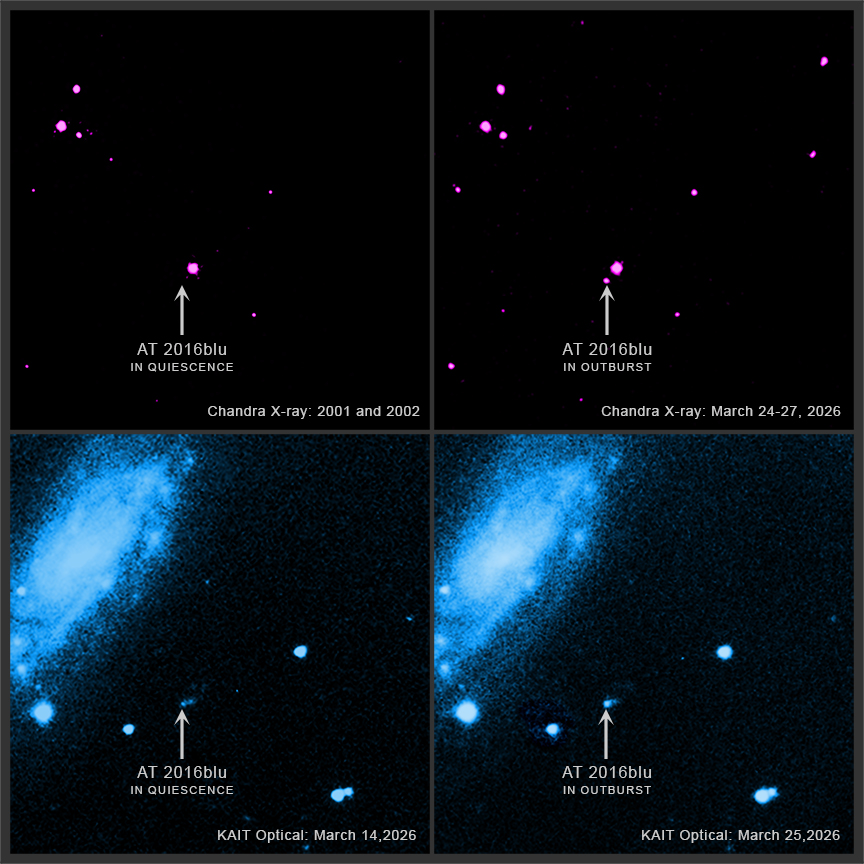
To solve the mystery, the team required more than just visible light observations; they needed to catch the star in the act of its outburst using X-ray data. Previous data from the early 2000s, captured by chance when Chandra looked toward NGC 4559, offered no clues. The breakthrough came in March 2026, when researchers finally secured time to point the Chandra X-ray Observatory at AT 2016blu during one of its periodic flares.
The results were immediate and revelatory. Chandra detected a massive blast of high-energy X-rays that synchronized perfectly with the visible-light outburst. This correlation provided the "smoking gun" the team needed. By mapping the X-ray emissions, the astronomers could infer the presence of a compact object—the "vampire"—orbiting the massive blue variable.
The 113-day cycle is not a sign of the star’s internal instability alone, but rather the orbital period of this binary system. As the compact object (a neutron star or black hole) swings through its elliptical orbit, it reaches a point of "periastron"—the closest point to its host. It is here that the vampire’s gravitational influence is at its zenith, stripping away the outer layers of the luminous blue variable.
Supporting Data: The Physics of Cannibalism
The mechanics of this cosmic feeding frenzy are violent and highly energetic. As material is torn from the LBV, it doesn’t fall directly into the companion. Instead, it forms an accretion disk—a swirling, superheated vortex of gas and plasma—around the neutron star or black hole.
The friction within this disk, generated as the material is accelerated to near-relativistic speeds, causes the gas to heat up to millions of degrees, emitting the intense X-rays detected by Chandra. These X-rays then blast outwards, slamming into the shell of gas that the LBV had shed in previous outbursts. This interaction heats the surrounding cloud, causing it to glow brilliantly in visible light.
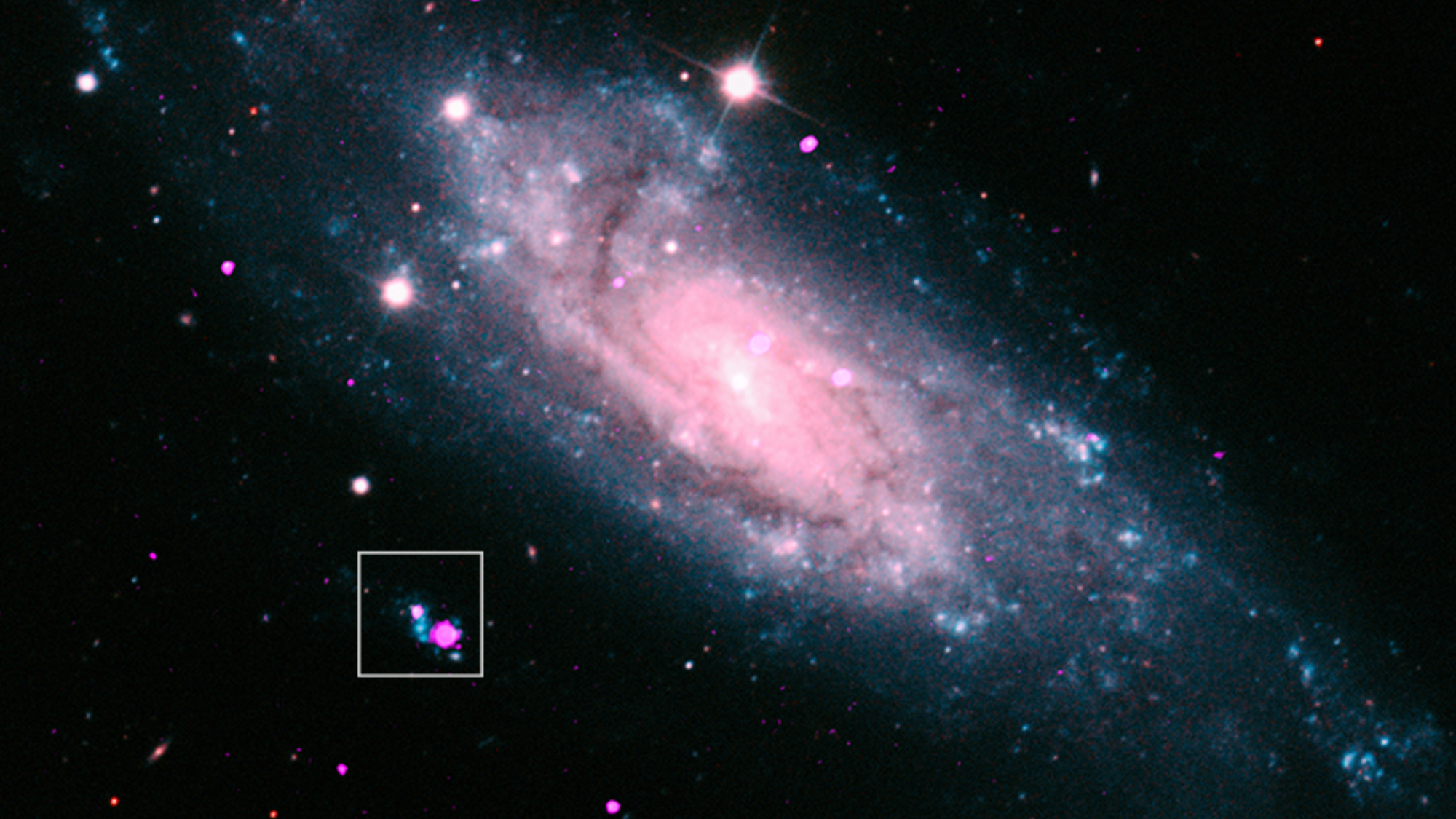
"We suspected that the bright repeating flashes at optical wavelengths might actually be powered by periodic blasts of high-energy X-rays," explained team member Nathan Smith of the University of Arizona. "The dense gas surrounding the system is heated by the X-rays and then glows in the optical."
The scale of this theft is staggering. Calculations suggest the compact object consumes at least 440 billion trillion pounds of material every year. While this is a drop in the bucket compared to the total mass of the host star—which is at least 33 times that of our sun—it is far above the "Eddington limit." The Eddington limit is the maximum luminosity a body can achieve when there is a balance between the outward force of radiation and the inward gravitational force. By exceeding this limit, the system essentially "chokes" on the incoming material, releasing the excess energy in the form of the outbursts we observe from Earth.
Official Perspectives and Scientific Context
The findings, published on November 9 in The Astrophysical Journal, represent a major shift in how we interpret the variability of massive stars. For decades, LBVs were assumed to be isolated, inherently unstable stars. AT 2016blu suggests that a significant number of these "unstable" giants may actually be the victims of binary evolution.
This discovery also places AT 2016blu in the context of Ultraluminous X-ray sources (ULXs). ULXs are objects that emit significantly more X-rays than a typical stellar-mass black hole should be able to produce, yet they are not as powerful as the supermassive black holes found at the centers of galaxies. The identity of the "engine" behind ULXs has long been a subject of debate. If AT 2016blu is a representative model, it suggests that many ULXs are simply binary systems where a compact object is gorging itself on a massive companion.
However, the team remains cautious. "It’s too early to say that," the authors noted regarding whether AT 2016blu is a universal Rosetta stone. They pointed to SN 2010da, another famous supernova imposter, which also exhibits X-ray emissions typical of accretion. In that specific case, however, the companion is a red supergiant, not a compact object. This suggests that the "vampire" phenomenon might manifest in various ways depending on the type of stars involved.
Implications for Stellar Evolution
What does this mean for our understanding of the universe? First, it highlights the prevalence of binary systems among the most massive stars in the cosmos. It is becoming increasingly clear that the "isolated" massive star is more of an exception than the rule.
Second, it provides a vital lesson in observational bias. By labeling these events as "supernovae," astronomers were looking for a single, terminal event. By re-classifying them as "periodic outbursts," they have opened a new window into the complex, messy, and often long-drawn-out deaths of stars. The "vampiric" behavior described here is a significant mechanism for mass loss in binary systems, which ultimately alters how these stars evolve and how they eventually die.
As for AT 2016blu, it will continue to flare every 113 days, a predictable, recurring ghost of a death that never truly happens. For researchers like Aghakhanloo, this system is a high-energy laboratory, a rare opportunity to observe the fundamental, violent processes that shape the most massive structures in our galaxy.
The mystery of the cosmic imposter has been solved, but the implications for stellar physics are only just beginning to be understood. Each cycle provides new data, allowing scientists to refine their models of accretion, orbital dynamics, and the intricate, often predatory relationships that exist in the dark, crowded reaches of space. In the grand cycle of the stars, AT 2016blu remains a testament to the fact that even in the vacuum of space, nothing ever truly goes to waste—it is simply stolen, recycled, and repurposed for the next grand display.