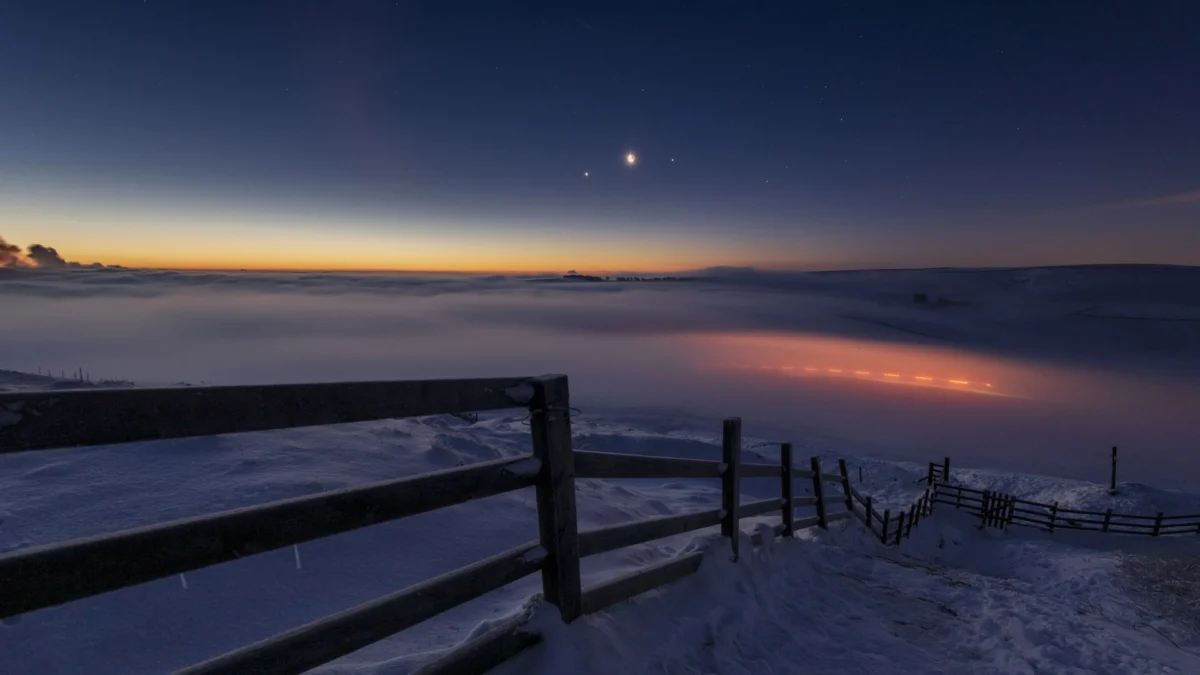
Early risers across the Northern Hemisphere have been greeted by a celestial spectacle that is impossible to ignore. In the quiet, pre-dawn hours, a brilliant, piercing light has emerged in the east-southeast horizon, commanding the attention of commuters and early birds alike. While those unfamiliar with the movements of the cosmos might be tempted to mistake this radiant object for something otherworldly, the reality is a far more profound astronomical event: the planet Venus has begun a spectacular, months-long residency in our morning skies.
Following its transit through inferior conjunction on October 24—where it passed directly between the Earth and the sun—the planet has effectively switched from an evening presence to a morning one. This transition marks the beginning of one of the most brilliant viewing periods for the "Morning Star" in recent memory, offering a rare opportunity for both amateur stargazers and casual observers to witness one of the solar system’s most dazzling phenomena.
The Mechanics of a Celestial Spectacle
To understand why Venus appears with such sudden and overwhelming intensity, one must look at its orbital mechanics. When Venus is at inferior conjunction, it is at its closest point to Earth. As it moves away from the sun’s glare, it climbs higher into the pre-dawn darkness, a process astronomers call "vaulting."
Currently, Venus is rising more than 90 minutes before the sun. This gap will widen significantly as we progress through the remainder of the year. By mid-December, the planet will be rising nearly four hours before dawn, allowing it to shine in a completely dark, unobstructed sky for well over two hours. The sheer brightness of the planet is a byproduct of its dense, reflective atmosphere, which acts like a giant mirror, bouncing sunlight back toward our planet with exceptional efficiency.
Chronology of the Morning Apparition
The current visibility cycle of Venus is defined by a gradual but steady climb in elevation and brilliance. Here is the trajectory for the coming months:
- Late October/Early November: Having just emerged from the sun’s glare, Venus is visible low on the horizon, increasing its distance from the sun daily.
- November 29 (Peak Brilliance): This is the high-water mark for the planet’s luminosity. Venus will reach a magnitude of -4.9. To put this in perspective, it will be roughly 12 times brighter than Jupiter and 25 times more luminous than Sirius, the brightest star in the night sky.
- Mid-December: Venus reaches its maximum "morning visibility" height. It will rise approximately 3 hours and 50 minutes before sunrise, providing the most dramatic viewing window.
- January through March: The planet begins its long, slow descent back toward the solar horizon. It will rise roughly 90 seconds later each morning.
- Late June: Venus will finally sink into the bright glow of the dawn twilight, eventually disappearing from view for a "summer sabbatical."
Supporting Data: Why Venus Commands the Sky
Venus is not merely bright; it is a geophysical powerhouse. Its magnitude of -4.9 is significant because it places the planet at the very limit of human perception. In rural areas—far from the light pollution of modern cities—the light from Venus is so intense that it is capable of casting distinct shadows on the ground.
Furthermore, because of its extreme brightness, Venus is one of the few objects that can be tracked well into the daylight hours. If an observer knows exactly where to look, the planet can often be spotted as a tiny, stark-white speck suspended against the deep blue of the morning sky, even after the sun has breached the horizon.
Astronomers often compare this phenomenon to the "Christmas Star" described in biblical texts. While the "Star of Bethlehem" remains a subject of historical and theological debate, the current position of Venus—glowing in the eastern sky—provides a modern-day approximation of the wonder that such a brilliant celestial body might inspire in the human imagination.
Official Perspectives and Scientific Context
While the appearance of Venus is a regular orbital occurrence, it never fails to generate a surge in reports to planetariums and local observatories. Joe Rao, a veteran meteorologist and instructor at New York’s Hayden Planetarium, emphasizes the importance of educating the public during these windows of high visibility.
"It is a classic case of celestial mechanics," Rao notes. "When people call in asking about a ‘strange UFO’ or a blinking light that isn’t moving like a plane, the answer is almost invariably Venus. It is the third-brightest object in the sky after the sun and the moon. Its position right now is optimal, making it the most dominant non-lunar object in our morning view."
Scientific institutions often use these periods of high visibility to engage the public in citizen science. By tracking the position and brightness of Venus, observers can better understand the interplay between planetary orbits and atmospheric light scattering. For the scientific community, the "Morning Star" serves as a vital reminder that the cosmos is dynamic; nothing remains static, and the view from Earth is constantly shifting based on our position in the solar system.
Implications for Stargazers and Commuters
The primary implication of this cycle is the opportunity for engagement. For the daily commuter, the sight of Venus provides a rare moment of connection with the natural world. In an age dominated by artificial light and digital screens, the presence of a planet that is 25 times brighter than the brightest star serves as a grounding experience.
However, observers should be prepared for the inevitable conclusion of this cycle. By July, Venus will have completed its journey, dipping below the horizon and disappearing until it reappears next year for an evening, rather than morning, apparition. This cycle is a testament to the "what goes up, must come down" nature of planetary movement.
Tips for Optimal Viewing
For those looking to maximize their experience of this phenomenon, consider the following recommendations:
- Seek Dark Skies: While Venus is bright enough to be seen from urban areas, moving away from city lights will allow you to see the planet’s brilliance against a deeper, more contrast-heavy background.
- Use a Steady Surface: If you are using binoculars or a small telescope, mount them on a tripod. Venus is so bright that even slight hand tremors can make it difficult to appreciate its steady, unblinking light.
- Timing is Key: Aim to step outside at least 60 to 90 minutes before the official sunrise time for your location. This allows your eyes to adjust to the darkness and ensures you catch the planet while it is still high enough above the horizon to avoid atmospheric distortion.
- Avoid Obstructions: Ensure your view to the east-southeast is not blocked by buildings, trees, or mountains.
Conclusion
As Venus continues its ascent, it offers a reminder of the clockwork precision of our solar system. It is a beacon of natural beauty that requires no equipment to view and no special knowledge to appreciate. Whether you are an amateur astronomer or simply someone walking to the bus stop on a cold November morning, take a moment to look toward the east. You aren’t just seeing a planet; you are witnessing a fundamental rhythm of the heavens that has guided and inspired humanity for millennia.
It isn’t an unidentified flying object, and it isn’t a trick of the light. It is Venus—the brightest, most enduring companion of our dawn sky—rising to the occasion once again.